
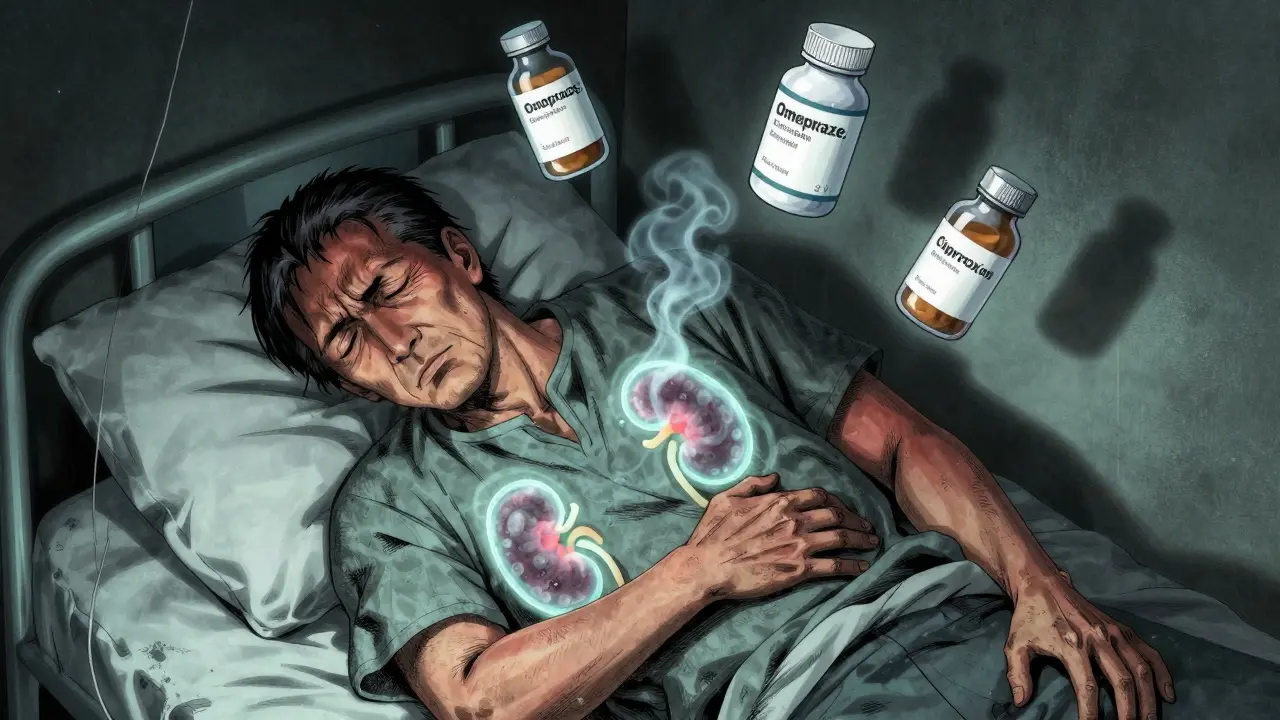
Medication Risk Checker for Acute Interstitial Nephritis
This tool helps assess your risk of developing acute interstitial nephritis (AIN), a serious kidney inflammation often caused by medications. Enter the medications you're taking to understand your potential risk level and recommended next steps.
Enter your medications and click "Assess My Risk" to see your results.
When your kidneys start to fail suddenly, it’s not always because you’re dehydrated or sick with the flu. Sometimes, it’s because of something you took for a headache, heartburn, or infection. Acute interstitial nephritis (AIN) is a hidden but serious reaction where your kidneys become inflamed due to common medications. It’s not rare - it’s one of the top causes of unexplained kidney injury in hospitals today. And the worst part? Most people don’t realize what’s happening until it’s too late.
What Exactly Is Acute Interstitial Nephritis?
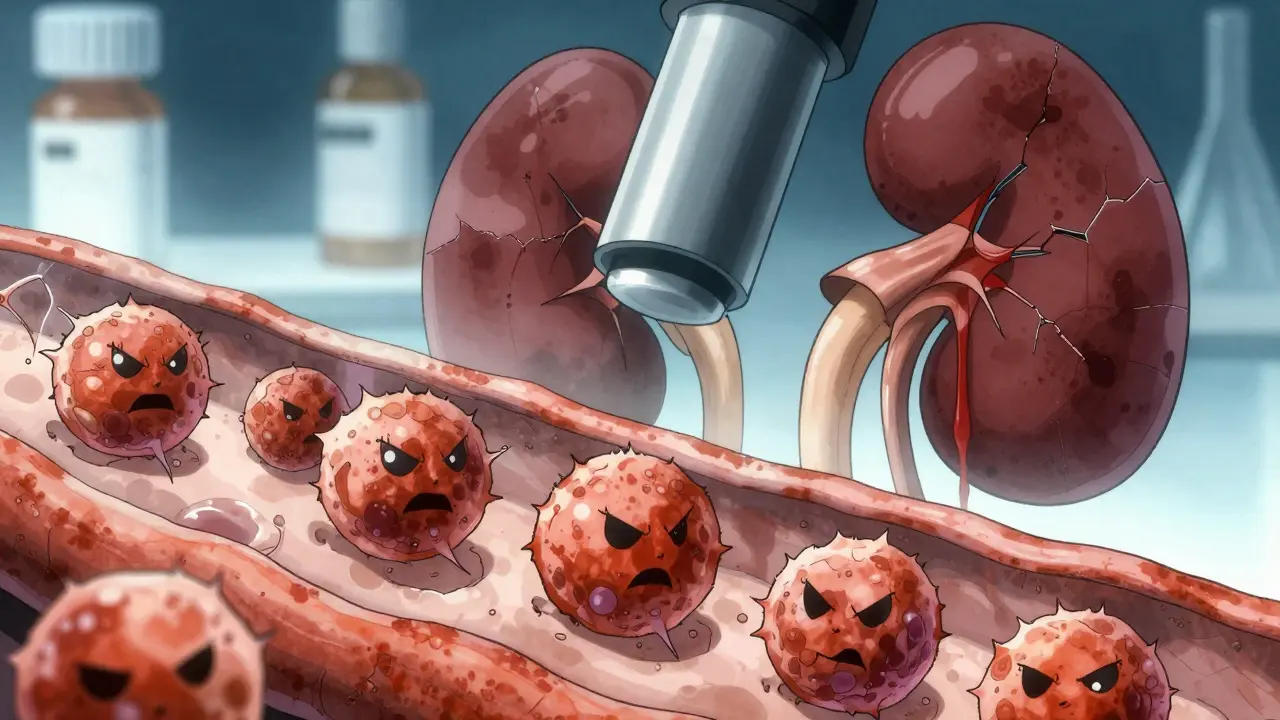
Acute interstitial nephritis is inflammation in the spaces between the tiny tubes in your kidneys. These tubes, called tubules, are what filter waste and balance fluids. When immune cells swarm into this area - usually because your body mistakes a drug for a threat - the filtering system gets clogged. Your kidneys can’t work right. Creatinine rises. Urine drops. And suddenly, you’re in acute kidney injury.
This isn’t just a theory. Studies show drug-induced AIN causes about 1 in 5 cases of sudden kidney failure with no clear cause. Over 250 medications have been linked to it. Some are prescription. Others? You can buy them off the shelf.
Which Medications Are Most Likely to Cause It?
Not all drugs carry the same risk. Some are far more dangerous than others.
- Antibiotics - Especially penicillin, ampicillin, and fluoroquinolones like ciprofloxacin. These cause about 35-40% of cases. Symptoms often show up within 1 to 2 weeks of starting the drug.
- Proton pump inhibitors (PPIs) - Omeprazole, pantoprazole, esomeprazole. These are among the most commonly prescribed drugs in the world. But they’re also the second leading cause of AIN. It can take weeks or even months - sometimes up to 6 months - before your kidneys react.
- NSAIDs - Ibuprofen, naproxen, diclofenac. Used daily for arthritis or back pain, these can quietly damage kidneys over time. About 1 in 4 people with NSAID-induced AIN develop nephrotic-range proteinuria - meaning they lose a dangerous amount of protein in their urine.
- Immune checkpoint inhibitors - Used in cancer treatment, these drugs (like pembrolizumab) trigger a unique form of AIN. It’s often severe, affects both kidneys, and requires long-term steroid treatment.
Here’s the catch: You don’t need to be on a high-dose or experimental drug. Even a 14-day course of amoxicillin or three months of omeprazole for heartburn can set off this reaction.
What Are the Real Signs You Should Watch For?
Most people think kidney problems mean swelling, fatigue, or dark urine. But with AIN, the signs are subtle - and often mistaken.
- Decreased urine output - You’re peeing less than usual. This happens in about half of cases.
- Fever - Not always high, but persistent. Often comes with chills.
- Rash - A red, itchy, or bumpy skin reaction. But here’s the twist: Only 1 in 10 patients with AIN have all three classic signs (rash, fever, eosinophilia). Most have none.
- Flank pain - A dull ache just below your ribs on one or both sides. Feels like a bad muscle strain.
- Swelling - In ankles, legs, or around the eyes. This signals fluid buildup because your kidneys aren’t filtering properly.
Many patients are misdiagnosed early on. One study found 65% of people with AIN were first told they had a urinary tract infection. Others were told it was just "aging" or "dehydration." By the time they see a nephrologist, kidney damage is already underway.
How Is It Diagnosed?
There’s no single blood test for AIN. Doctors have to piece it together.
First, they check your creatinine. A jump of 0.3 mg/dL in 48 hours - or 1.5 times your baseline - means acute kidney injury. That’s the red flag.
Next, a urine test. Look for:
- Sterile pyuria - White blood cells in urine, but no bacteria. Happens in 70-90% of AIN cases.
- Eosinophiluria - Eosinophils (a type of immune cell) in urine. Found in 30-70% of cases. This is a strong clue - but not all labs test for it.
- Mild proteinuria - Usually under 2 grams per day. But with NSAIDs, it can spike above 3 grams.
If suspicion is high, the only way to confirm AIN is a kidney biopsy. It shows immune cells swelling the spaces between tubules, with signs of tubulitis - inflammation of the tubules themselves. Biopsy is most accurate if done within 3 to 7 days of symptom onset.
And yes - it’s invasive. But skipping it can cost you your kidney function.
What Happens If You Don’t Act Fast?
Time matters. The sooner you stop the drug, the better your chances.
Studies show that if you discontinue the offending medication within 48 to 72 hours of noticing symptoms, your kidneys have an 80-90% chance of recovering fully - especially with antibiotics. But if you wait longer? Recovery drops to 60-70%.
And here’s the scary part: 15-25% of untreated cases progress to chronic kidney disease. Some people end up on dialysis. Others need a transplant.
Age plays a role too. People under 50 usually recover in 6 to 8 weeks. Those over 65? It takes 12 to 16 weeks - and even then, many never fully bounce back.
Do Steroids Help?
This is where things get messy.
Some nephrologists give prednisone - a steroid - right away. Others wait. Why? Because there’s no solid proof from randomized trials that steroids save kidneys in AIN. They help in some cases. They don’t in others.
Guidelines are split:
- European guidelines say: Give steroids if creatinine hasn’t improved after 7 days of stopping the drug.
- U.S. guidelines say: Only use steroids if creatinine is above 3.0 mg/dL - meaning severe damage.
One survey found 30-70% of nephrologists prescribe steroids - depending on their hospital. No two doctors agree completely.
What’s clear? If your kidney function is still dropping after 3 days of stopping the drug, steroids are worth considering. But they’re not magic. They’re a tool - and they come with side effects: weight gain, mood swings, high blood sugar.
Who’s Most at Risk?
You might think this only happens to older people on dozens of pills. But the data tells a more specific story.
- Age 65+ - 65% of all AIN cases. Even though this group is only 16% of the population.
- Women - 1.8 times more likely than men to develop drug-induced AIN.
- People on 5+ medications - Risk jumps 4.7 times. Polypharmacy is the silent killer here.
- Those on long-term PPIs - The number of AIN cases tied to omeprazole has jumped 237% since 2005.
And here’s something most patients don’t realize: Over-the-counter drugs are often the culprit. A 2022 study found that 40% of AIN cases involved NSAIDs or PPIs that patients never told their doctor about. They thought, "It’s just ibuprofen. It’s safe."
What Should You Do If You Suspect AIN?
Here’s your action plan:
- Stop the drug - Immediately. Don’t wait for a doctor’s note. If you started a new medication in the last 3 months and your kidneys are acting up - stop it.
- Get a urine test - Ask for urinalysis and, if possible, urine eosinophils. Don’t settle for "no infection" - ask if there are white cells without bacteria.
- Check your creatinine - If it’s rising, don’t ignore it. Go to urgent care or your doctor right away.
- See a nephrologist within 48 hours - This isn’t optional. Primary care doctors aren’t trained to spot AIN early. Nephrologists are.
- Bring your full medication list - Include vitamins, supplements, and OTC drugs. Write them down. Don’t rely on memory.
And if you’ve had AIN before? Never take the same drug again. The risk of recurrence is high - and the damage can be worse the second time.
What’s Changing in the Future?
Science is catching up. New tools are emerging:
- NGAL blood test - A biomarker that can detect kidney inflammation before creatinine rises. Sensitivity: 85%. Still not widely available, but coming fast.
- AI risk prediction - Algorithms are now being trained to flag AIN risk by analyzing your EHR - medications, lab trends, age. One model got 89% accuracy.
- Genetic testing - If you carry the HLA-DRB1*03:01 gene, you’re 4 times more likely to develop AIN from PPIs. Testing may soon be routine for long-term users.
The big takeaway? This isn’t going away. As more older adults take PPIs and NSAIDs daily, AIN cases will keep climbing. But if we learn to spot it early - and stop the drug fast - we can prevent most of the damage.
Real Stories From Real People
One 68-year-old woman took omeprazole for 3 months for heartburn. She got a rash, then a fever. Her creatinine jumped to 3.2. She was hospitalized. After stopping the drug and 8 weeks of prednisone, her kidney function recovered to 75%. She still checks it every month.
A nurse practitioner in Ohio saw 5 cases of AIN from antibiotics in 10 years. Three of those patients had permanent kidney damage - even though they stopped the drug right away.
Another man took ibuprofen every day for arthritis for 6 months. One morning, he couldn’t pee. His legs were swollen. He spent 4 months recovering kidney function. He now uses acetaminophen instead - and avoids NSAIDs entirely.
These aren’t outliers. They’re the norm.
Joie Cregin
January 16, 2026 AT 18:56Also, why is everyone on PPIs? My grandma takes omeprazole like it's candy. She's 78 and swears by it. Now I'm scared to even look at antacids.
Melodie Lesesne
January 18, 2026 AT 17:06Corey Sawchuk
January 19, 2026 AT 18:34Stephen Tulloch
January 20, 2026 AT 10:14kanchan tiwari
January 22, 2026 AT 08:24Bobbi-Marie Nova
January 24, 2026 AT 00:07Allen Davidson
January 24, 2026 AT 14:26Rob Deneke
January 26, 2026 AT 04:48Jody Fahrenkrug
January 27, 2026 AT 17:27Samyak Shertok
January 28, 2026 AT 07:26Bianca Leonhardt
January 29, 2026 AT 22:38Travis Craw
January 31, 2026 AT 21:52Christina Bilotti
February 1, 2026 AT 14:54