
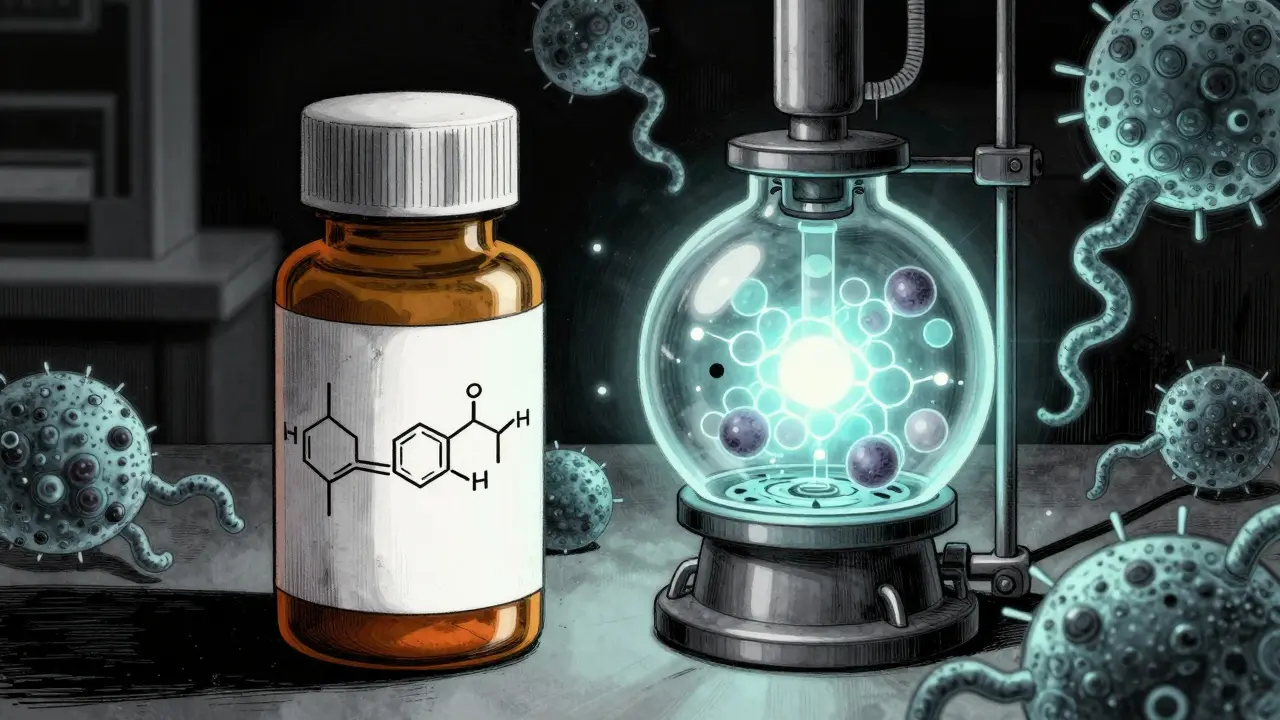
When you hear "generic drug," you probably think of a cheaper version of your prescription pill-same active ingredient, same effect, same price cut. But what if your medicine isn’t a simple chemical pill at all? What if it’s a complex protein made inside living cells? That’s where biosimilars come in. And here’s the thing: biosimilars are not generics. They’re not even close. Yet many people, even some doctors, use the terms interchangeably. That’s dangerous. It’s like calling a Boeing 787 and a Honda Civic both "cars" and assuming they work the same way.
What Exactly Is a Generic Drug?
Generic drugs are the workhorses of modern pharmacy. They’re small-molecule medicines made from precise chemical formulas. Think ibuprofen, metformin, or lisinopril. Once the patent on the brand-name version expires, any manufacturer can copy the exact chemical structure. They don’t need to run new clinical trials. All they have to prove is that their version gets absorbed into your bloodstream at the same rate and to the same extent as the original. That’s called bioequivalence. The FDA requires it to be within 80-125% of the brand drug’s performance. In practice, that means your body can’t tell the difference.Because the chemistry is simple and repeatable, generics are cheap to make. Development costs? Around $2 million to $5 million. That’s why they’re 40% to 50% cheaper than brand-name drugs. Over 90% of prescriptions filled in the U.S. are generics. And they’re interchangeable by law in every state. Your pharmacist can swap your brand-name drug for a generic without asking your doctor. No paperwork. No hesitation. Just lower cost, same result.
What Are Biosimilars?
Biosimilars are the cousins of generics-but they come from a completely different family. They’re not made in a lab with beakers and chemicals. They’re made in bioreactors using living cells-often Chinese hamster ovary cells or other engineered cell lines. These cells are programmed to produce large, complex proteins like monoclonal antibodies. Examples include adalimumab (Humira), infliximab (Remicade), and trastuzumab (Herceptin). These are biologics. They’re huge molecules-up to 5,000 times bigger than a typical small-molecule drug.Because they’re made by living systems, no two batches are exactly alike. Tiny variations in sugar chains, folding patterns, or impurities can happen. That’s normal. The FDA doesn’t expect biosimilars to be identical to the original. They just need to be "highly similar" with no clinically meaningful differences in safety, purity, or potency. That’s a big deal. It means the manufacturer has to do hundreds of analytical tests, animal studies, and sometimes even clinical trials to prove similarity. The process is expensive-$100 million to $200 million per product.
As of November 2023, the FDA has approved 42 biosimilars. That sounds like a lot, but compare it to the 10,000+ generic drugs on the market. Biosimilars still make up less than 3% of the biologics market in the U.S., even though they’ve been around since 2015. Why? Because they’re harder to make, harder to prove, and harder to get doctors to use.
The Regulatory Divide
Generics and biosimilars don’t even follow the same rules. Generics are approved under the Hatch-Waxman Act of 1984. Biosimilars? They’re governed by the Biologics Price Competition and Innovation Act (BPCIA) of 2009. Two different laws. Two different agencies within the FDA. Two different worlds.For generics, the FDA looks at the chemical structure, dissolution rates, and blood concentration over time. Done. For biosimilars? The FDA requires a full package: structural analysis, functional assays, pharmacokinetic studies, immunogenicity testing, and sometimes even comparative clinical trials. The molecule has to be analyzed for over 200 quality attributes. That’s not just a few tests-it’s a full scientific audit.
And here’s the kicker: biosimilar manufacturers can’t copy the reference product’s manufacturing process. They have to build their own from scratch. That’s why even though two biosimilars are made for the same biologic, they’re not the same as each other. They’re both similar to the original-but they might differ slightly from each other. That’s not a flaw. That’s biology.
Substitution: The Big Difference
This is where it gets real for patients and providers. With generics, substitution is automatic. In every state, your pharmacist can switch your brand-name drug for a generic without telling you or your doctor. The law says they can. The system is built for it.With biosimilars? Not so fast. Only biosimilars that are designated "interchangeable" by the FDA can be swapped at the pharmacy counter without a doctor’s permission. And as of early 2026, only 7 out of the 42 approved biosimilars have that status. The rest? You need a new prescription if you want to switch from the original biologic to a biosimilar. That means more paperwork, more delays, and more confusion.
Why the hesitation? Because biologics can trigger immune reactions. If your body reacts to one version of adalimumab, will it react the same way to a biosimilar? Maybe. Maybe not. That’s why doctors are cautious. The American College of Rheumatology says switching between biologics and biosimilars should be done carefully-with monitoring. That’s not the case with generics. You can switch back and forth all day long. No one blinks.
Costs and Savings
Generics save you money. A lot of it. You’re looking at 40-50% off the brand price. Sometimes more. That’s why they dominate.Biosimilars? They save less. Typically 15-20%. Some reports say up to 33%. But even that’s not guaranteed. Why the smaller discount? Because biosimilars cost way more to develop. The manufacturer can’t just copy a formula-they have to reverse-engineer a living system. Plus, the original biologic makers fight hard to protect their market. AbbVie filed over 240 patents for Humira to delay competition. That pushed biosimilar entry back by years.
And here’s the hidden cost: if your insurance doesn’t cover the biosimilar, or if your doctor won’t prescribe it, you might end up paying just as much as you did for the brand. That’s not a win for patients.

Where Are They Used?
Generics are everywhere. They’re in your blood pressure pills, your antibiotics, your antidepressants. They’re in primary care, emergency rooms, pharmacies, nursing homes.Biosimilars? They’re mostly in specialty settings. Oncology. Rheumatology. Endocrinology. Think cancer treatments, autoimmune diseases like rheumatoid arthritis or Crohn’s disease, and insulin for diabetes. These are high-cost, high-complexity drugs. That’s where the savings matter most. A single course of Humira can cost $20,000 a year. A biosimilar might bring it down to $14,000. That’s life-changing for patients on Medicare or with high-deductible plans.
Hospitals and specialty pharmacies have been early adopters. About 45% of U.S. hospitals now use at least one biosimilar. But primary care doctors? Many still don’t feel comfortable prescribing them.
What’s Next?
The future of biosimilars is bright-but not easy. The Inflation Reduction Act of 2022 is helping by reducing out-of-pocket costs for biologics in Medicare Part D. More patents are expiring. By 2028, analysts expect biosimilars to make up 25-30% of the U.S. biologics market, up from under 3% today. The FDA is also updating its guidance to make approval easier-for example, allowing extrapolation of indications (using data from one condition to support approval in another).Meanwhile, generics aren’t slowing down. They’re still the backbone of affordable medicine. And they will be for decades to come.
The bottom line? Biosimilars are not generics. They’re a different kind of savings tool. One that works for complex, high-cost drugs. One that needs more education, more trust, and more time to catch on. But they’re here. And they’re changing the game-for patients who need biologics, they’re offering real relief.
Are biosimilars as safe as brand-name biologics?
Yes. The FDA requires biosimilars to show no clinically meaningful differences in safety, purity, or potency compared to the original biologic. Thousands of patients have used biosimilars since 2015, and safety data from real-world use matches that of the reference products. Immunogenicity-how likely the drug is to trigger an immune response-is closely monitored, and no new safety risks have emerged from approved biosimilars.
Can I switch from a biologic to a biosimilar on my own?
Only if the biosimilar has been designated "interchangeable" by the FDA. As of 2026, only 7 out of 42 approved biosimilars have that status. For all others, your doctor must write a new prescription. Even if your pharmacist wants to switch you, they can’t legally do it without your provider’s approval. Never switch medications on your own-always talk to your doctor first.
Why are biosimilars more expensive to develop than generics?
Biosimilars are made from living cells, not chemicals. That means the manufacturing process is complex, variable, and hard to replicate. Manufacturers can’t access the original company’s secret production methods. They have to build their own cell lines, optimize growth conditions, and test hundreds of molecular characteristics to prove similarity. Generics are made by mixing known chemicals in a fixed recipe. That’s far simpler and cheaper.
Do biosimilars work as well as the original biologic?
Yes. Clinical trials and post-market studies show that biosimilars produce the same clinical outcomes as their reference products-for example, same reduction in joint pain for rheumatoid arthritis, same tumor shrinkage in cancer patients. The FDA only approves them if they’re "highly similar" with no meaningful differences in effectiveness. Many patients switch successfully without any loss of benefit.
Why aren’t more biosimilars interchangeable?
The FDA requires extra data to grant "interchangeable" status. Manufacturers must prove that switching back and forth between the biosimilar and the original won’t increase safety risks or reduce effectiveness. That means additional clinical studies, which are costly and time-consuming. Most companies focus on getting approval first, then decide later whether to pursue interchangeability.
Are biosimilars available outside the U.S.?
Yes. Europe led the way, with biosimilars making up 35% of the biologics market by 2022. Countries like Germany, Sweden, and the UK have strong adoption policies and lower prices. In contrast, the U.S. has been slower due to patent strategies, reimbursement models, and provider hesitancy. But adoption is accelerating, especially as more high-cost biologics lose patent protection.
June Richards
February 1, 2026 AT 20:04Bro, biosimilars are just generics with a fancy lab coat and a $200M price tag. 😴
Lu Gao
February 3, 2026 AT 07:06Actually… 🤔 biosimilars aren’t just ‘complex generics’-they’re biological art. Think of it like this: a generic is a photocopy of a handwritten note. A biosimilar is a live painting recreated by a different artist using the same palette, but their brushstrokes? Slightly different. Still the same emotion. Still the same masterpiece. 🎨
Nidhi Rajpara
February 3, 2026 AT 13:41Dear author, I am writing to you with the utmost respect. However, I must point out that your statement regarding interchangeability is misleading. The FDA does not permit pharmacists to substitute biosimilars without prescriber authorization unless designated interchangeable. This is a legal fact, not a suggestion. Please correct this error. Thank you. 🙏
Naresh L
February 4, 2026 AT 11:14It’s funny how we reduce medicine to a math problem-cheaper = better. But biology doesn’t care about cost. It cares about fidelity. A biosimilar isn’t a copy-it’s a reinterpretation. And just like a symphony played by two different orchestras, both can be beautiful, but one might make your soul tremble while the other just… plays the notes. We need to stop treating life like a spreadsheet.
Maybe the real issue isn’t the science. It’s our hunger for predictability. We want pills to be like coffee-same bean, same roast, same taste. But proteins? They’re more like bread baked by hand. Every loaf breathes differently. And that’s not a flaw. That’s what makes it alive.
Generics saved millions. Biosimilars might save the future. But only if we stop calling them the same thing.
Jamie Allan Brown
February 4, 2026 AT 21:40As someone who’s worked in rural clinics for 15 years, I’ve seen both sides. Generics? Patients trust them. Biosimilars? They’re terrified. Not because they’re unsafe-but because no one explained them. We need better patient education, not just regulatory tweaks. A pamphlet in the waiting room won’t cut it. We need conversations.
One patient asked me: ‘Doc, if it’s not the same, why are you giving it to me?’ I didn’t have a good answer then. I do now. And I’m trying to share it.
Nicki Aries
February 5, 2026 AT 05:51I’ve been a nurse for 22 years, and I’ve seen patients switch from Humira to a biosimilar-and thrive. No flare-ups. No new rashes. No ‘immune drama.’ But I’ve also seen doctors refuse to prescribe them because they ‘don’t trust the data.’ The data’s solid. It’s the fear that’s outdated.
Let’s stop letting pharma’s marketing scare us. Biosimilars aren’t ‘lesser.’ They’re just… different. And different doesn’t mean dangerous.
Also: why does the FDA require extra studies for interchangeability? Because they’re being extra careful. Not because biosimilars are risky. Because we’re still learning. And that’s okay.
Ed Di Cristofaro
February 6, 2026 AT 15:24Ugh. Another ‘biologics are special’ lecture. Newsflash: if it’s cheaper and works the same, stop overcomplicating it. People don’t care if it’s made by hamster cells or a chemist in a lab. They care if their joint pain goes away. Stop treating patients like lab rats and just let them save money.
Bryan Coleman
February 8, 2026 AT 00:57Biggest myth I hear: ‘Biosimilars aren’t as effective.’ Nope. I’ve reviewed over 80 real-world studies. The outcomes? Statistically identical. The only difference? Cost. And sometimes, the side effect profile is actually smoother because manufacturers tweak impurities. Not a bug. A feature.
Also-pharmacists can’t swap them? Yeah, that’s a mess. Why not just let the docs decide? We don’t force patients to use a specific brand of insulin. Why treat biosimilars like they’re radioactive?
Sami Sahil
February 9, 2026 AT 05:26Guys, I’m a diabetic. My insulin biosimilar saved me $12K last year. I didn’t get sick. I didn’t have side effects. I just got to eat dinner without crying about my bill. Biosimilars aren’t magic. They’re justice. Let’s stop talking like they’re risky and start talking like they’re a lifeline.
franklin hillary
February 10, 2026 AT 12:36Let’s reframe this. Generics are like replacing a car battery. Biosimilars are like replacing the entire engine with a rebuilt version from a different factory. You’re still driving the same car. But now you’re using a different blueprint. The performance? Identical. The origin? Totally different. And that’s why we need to stop calling them the same thing. Language shapes perception. And perception shapes policy. And policy shapes access. This isn’t semantics. It’s survival.
Also-Europe got it right. They didn’t wait for patients to beg. They mandated education, reimbursement reform, and provider incentives. We’re still stuck in ‘trust us, it’s science.’ Meanwhile, people are skipping doses because they can’t afford the brand.
We’re not just talking about drugs. We’re talking about dignity.
Ishmael brown
February 10, 2026 AT 12:47Wait… so you’re saying a biosimilar made by a company that doesn’t even know the original’s recipe is ‘safe’? 🤨 That’s like saying a knockoff Rolex is just as good because it tells the right time. It’s not the same thing. And don’t tell me the FDA says it’s fine-I’ve seen what happens when ‘close enough’ becomes standard. Look at the opioid crisis. We didn’t need ‘close enough.’ We needed perfect.
Nancy Nino
February 11, 2026 AT 07:15How charming. You’ve written a 2,000-word essay on pharmaceutical taxonomy… and yet, the only thing that matters is that a single mother in rural Ohio can now afford to treat her rheumatoid arthritis. 🤷♀️