
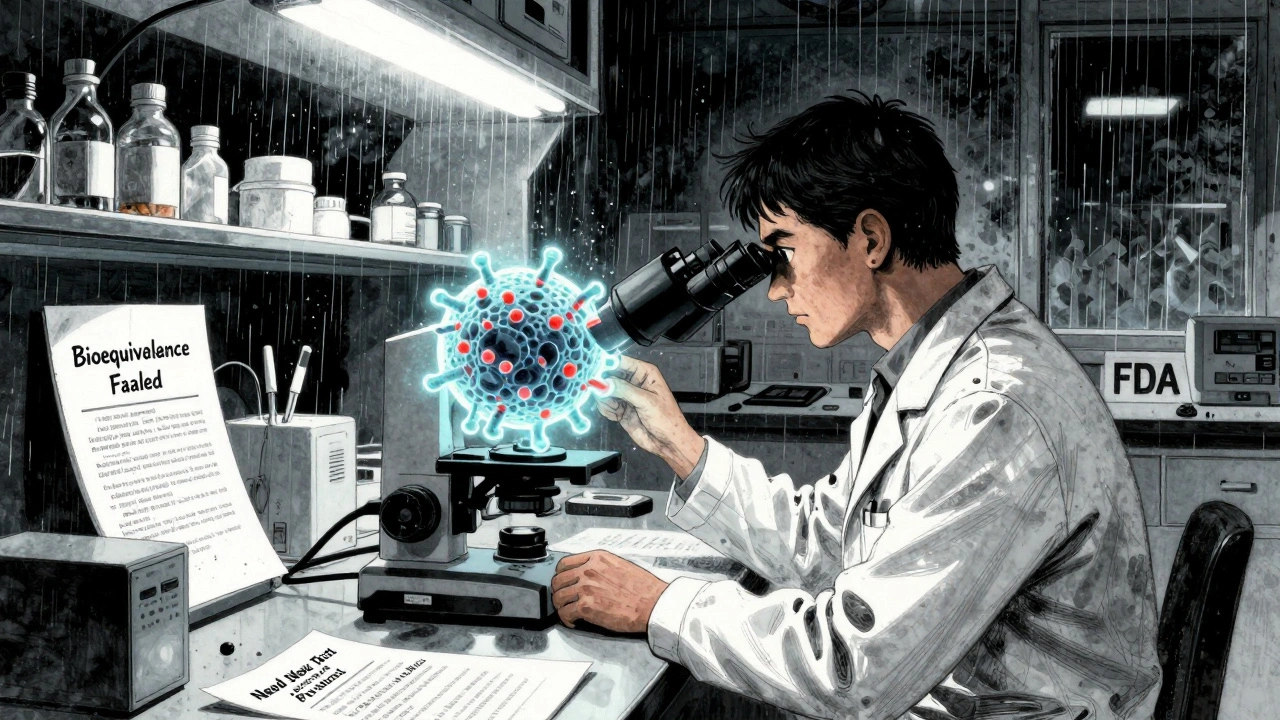
Not all generic drugs are created equal. While you might think a generic version of a brand-name medicine is just a cheaper copy, that’s not true for every drug. Some generics-called complex generic drugs-are incredibly hard to get approved, even when the patent on the original drug has expired. These aren’t simple pills you can swap out. They’re liposomal injections, inhalers, long-acting injectables, or peptide-based therapies. And getting them through the FDA? It’s like trying to rebuild a jet engine with spare parts while blindfolded.
What Makes a Generic Drug "Complex"?
A complex generic drug isn’t just a molecule in a capsule. It’s a system. The active ingredient might be a large protein, a polymer, or a fat-coated particle that releases medicine slowly over weeks. The delivery method could be an inhaler with a precise spray pattern, or an injection that needs to stay stable in your body for months. Even tiny changes in how it’s made can change how it works. The FDA defines these as products with:- Complex active ingredients (like peptides or liposomes)
- Complex formulations (think nanoparticles or gels that don’t dissolve easily)
- Complex delivery systems (inhalers, patches, implantable devices)
- Drug-device combinations (like auto-injectors or nebulizers)
The Approval Process Isn’t Built for This
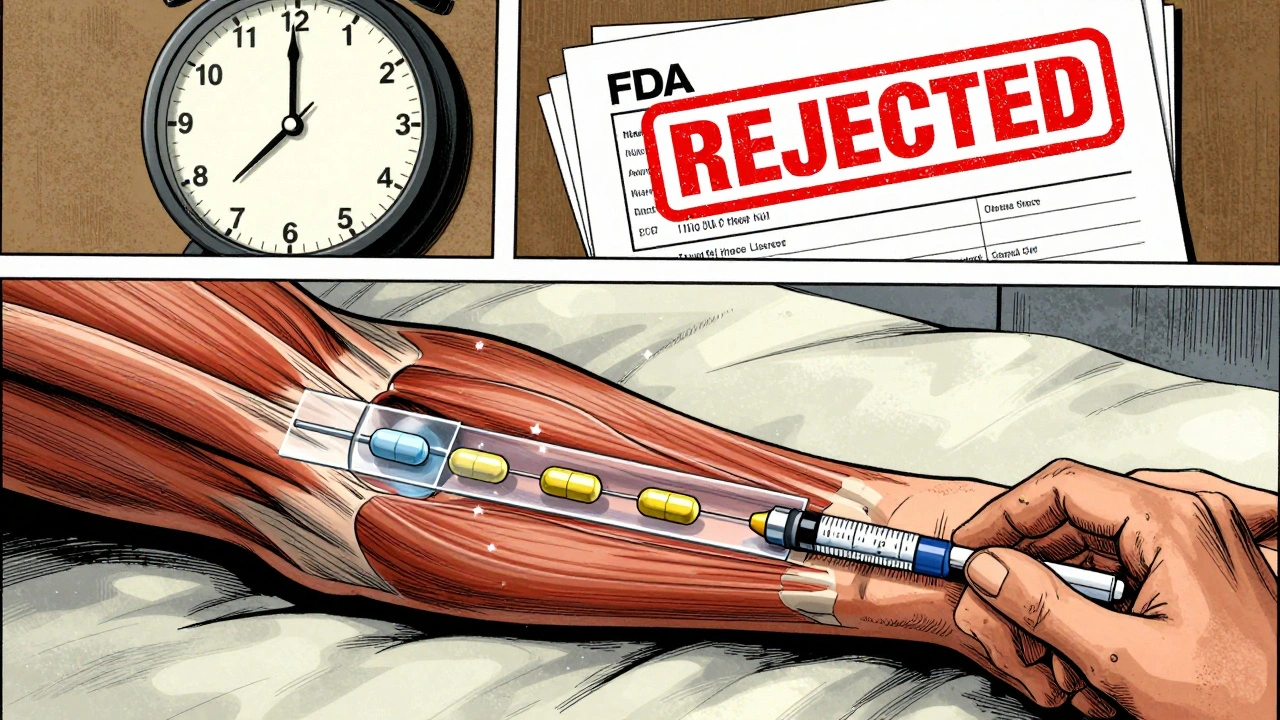
The standard way to get a generic drug approved is through an Abbreviated New Drug Application, or ANDA. It’s called "abbreviated" because you don’t have to run full clinical trials. You just prove your version is bioequivalent-meaning it acts the same way in the body as the brand-name drug. But bioequivalence doesn’t work the same way for complex drugs. Take bupivacaine liposome injectable, a long-acting painkiller. The brand version releases the drug slowly over 72 hours. A generic version might release it over 60 hours. Is that close enough? Maybe. But how do you prove it? You can’t just measure blood levels at one point. You need to track how the drug moves through tissue, how it’s absorbed, how long it lasts. The FDA had to invent a whole new way to test this before approving the first generic version in 2019. That’s the problem. The rules were written for aspirin, not for fat-coated nanoparticles that linger in your muscles for days.Why So Few Get Approved
Since 2015, only about 15 complex generic drugs have been approved by the FDA. Meanwhile, over 1,000 regular generics got the green light in the same period. Why such a gap?- Science is hard: Characterizing a liposome or a peptide requires expensive tools like cryo-electron microscopes and advanced chromatography. Not every generic company has these.
- Testing is expensive: A single complex generic can cost $20 million to $50 million to develop. For a regular pill? Maybe $2 million.
- Time is long: Development takes 5 to 7 years. Regular generics? 2 to 3 years.
- Regulatory uncertainty: If the FDA hasn’t published a specific guidance for your drug, you’re guessing what they want. One company spent three years developing a generic inhaler, only to be told the device’s nozzle shape was too different from the brand version-even though patients couldn’t tell the difference.
Regulatory Hurdles Are Getting Worse, Not Better
The FDA tried to fix this with GDUFA II in 2017. They created a special track for complex generics and promised faster reviews. They also launched the Pre-ANDA Meeting Program, where companies can sit down with FDA scientists before submitting an application. By 2023, over 1,200 of these meetings had been held. They also published over 160 Product-Specific Guidelines (PSGs) in 2019 alone-detailed roadmaps telling companies exactly what data they need. But here’s the problem: not every complex drug has a PSG. And when they don’t? Companies are flying blind. One expert put it bluntly: "FDA’s expectations are unclear and appear to be continuously evolving." That means a company might spend millions building a drug, only to have the FDA suddenly demand a new test they didn’t know was needed. International rules make it worse. In China, you need a local agent and often must run clinical trials there. In Brazil, labs and clinical sites must be certified under strict international standards. So even if you solve the science, you still have to navigate a maze of foreign regulations.Who’s Really Affected?
The biggest losers here aren’t the drug companies. They’re the patients. Many complex drugs treat chronic conditions: chronic pain, COPD, cancer, autoimmune diseases. These aren’t optional medications. They’re life-changing. But because generics are so hard to get approved, patients are stuck paying hundreds or even thousands of dollars a month for brand-name versions-even when the patent expired years ago. The Commonwealth Fund found that most new generics approved today aren’t the first generic. They’re the fourth, fifth, or sixth version of a drug that’s already cheap. That doesn’t lower prices much. What patients need are the first generics of complex drugs-and those are the ones that rarely come to market.
What’s Changing? Slowly.
There’s hope. The FDA is investing in better science. They’re using machine learning to predict how a drug will behave in the body. They’re adopting quality-by-design methods, where manufacturers build in quality from the start instead of testing for it at the end. These approaches could cut approval times by 35% or more. In 2023, the FDA promised to review most new generic applications within 10 months. They hired 128 new staff for the generic drug program. They’re pushing for more PSGs. And they’re working with manufacturers to design better bioequivalence studies. But progress is slow. The bupivacaine liposome approval in 2019 was a milestone-but it took over a decade of back-and-forth. That’s not a model. That’s an exception.What’s Next?
By 2028, complex generics could make up 25% of the $250 billion global generic drug market. That’s because over $75 billion in branded complex drugs will lose patent protection by then. If the system doesn’t adapt, patients will keep paying high prices while drugmakers sit on billions in potential savings. The solution isn’t just more money or more staff. It’s smarter rules. Clearer guidance. And a willingness to accept that a drug doesn’t have to be identical to work the same way. Right now, the FDA is trying to catch up. But until the system learns how to evaluate complex drugs on their own terms-not by the standards of aspirin-we’ll keep seeing the same pattern: breakthrough science, long delays, and patients waiting.Why can’t complex generic drugs be approved the same way as regular generics?
Regular generics rely on bioequivalence testing-measuring how much drug enters the bloodstream. But complex drugs like liposomal injections or inhalers don’t release their active ingredient the same way every time. Their effect depends on particle size, release rate, and how they interact with tissues. Standard blood tests can’t capture that. You need advanced methods to prove they behave the same in the body, and those methods aren’t standardized yet.
How long does it take to get a complex generic approved?
It typically takes 5 to 7 years from start to approval-nearly double the time for a regular generic. That’s because of the need for specialized manufacturing, complex testing, and lengthy back-and-forth with regulators. Even after submission, FDA review can take 2-3 years if there’s no existing guidance for that specific product.
What’s the difference between an ANDA and a 505(b)(2) application?
An ANDA is the standard path for generics: you prove your product is the same as the brand-name drug. A 505(b)(2) is a hybrid path that lets you rely partly on the brand’s data. It’s often used for complex generics because you can’t always prove bioequivalence the traditional way. But it’s more expensive and takes longer than an ANDA, and it’s not always clear which path the FDA will require.
Why are drug-device combinations so hard to approve?
For inhalers or auto-injectors, the device isn’t just packaging-it’s part of the drug’s function. A slightly different nozzle, button pressure, or spray pattern can change how much medicine reaches the lungs or skin. The FDA treats these as a single product, so even minor design changes require full retesting. Patients may not notice the difference, but regulators can’t accept it without proof.
Are there any success stories with complex generics?
Yes. The first generic version of bupivacaine liposome injectable was approved in 2019 after years of collaboration between the manufacturer and the FDA. It required a completely new bioequivalence approach because the drug releases slowly over three days. This approval showed that with clear guidance and scientific cooperation, complex generics can be approved-but it took a decade of effort.
Will AI help speed up complex generic approvals?
Yes. The FDA is testing AI and machine learning to predict how complex drugs behave in the body. These tools can simulate release patterns, absorption rates, and immune responses without running hundreds of lab tests. Early estimates suggest AI could cut development time by 20-30% and reduce regulatory review cycles by up to 45% for well-characterized products.
Sophia Lyateva
December 4, 2025 AT 10:44AARON HERNANDEZ ZAVALA
December 5, 2025 AT 13:11Lyn James
December 7, 2025 AT 04:08Craig Ballantyne
December 9, 2025 AT 01:05Victor T. Johnson
December 10, 2025 AT 01:56Nicholas Swiontek
December 10, 2025 AT 04:13Robert Asel
December 11, 2025 AT 15:28Ben Wood
December 13, 2025 AT 05:04Sakthi s
December 14, 2025 AT 16:21