
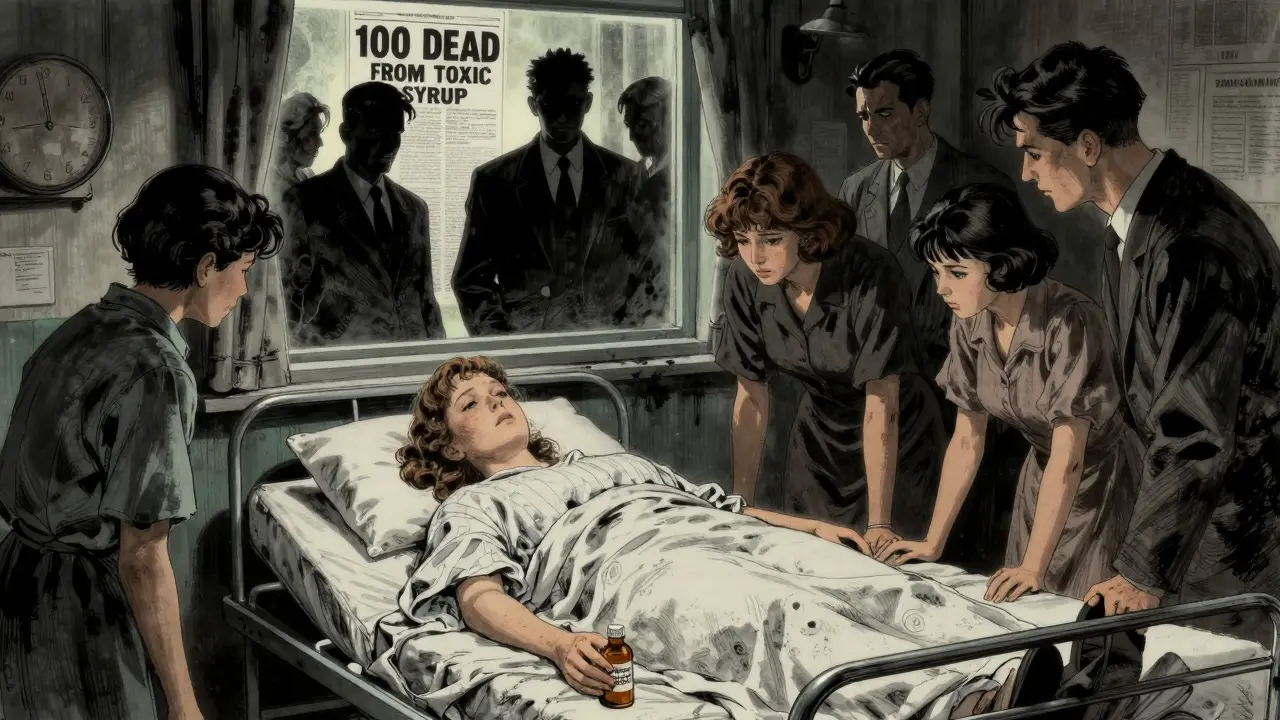
The FD&C Act didn’t start out as a law for generic drugs. In 1938, it was created after more than 100 people died from a toxic cough syrup called elixir sulfanilamide. The drug had no safety testing. No warnings. No oversight. That tragedy forced Congress to act. The result? The Federal Food, Drug, and Cosmetic Act - the first real federal law giving the FDA power to stop dangerous drugs from reaching the public. But it wasn’t until nearly 50 years later that this same law became the backbone of the generic drug industry we rely on today.
From Safety to Affordability: The Long Road to Generics
For decades after 1938, the FD&C Act only required drugmakers to prove their products were safe. Efficacy? That wasn’t required until 1962, after the thalidomide scandal. Even then, if you wanted to make a copy of a brand-name drug, you had to go through the same full clinical trials as the original maker. That meant spending hundreds of millions of dollars and waiting years just to prove your version worked - even though the original drug had already been proven safe and effective. It made no sense. And it kept generics off the market.
By the early 1980s, only about 19% of prescriptions filled in the U.S. were for generic drugs. Yet those generics made up just 3% of total drug spending. Why? Because the system was rigged against competition. Brand-name companies had a monopoly. Patients paid more. The FDA was overwhelmed. Something had to change.
The Hatch-Waxman Amendments: The Game Changer
In 1984, Congress passed the Drug Price Competition and Patent Term Restoration Act - better known as the Hatch-Waxman Amendments. Named after its sponsors, Senator Orrin Hatch and Representative Henry Waxman, this wasn’t a new law. It was an amendment to the FD&C Act. Specifically, it added Section 505(j). That one section changed everything.
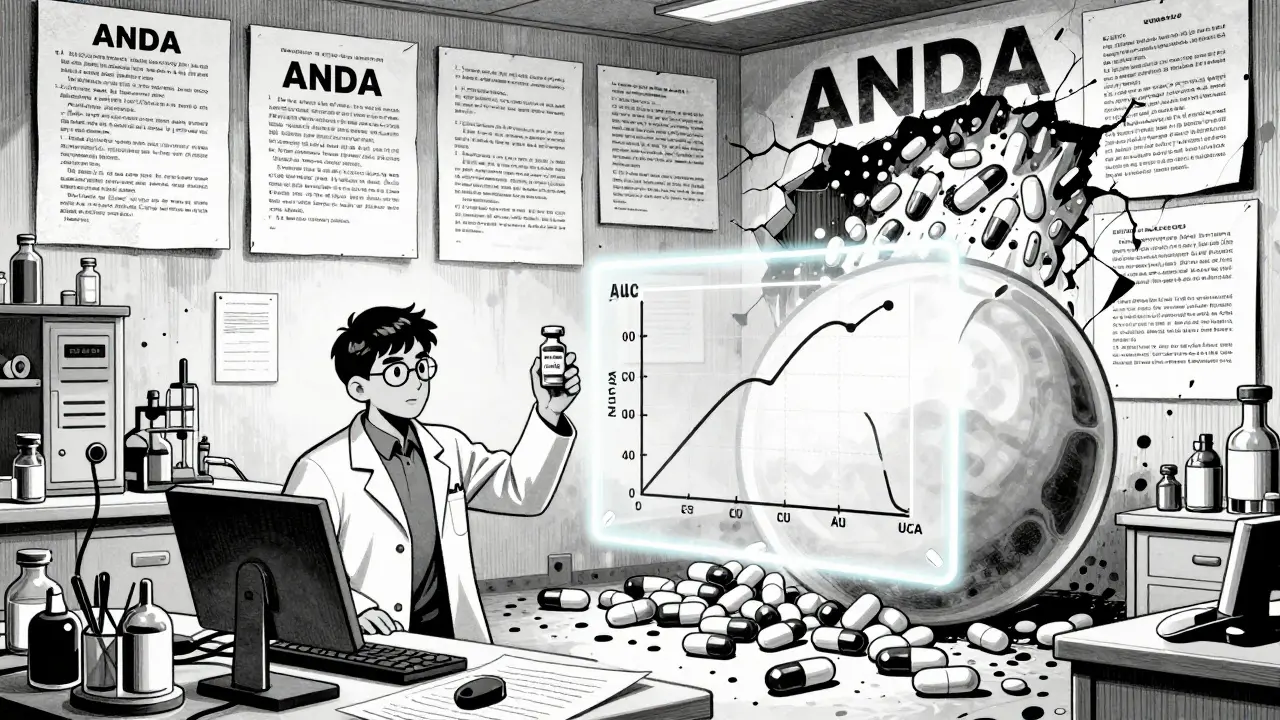
Before Hatch-Waxman, generics needed full new drug applications (NDAs). After? They only needed an Abbreviated New Drug Application - the ANDA. Instead of running new clinical trials, generic makers had to prove two things: their drug had the same active ingredient, strength, dosage form, and route of administration as the brand-name drug. And that it was bioequivalent - meaning it got into the bloodstream at the same rate and amount.
The FDA didn’t need to retest safety or effectiveness. The brand-name drug had already done that. All the generic had to do was match it. This cut development time from 10 years to under 2. Costs dropped by 90%. Suddenly, generics became feasible.
How Bioequivalence Works in Practice
Let’s say you’re making a generic version of Lipitor (atorvastatin). You don’t run a trial with 5,000 heart patients. You don’t wait for heart attacks or strokes to happen. Instead, you give 24-36 healthy volunteers your pill and the brand-name pill. You take blood samples over 24-72 hours. You measure how much of the drug shows up in the blood (AUC) and how fast it peaks (Cmax).
Your generic’s numbers have to fall within 80-125% of the brand’s. That’s the FDA’s bioequivalence window. It’s not a guess. It’s science. And it’s been validated by thousands of studies. If your drug hits that range, the FDA says it will work the same way in patients - whether they’re taking it for cholesterol, high blood pressure, or diabetes.
This system works. Today, 90% of prescriptions in the U.S. are filled with generics. But they cost only 17% of what brand drugs do. That’s not magic. That’s Hatch-Waxman.
The Patent Game: Incentives and Delays
Hatch-Waxman didn’t just make generics easier to approve. It created a delicate balance. Brand-name companies get patent protection. But they also get a bonus: if their drug took years to get FDA approval, they can get up to five extra years of patent life. That’s called patent term restoration.
For generics, the big incentive? 180 days of exclusive market access if you’re the first to challenge a brand’s patent. That’s huge. One generic company can dominate the market before others even enter. That’s why you sometimes see only one generic on the shelf at first - and then suddenly, five show up after six months.
But this system has been exploited. Brand companies now file dozens of weak patents - on coating, packaging, delivery systems - just to block generics. They call it “evergreening.” They file citizen petitions with the FDA, asking for delays. They refuse to sell samples to generic makers so they can’t test their product. The FDA calls these “product hopping.”
The CREATES Act of 2019 tried to fix this. It lets generic companies sue if a brand refuses to provide samples. The FTC says these tactics cost consumers billions. But they’re still happening.
What Gets Approved - and What Doesn’t
The FDA’s Orange Book lists every approved drug and its therapeutic equivalence rating. As of 2023, it had over 20,000 entries. But not all drugs are easy to copy. Inhalers, injectables, creams, and complex biologics? They’re harder. The science is more complicated. The manufacturing is harder to replicate. And the FDA’s guidance for these is still catching up.
That’s why generic entry for inhalers dropped 42% compared to simple pills. The Hatch-Waxman framework was built for pills and injections. It’s not perfect for modern drugs. The FDA’s 2023-2027 plan says it’s working on new guidance for nasal sprays and eye drops. That’s progress.
Compliance and Enforcement: The Hidden Costs
Just because a generic is approved doesn’t mean it’s safe. Manufacturing matters. In 2022, the FDA issued 47 warning letters to generic drugmakers. The top two problems? Poor quality control and data造假 - fake or altered test results. One company in India falsified bioequivalence data. Another in China didn’t clean equipment between batches. Both were shut down.
Under the FD&C Act, selling an adulterated or misbranded drug is a crime. Fines can hit over $1.1 million per violation. Criminal charges are possible. The FDA doesn’t just approve drugs - it inspects factories. It audits labs. It checks records. And it shuts down bad actors.
That’s why you can trust a generic. It’s not a cheap knockoff. It’s a regulated, tested, monitored copy - held to the same standard as the brand.
The Bigger Picture: Savings and Future Challenges
Over the last decade, generic drugs saved U.S. consumers $2.2 trillion. That’s not a number from a marketing brochure. That’s from the FTC. It’s real money. A prescription that costs $300 as a brand name? The generic might be $12. That’s the power of the FD&C Act - evolved.
The Congressional Budget Office predicts that by 2032, current policies will save the federal government $158 billion on drug spending. That’s Medicare, Medicaid, VA - all of it.
But challenges remain. Complex generics. Patent thickets. Supply chain risks. Manufacturing quality. The FDA is underfunded. GDUFA - the Generic Drug User Fee Amendments - lets the industry pay fees to speed up reviews. Since 2012, review times dropped from 30 months to under 10. That’s a win. But it’s fragile.
The FD&C Act didn’t create generics. But it gave them a legal home. The Hatch-Waxman Amendments turned a safety law into a competition engine. And that’s why today, if you take a pill for blood pressure, diabetes, or cholesterol, there’s a 9 in 10 chance it’s a generic. And that’s not luck. That’s law.
What is the FD&C Act and how does it relate to generic drugs?
The Federal Food, Drug, and Cosmetic Act (FD&C Act), passed in 1938, gave the FDA authority to regulate drug safety. It didn’t originally cover generics. That changed in 1984 with the Hatch-Waxman Amendments, which added Section 505(j) to the FD&C Act. This created the ANDA pathway, allowing generic manufacturers to prove their drugs are equivalent to brand-name drugs without repeating costly clinical trials.
What is an ANDA and why is it important for generics?
An Abbreviated New Drug Application (ANDA) is the application generic drugmakers submit to the FDA to get approval. Unlike full NDAs, ANDAs don’t require new clinical trials. Instead, they prove bioequivalence - that the generic delivers the same amount of active ingredient into the bloodstream at the same rate as the brand-name drug. This cuts approval time and cost, making generics affordable and widely available.
How does the FDA ensure generic drugs work the same as brand-name drugs?
The FDA requires generics to match the brand in active ingredient, strength, dosage form, and route of administration. Then, through pharmacokinetic studies, they must show bioequivalence: the generic’s Cmax and AUC values must fall within 80-125% of the brand’s. This range is scientifically proven to ensure the same therapeutic effect. The FDA also inspects manufacturing sites to ensure quality.
Why do some generic drugs take longer to reach the market?
Patent disputes, legal challenges, and brand-name companies blocking access to drug samples can delay generic entry. The 180-day exclusivity period for first filers can also create bottlenecks. Complex drugs like inhalers or injectables face additional scientific hurdles, and the FDA’s guidance for these is still evolving. Some brand companies use “evergreening” - filing weak secondary patents - to delay competition.
Are generic drugs as safe as brand-name drugs?
Yes. Generic drugs are held to the same FDA standards as brand-name drugs. They must contain the same active ingredient, meet the same purity and strength requirements, and be manufactured under the same strict quality controls (cGMP). The FDA inspects both brand and generic factories. In fact, many brand companies make their own generics. The only difference is price - not safety or effectiveness.
What role does the Orange Book play in generic drug approval?
The FDA’s Approved Drug Products with Therapeutic Equivalence Evaluations, known as the Orange Book, lists all approved drugs and their therapeutic equivalence ratings. Generic manufacturers use it to identify the reference listed drug (RLD) they must match. It also shows patent and exclusivity information, helping generics navigate legal barriers before filing their ANDA. It’s the roadmap for generic development.
What Comes Next for Generic Drugs?
The system works - but it’s under pressure. The FDA is working on new guidance for complex generics like nasal sprays and eye drops. The 21st Century Cures Act and CREATES Act are helping break down barriers. But without continued funding, oversight, and political will, the balance could tip.
Generic drugs aren’t just cheaper. They’re essential. They keep millions of Americans on their medications. They reduce strain on public health systems. They make treatments accessible. The FD&C Act didn’t start out as a tool for competition. But thanks to the Hatch-Waxman Amendments, it became one of the most powerful tools for lowering drug costs in modern history. And that’s a legacy worth protecting.
Raj Kumar
December 16, 2025 AT 00:53Man, I remember when my dad had to pay $200 for his blood pressure med. Now he gets the generic for $8. Hatch-Waxman saved his life and our wallet. The system ain’t perfect but it works.
Christina Bischof
December 17, 2025 AT 18:37So basically the FDA just says 'if it looks and acts like the real thing, it is the real thing' and we're good? Wild that science can be this simple and still save billions
Nupur Vimal
December 17, 2025 AT 19:48Generic drugs are just knockoffs with a fancy label. The FDA lets them slide because they're too lazy to do real testing. People die from bad generics every year and nobody cares
Cassie Henriques
December 18, 2025 AT 01:50bioequivalence window 80-125%?? That’s actually brilliant. So it’s not about being identical, it’s about being functionally identical. 🤯 FDA’s doing the math so we don’t have to
Michelle M
December 19, 2025 AT 19:28It’s funny how a law born from a tragedy - 100 people dead from poison syrup - ended up becoming the engine of affordable healthcare. Sometimes the most powerful change comes from the darkest moments.
We don’t celebrate these laws enough. We take them for granted until we need them.
And now? We’re fighting to protect it from patent trolls and corporate games.
Generics aren’t just cheaper - they’re a moral choice. A choice to let people live.
That’s not policy. That’s humanity.
And if we let it slip, we won’t just lose money.
We’ll lose trust.
And once that’s gone? Good luck rebuilding it.
Let’s not forget why we started this.
Because people deserve to breathe.
And to take their pills without choosing between rent and refills.
That’s the real win here.
Lisa Davies
December 21, 2025 AT 16:0390% of prescriptions = generics 🙌 That’s not luck. That’s science + policy + people fighting for change. 🇺🇸💊
Also, side note: my mom’s cholesterol med? Generic. She’s alive. Brand? Would’ve cost $400/month. 😭
Jake Sinatra
December 22, 2025 AT 05:22The FD&C Act was a necessary evolution of regulatory oversight. The Hatch-Waxman Amendments represent a rational balancing of innovation incentives and public access. This is not a partisan issue - it is a public health imperative grounded in empirical evidence and sound economic principles.
RONALD Randolph
December 23, 2025 AT 09:51Who the hell let India and China make our meds?! They're falsifying data, cutting corners, and we're letting them?! This isn't healthcare - it's national suicide. We need to ban foreign manufacturing NOW. The FDA is a joke.
Benjamin Glover
December 24, 2025 AT 09:08How quaint. A 1984 compromise that somehow still functions. The Americans, always the last to innovate - but the first to monetize.
Melissa Taylor
December 25, 2025 AT 22:18It’s easy to forget that behind every generic pill is a scientist, a regulator, a factory worker - all trying to make sure someone gets better. That’s quiet heroism.
And we owe it to them to keep the system strong.
John Brown
December 27, 2025 AT 19:12My cousin in rural Kentucky gets her diabetes meds via mail-order generic. She’s 72. Lives alone. Without this law? She’d be choosing between insulin and groceries. This isn’t politics. This is life.
Jocelyn Lachapelle
December 28, 2025 AT 08:34People think generics are cheap because they’re low quality - but no. They’re cheap because the system finally stopped letting pharma charge $1000 for a pill that costs $2 to make
That’s the real scandal
Mike Nordby
December 29, 2025 AT 01:21The bioequivalence standard of 80-125% is not arbitrary. It is derived from statistically validated pharmacokinetic models and has been consistently upheld by peer-reviewed literature. The FDA’s adherence to this threshold ensures clinical equivalence without unnecessary duplication of trials. This is regulatory excellence.
John Samuel
December 30, 2025 AT 19:37Imagine a world where your life-saving medicine costs less than your coffee. 🤯 That’s not fantasy - that’s the FD&C Act, upgraded by Hatch-Waxman. The system’s got cracks? Sure. But it’s still the only thing holding back pharmaceutical feudalism.
Let’s not fix what ain’t broke - let’s protect what saves millions.
💊🇺🇸
Sai Nguyen
December 31, 2025 AT 15:07Why do we let foreigners make our pills? We should make them here. America First. No more Indian generics. No more Chinese labs. End this.