

When someone with HIV needs an antibiotic-whether for pneumonia, a urinary tract infection, or tuberculosis-their treatment plan isn’t as simple as picking a pill off the shelf. Mixing HIV medications with antibiotics can lead to dangerous, sometimes life-threatening interactions. These aren’t rare edge cases. In fact, nearly one in five hospital admissions for HIV patients involves a harmful drug interaction, and more than 40% of those involve antibiotics. The problem? Many providers still don’t know how deep this complexity goes.
Why HIV Drugs and Antibiotics Don’t Always Play Nice
HIV treatment relies on combination antiretroviral therapy (ART), which keeps the virus under control. But antibiotics? They’re often needed because HIV weakens the immune system, making patients more vulnerable to infections. The trouble starts when both types of drugs are processed by the same system in your liver: the CYP450 enzyme system, especially the CYP3A4 enzyme.
Most HIV drugs-especially protease inhibitors (PIs) and non-nucleoside reverse transcriptase inhibitors (NNRTIs)-are broken down by CYP3A4. Many antibiotics are too. When you take both, they fight over the same enzymes. One can slow down the other’s breakdown, making it build up to toxic levels. Or, worse, one can speed up the other’s breakdown, making it useless.
Take boosted PIs like ritonavir or cobicistat. These aren’t just HIV drugs-they’re powerful enzyme blockers. When paired with antibiotics like clarithromycin, they can spike clarithromycin levels by 60-80%. That might sound like a good thing-more drug, better effect-but it can cause heart rhythm problems, liver damage, or severe nausea. On the flip side, rifampin (used for TB) is a strong enzyme inducer. It can slash HIV drug levels by up to 80%, leading to treatment failure and drug resistance.
Which HIV Drugs Are Most Likely to Cause Problems?
Not all HIV medications are created equal when it comes to interactions. Some are quiet players. Others? They’re the ones you need to watch like a hawk.
- Boosted PIs (ritonavir, cobicistat): These are the biggest troublemakers. They’re designed to boost other HIV drugs by blocking CYP3A4-but they also block the metabolism of antibiotics. This makes them interact with over 70% of commonly used drugs.
- NNRTIs (efavirenz, rilpivirine): These can either inhibit or induce enzymes depending on the drug. Efavirenz, for example, can lower levels of azithromycin and fluoroquinolones, reducing their effectiveness.
- INSTIs (dolutegravir, bictegravir): These are the new favorites for a reason. They don’t rely on CYP450 enzymes much. Dolutegravir has fewer than 10 known significant interactions. That’s why it’s often the go-to when antibiotics are needed.
- NRTIs (tenofovir, emtricitabine): These don’t touch CYP450 at all. But they can still cause trouble. Tenofovir, for instance, harms the kidneys. So does ciprofloxacin. Together? They can push kidney function into danger territory.
Even newer drugs like lenacapavir and islatravir are designed to avoid these issues. Lenacapavir, approved in 2022, has no CYP450 interactions. Islatravir, studied in 2023, only changed by 7% when taken with clarithromycin-compared to 80% changes with older PIs. That’s a huge leap forward.
Common Antibiotics That Clash With HIV Meds
Here’s what you need to know about the most frequently prescribed antibiotics and how they behave with HIV drugs:
| Antibiotic | Common HIV Drug Interaction | Recommended Action |
|---|---|---|
| Clarithromycin | Boosted PIs (e.g., darunavir/cobicistat) | Avoid. Use azithromycin instead. Clarithromycin levels can rise 82%. |
| Rifampin | All boosted PIs, most NNRTIs | Contraindicated. Can reduce HIV drug levels by 80%. Use rifabutin instead. |
| Rifabutin | Boosted PIs | Use at 150mg every other day. Monitor for uveitis and low white blood cell count. |
| Ciprofloxacin | Tenofovir disoproxil fumarate (TDF) | Use with caution. Risk of kidney injury increases 3.2-fold. |
| Fluconazole | Boosted PIs | Reduce fluconazole dose by 50%. Avoid voriconazole-use posaconazole instead. |
| Trimethoprim-sulfamethoxazole | Dolutegravir | Safe, but monitor potassium. Risk of hyperkalemia increases. |
Notice a pattern? The safest choices are often the ones that don’t go through CYP450. Azithromycin, for example, is cleared by the liver without enzyme involvement. That’s why it’s the top pick for pneumonia in HIV patients on boosted regimens. Nitrofurantoin works for UTIs with INSTIs. But trimethoprim-sulfamethoxazole? It’s fine with dolutegravir-but you have to watch for high potassium levels.
What Happens When You Get It Wrong
Ignoring these interactions isn’t just risky-it’s costly. A 2023 study found that HIV patients who received the wrong antibiotic due to a drug interaction had an 18.3% higher chance of being readmitted within 30 days. That’s not just about discomfort. It’s about treatment failure, resistant infections, and even death.
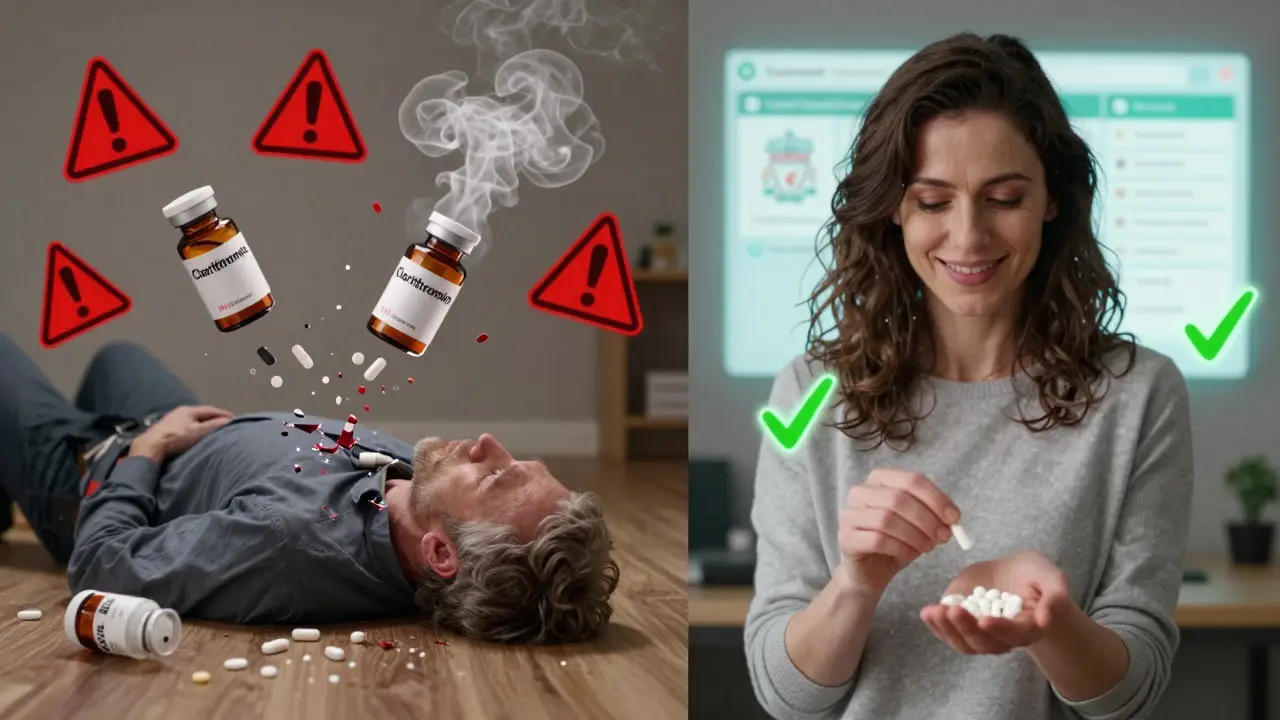
One real-world example: A 58-year-old man on darunavir/cobicistat was prescribed clarithromycin for pneumonia. His clarithromycin levels skyrocketed. He developed severe nausea, vomiting, and a prolonged QT interval-a heart rhythm problem that can trigger sudden cardiac arrest. He was hospitalized. His HIV treatment was interrupted. He ended up with a detectable viral load.
On the other side: A 42-year-old woman on dolutegravir needed antibiotics for a UTI. Her provider chose nitrofurantoin. No interaction. No side effects. She recovered in five days.
The difference? Knowledge.
How to Stay Safe: A Practical Checklist
If you’re on HIV meds and need an antibiotic, here’s what to do:
- Check every new drug. Even if it’s an OTC antibiotic, herbal supplement, or over-the-counter cough syrup. Many contain hidden ingredients that interact.
- Use the Liverpool HIV Drug Interactions Checker. It’s free, updated weekly, and trusted by clinics worldwide. It’s more accurate than most hospital databases.
- Ask: Is this antibiotic metabolized by CYP3A4? If yes, and you’re on a boosted PI or NNRTI, it’s likely dangerous.
- Consider alternatives. Azithromycin over clarithromycin. Posaconazole over voriconazole. Rifabutin over rifampin.
- Monitor kidney function. If you’re on tenofovir and a fluoroquinolone, get a creatinine test before and after.
- Don’t stop your HIV meds. Even if you feel sick. Stopping ART leads to resistance. Work with your provider to adjust the antibiotic instead.

What’s Changing in 2026?
The field is evolving fast. In January 2024, the Liverpool database launched version 10.0 with machine learning that predicts new interactions based on drug structure-89% accurate. The NIH just funded a $15.7 million project to build personalized dosing algorithms using genetic data. And by late 2025, all major drug databases (Micromedex, Drugs.com, Liverpool) are expected to finally align on a single classification system for interactions.
Meanwhile, newer HIV drugs are being designed with interaction avoidance in mind. The next generation of long-acting injectables-like the monthly cabotegravir and rilpivirine shots-still linger in the body for weeks. That means interactions can pop up even after you stop taking them. You can’t just stop one drug and assume the problem’s gone.
Final Takeaway
HIV and antibiotics don’t have to be a minefield. But you need to treat them like one. Every time you’re prescribed a new antibiotic, assume it might interfere with your HIV meds-until you check. Don’t rely on memory. Don’t assume your pharmacist caught it. Use the Liverpool tool. Talk to your provider. And remember: the safest antibiotic isn’t always the strongest. Sometimes, it’s the one that doesn’t fight with your HIV treatment at all.
Can I take azithromycin with my HIV meds?
Yes, azithromycin is generally safe with most HIV medications. It doesn’t rely on the CYP3A4 enzyme, so it rarely interferes with boosted PIs or NNRTIs. It’s often the preferred antibiotic for pneumonia or bronchitis in people on ART. Always confirm with your provider, but it’s one of the safest choices.
Is rifampin ever safe to use with HIV drugs?
No, rifampin is contraindicated with all boosted protease inhibitors and most NNRTIs. It cuts HIV drug levels by up to 80%, which can lead to treatment failure and drug resistance. If you need TB treatment, rifabutin is the substitute-but even that requires dose adjustments and monitoring.
Why is dolutegravir considered safer than other HIV drugs?
Dolutegravir is an INSTI that doesn’t rely on the CYP450 enzyme system for metabolism. Most of its elimination happens through direct excretion and glucuronidation, which means fewer opportunities for drug interactions. It has fewer than 10 clinically significant interactions, making it ideal for patients who need antibiotics or other common medications.
Can antibiotics make my HIV treatment stop working?
Yes. Antibiotics like rifampin can reduce HIV drug levels so much that the virus rebounds. This can lead to drug-resistant HIV, which is harder and more expensive to treat. Even if you feel fine, undetected drops in drug levels can cause resistance over time. Always check interactions before starting any new drug.
Should I avoid antibiotics if I have HIV?
No. People with HIV need antibiotics just like anyone else-sometimes more often. The goal isn’t to avoid them, but to choose the right ones. With proper checking and planning, antibiotics can be used safely. The key is using tools like the Liverpool HIV Drug Interactions Checker and working with a provider who understands these interactions.
Do I need to stop my HIV meds before taking an antibiotic?
Never stop your HIV meds without guidance. Stopping ART can cause viral rebound and resistance. Instead, work with your provider to adjust the antibiotic, choose a safer alternative, or modify the dose. The right antibiotic can be found without compromising your HIV treatment.
Milad Jawabra
March 4, 2026 AT 13:56Bro, this is why I tell my buddies on ART to never just grab an antibiotic from the pharmacy like it's Advil. I had a cousin almost die because he took clarithromycin with his darunavir. His heart went haywire. He didn't even know HIV meds and antibiotics could fight each other. Use the Liverpool checker. Seriously. It's free. Save your life. 🚨
Siri Elena
March 5, 2026 AT 21:38Oh wow. A *comprehensive* article that doesn’t assume we’re all medical residents. How quaint. I almost cried. 😭
But let’s be real-most providers still think ‘HIV patient’ = ‘just give them azithromycin and call it a day.’ No one’s updating their 2012 protocols. And yet, somehow, we’re still alive? Magic? Or just dumb luck?
Pankaj Gupta
March 7, 2026 AT 05:19The precision of this breakdown is commendable. The distinction between CYP450-dependent and non-dependent pathways is critical for clinical decision-making. Notably, the avoidance of rifampin in favor of rifabutin-when properly dosed-is a cornerstone of TB management in HIV-positive populations. Furthermore, the emphasis on dolutegravir’s pharmacokinetic profile underscores its role as a first-line agent in complex polypharmacy scenarios. A well-researched and clinically grounded contribution.
Matt Alexander
March 7, 2026 AT 05:40Simple version: If you’re on HIV meds and need an antibiotic, don’t guess. Go to LiverpoolHIVDrugInteractions.com. Type in your meds. It tells you what’s safe. No jargon. No fluff. Just ‘yes’ or ‘no.’ I use it every time. Saved my friend from a hospital trip. Do it.
Aisling Maguire
March 9, 2026 AT 03:23So basically, your HIV meds are like that one ex who ruins every party? ‘Oh, you brought a new friend? Cool. Let me poison them.’
And rifampin? That’s the ex’s new partner who shows up with a flamethrower.
Meanwhile, dolutegravir just sits there quietly sipping tea. No drama. Just peace.
Also, azithromycin? The chill cousin who always brings snacks. Never leave home without it.
marjorie arsenault
March 10, 2026 AT 12:22I’m so proud of how far we’ve come. When I first started on ART, we were just guessing. Now? We’ve got tools. We’ve got data. We’ve got people like you who take the time to explain this clearly.
It’s not just about survival anymore. It’s about living well. And that’s worth celebrating.
Thank you for this. Truly.
Deborah Dennis
March 11, 2026 AT 18:07Megan Nayak
March 12, 2026 AT 01:37Let’s not pretend this is about medicine. It’s about control. The pharmaceutical industry doesn’t want you to have simple solutions. They want complexity. They want you dependent on databases, on providers, on ‘protocols.’ The real question: Why are we still treating HIV like it’s a puzzle to be solved, rather than a condition to be managed? The answer? Profit. Always profit.
Divya Mallick
March 13, 2026 AT 12:57As an Indian clinician, I’ve seen this play out daily. In Mumbai, patients are given rifampin because it’s cheap. Then they lose their viral suppression. Then they come back with MDR-TB. Then we lose them. This isn’t science-it’s systemic neglect. Western guidelines? Beautiful on paper. But in the Global South? We’re forced to choose between starvation and suicide. No one talks about that. Only ‘check the Liverpool tool.’ Like that fixes poverty.
Alex Brad
March 15, 2026 AT 05:17Use azithromycin. Avoid rifampin. Check the tool. Don’t stop your meds. That’s it.
Renee Jackson
March 16, 2026 AT 06:32This is an exemplary piece of clinical communication. The integration of evidence-based recommendations with accessible, actionable guidance represents a paradigm shift in patient-centered care. The emphasis on pharmacokinetic mechanisms, coupled with practical decision-making frameworks, ensures that both clinicians and patients are empowered. I commend the author for this meticulous and compassionate contribution to the field.
RacRac Rachel
March 17, 2026 AT 11:40YAS QUEEN 🌟 This is the kind of post that makes me feel seen! Dolutegravir is my vibe 💅 Azithromycin? My ride-or-die. Rifampin? Never, ever, EVER. 😤 I used the Liverpool tool yesterday and it saved my butt. I’m telling all my HIV squad to read this. You’re a hero. 🫶💖
Jane Ryan Ryder
March 18, 2026 AT 18:25Callum Duffy
March 20, 2026 AT 12:09While the clinical insights presented are robust and well-documented, I would urge caution in over-reliance on digital tools alone. The human clinical context-patient adherence, socioeconomic factors, access to follow-up-remains paramount. The Liverpool database is invaluable, but it does not replace the therapeutic alliance between patient and provider. A nuanced, person-centered approach remains the gold standard.
Chris Beckman
March 21, 2026 AT 06:14lol i read this whole thing and im still confused. why cant u just take one pill? i thought hiv was like, a pill a day? now u gotta check a website? and what if u dont have internet? what if ur poor? why do they make it so hard? also i think they just want us to buy more drugs. its a scam.