
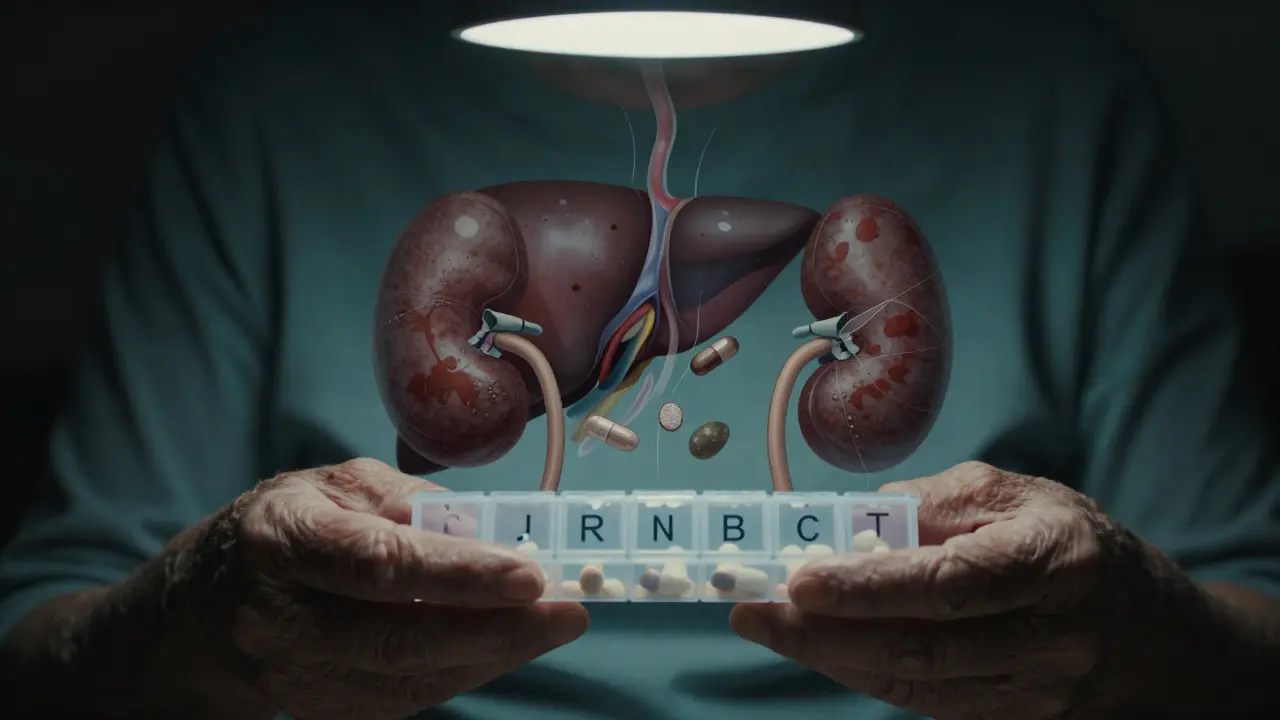
When you’re over 65, your body doesn’t process medications the same way it did when you were 40. It’s not about being weak or slow-it’s biology. Your liver and kidneys, the two main organs that clean drugs out of your system, naturally change as you age. These changes don’t always show up in blood tests, but they can turn a safe dose into a dangerous one. That’s why so many older adults end up in the hospital-not because they took too many pills, but because the pills stayed in their bodies too long.
What Happens to Your Liver as You Age?
Your liver shrinks. By the time you hit 70, it’s lost about 30% of its mass. Blood flow through it drops by 40%. That means drugs don’t get processed as quickly. Some medications rely on the liver to break them down before they can work-like propranolol for high blood pressure or morphine for pain. When liver flow slows, these drugs build up. You might get dizzy, drowsy, or even fall. That’s not normal aging. That’s a drug reaction.
Not all liver metabolism slows the same way. There are two types of drugs: flow-limited and capacity-limited. Flow-limited drugs-like lidocaine, morphine, and verapamil-depend on how fast blood moves through the liver. When blood flow drops, clearance drops too. These drugs can become toxic at standard doses. Capacity-limited drugs-like diazepam, phenytoin, and theophylline-depend on enzyme activity. Surprisingly, many of these enzymes stay fairly steady with age. So while your liver is smaller, it’s still doing its job on these drugs. But don’t assume that means safety. Even small changes can add up, especially if you’re on five or more medications.
Your Kidneys Don’t Filter Like They Used To
Kidney function declines steadily after 30. By age 80, most people have lost 30-50% of their glomerular filtration rate (GFR). That’s the measure of how well your kidneys filter waste. But here’s the trap: your serum creatinine-a common blood test used to check kidney health-often stays normal. Why? Because muscle mass drops with age, and creatinine comes from muscle. So your kidneys might be failing, but your lab results look fine. That’s why doctors can’t rely on creatinine alone.
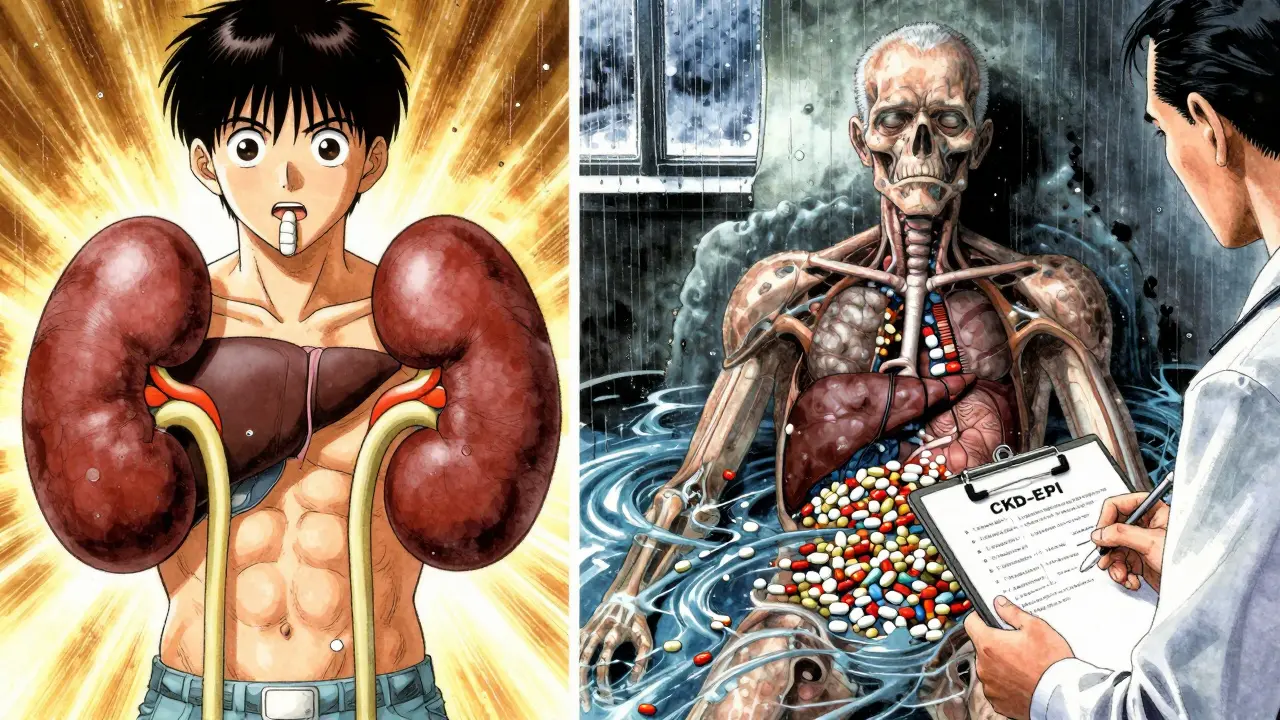
Drugs like digoxin, metformin, and vancomycin are cleared almost entirely by the kidneys. If your GFR drops and your dose doesn’t change, these drugs can pile up. Vancomycin, for example, can cause permanent hearing loss or kidney damage if levels get too high. In one 2022 case study, a 78-year-old patient avoided nephrotoxicity only because their doctor used an estimated GFR from the CKD-EPI equation (not the old Cockcroft-Gault) and adjusted the dose accordingly.
Why Some Drugs Work Differently in Older Adults
Some medications are prodrugs-meaning they need to be activated by the liver before they work. Perindopril, an ACE inhibitor for blood pressure, is one. In older adults, this activation slows down. The drug might not work as well, even if the dose looks right. Meanwhile, drugs with high first-pass metabolism-like propranolol-get absorbed more fully because the liver isn’t breaking them down as they pass through. That means 25-50% more of the drug enters your bloodstream than it used to. A standard 10 mg dose could act like 15 mg. That’s enough to cause a dangerous drop in heart rate or blood pressure.
And then there’s acetaminophen. It’s in hundreds of over-the-counter cold and pain meds. In older adults, even normal doses can cause liver damage. Why? Because the liver’s ability to detoxify it declines, and many seniors take it daily without realizing the cumulative effect. In fact, acetaminophen is behind half of all acute liver failure cases in people over 65.
What Does This Mean for Your Medications?
The American Geriatrics Society’s Beers Criteria® says this plainly: start low, go slow. For drugs cleared by the liver, reduce the initial dose by 20-40% in people over 65. For those over 75, go even lower. Don’t wait for side effects to appear. Prevent them.
Use the right tool to check kidney function. The CKD-EPI equation is now preferred over Cockcroft-Gault because it doesn’t use race as a factor and gives a more accurate GFR estimate. If you’re on a drug that’s cleared by the kidneys, ask your doctor to calculate your estimated GFR-not just look at creatinine.
Also, watch for drug interactions. Many seniors take supplements, herbal remedies, or OTC painkillers without telling their doctor. St. John’s wort can interfere with antidepressants. Ibuprofen can hurt kidneys already struggling. Even common antacids can change how other drugs are absorbed. One Reddit user shared how their 82-year-old mother ended up in the ER after starting amitriptyline at a standard dose. The doctor later realized her liver couldn’t clear it. The dose was cut in half-and the dizziness vanished.
Why Most Clinical Trials Don’t Tell the Whole Story
Here’s the uncomfortable truth: most new drugs are tested on people under 65. In 2022, only 38% of participants in FDA-approved drug trials were over 65. That means we’re prescribing drugs based on data from younger bodies. The FDA is trying to fix this. Their 2019 guidance now requires drug makers to include older adults in trials and analyze results by age group. But progress is slow.
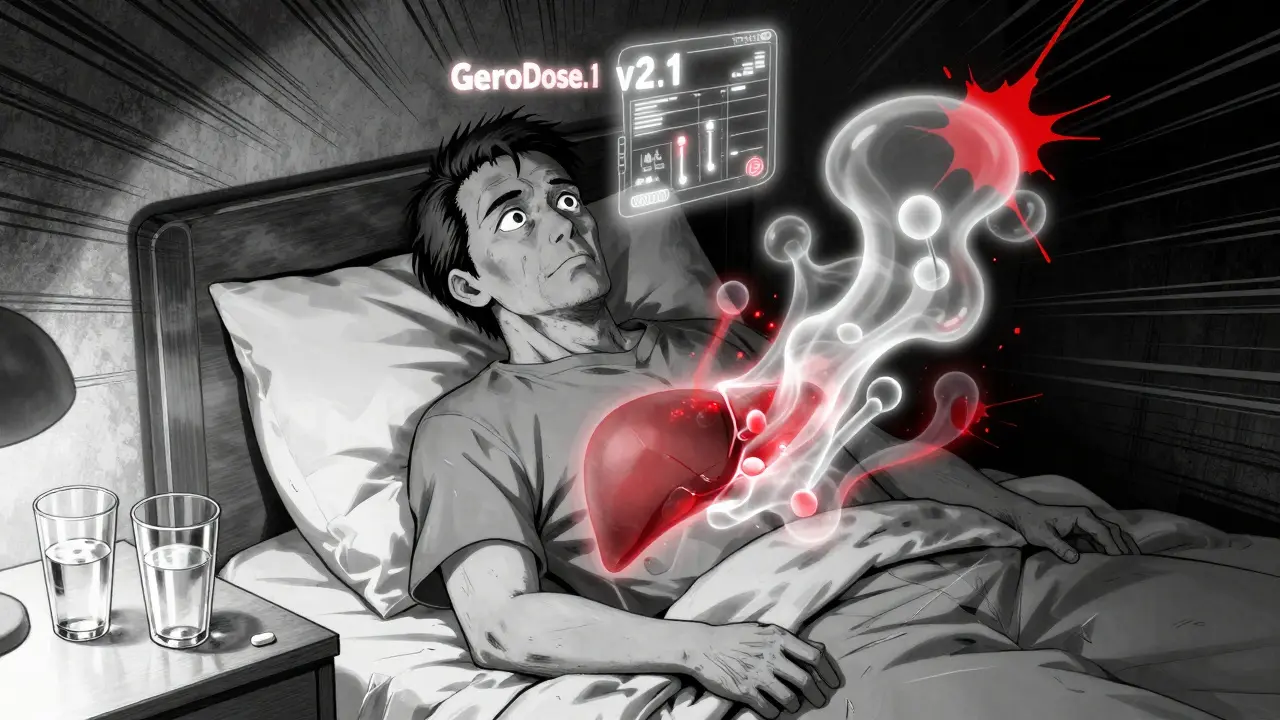
That’s why tools like GeroDose v2.1-the first FDA-approved software for modeling drug levels in older adults-are so important. It takes your age, weight, liver enzymes, kidney function, and current meds, then simulates how a drug will behave in your body. It’s not magic. But it’s better than guessing.
What You Can Do Right Now
- Ask your doctor: "Is this dose right for my liver and kidneys?"
- Request an estimated GFR calculation-not just a creatinine test.
- Make a full list of everything you take: prescriptions, vitamins, herbs, OTC pain meds.
- Don’t assume "natural" means safe. Many herbal supplements affect liver enzymes.
- If you feel unusually tired, dizzy, or confused after starting a new drug, speak up. It might not be "just aging."
There’s no magic number for how much to reduce a dose. It depends on the drug, your health, and your body. But the principle is simple: older adults need less-not more-of many medications. And the best way to avoid hospitalization? Start with the lowest possible dose and watch closely.
What’s Next for Senior Medication Safety
Researchers are now looking beyond age. They’re studying epigenetics-how lifestyle, diet, and stress change how your genes control liver enzymes. A 2023 study found 17 specific DNA methylation sites linked to CYP3A4 activity that shift with age. That means two 75-year-olds might metabolize the same drug completely differently. The future isn’t about age-based dosing. It’s about personalized dosing based on real-time biomarkers.
The National Institute on Aging has committed $150 million over the next few years to research precision geriatric pharmacology. By 2030, the American Geriatrics Society predicts that using these tools could cut adverse drug events in older adults by 35-50%. That’s thousands of lives saved. But it starts today-with better questions, better tests, and better communication between patients and providers.
You don’t have to accept side effects as part of getting older. Your body changes. Your meds should change too.
Do all older adults need lower drug doses?
Not all, but many do. It depends on the drug and how your liver and kidneys are functioning. Some older adults have excellent organ function and can tolerate standard doses. Others, especially those over 75 or with chronic conditions, need reduced doses. The key is to assess function-not just age. Always ask your doctor to check your estimated GFR and consider liver metabolism when prescribing.
Can blood tests show if my liver or kidneys are processing drugs slower?
Standard liver enzyme tests (ALT, AST) often stay normal even when drug metabolism slows. Creatinine levels can also stay normal despite reduced kidney function because muscle mass declines with age. The best indicators are estimated GFR (using CKD-EPI) for kidneys and clinical signs of drug buildup-like dizziness, confusion, or falls. Specialized tests for liver enzyme activity exist but aren’t routine. The safest approach is to assume some decline and adjust doses accordingly.
Why do some medications work poorly in older adults?
Some drugs are prodrugs, meaning they need to be converted by the liver into their active form. Examples include perindopril and codeine. With age, this conversion slows down, so the drug doesn’t work as well-even if the dose is unchanged. This can lead to under-treatment. If you notice your blood pressure or pain isn’t controlled like it used to be, ask your doctor if your medication needs to be switched or adjusted.
Is it safe to take over-the-counter painkillers like ibuprofen or acetaminophen as I get older?
Acetaminophen is risky. It’s the leading cause of acute liver failure in older adults, even at recommended doses. Ibuprofen can reduce kidney blood flow and worsen existing kidney disease. Both can interact with blood pressure or heart meds. For chronic pain, talk to your doctor about safer alternatives like physical therapy, topical creams, or low-dose gabapentin. Never assume OTC means safe-especially after 65.
What should I do if I’m taking five or more medications?
Polypharmacy (five or more meds) increases your risk of adverse reactions by 88%. Ask your doctor or pharmacist for a full med review. Use the STOPP/START criteria-tools designed to find inappropriate prescriptions and missed treatments in older adults. Bring all your pills to the appointment, including vitamins and supplements. You might find that one or two can be stopped safely, reducing your risk dramatically.
If you’re caring for an older adult, don’t wait for a crisis. Ask the questions. Push for testing. Advocate for dose adjustments. Your loved one’s safety doesn’t depend on how many pills they take-it depends on whether those pills still fit their body.
Adarsh Dubey
December 24, 2025 AT 08:13This is one of the clearest explanations I’ve read on geriatric pharmacology. The distinction between flow-limited and capacity-limited drugs? Spot on. I’ve seen too many elderly patients on standard doses of propranolol crash into hypotension because no one checked liver flow. It’s not negligence-it’s outdated training.
Bartholomew Henry Allen
December 24, 2025 AT 08:42claire davies
December 24, 2025 AT 15:22Oh honey, I’ve been telling my sister-in-law for years that just because her bloodwork looks ‘fine’ doesn’t mean her kidneys are doing the tango. I mean, imagine your kidneys are a coffee filter-over time, the holes get bigger but the paper still looks white. You pour in the espresso and suddenly your mug is full of grounds. That’s what happens with creatinine and GFR. And acetaminophen? Sweetheart, it’s not ‘just a painkiller’-it’s a slow cooker for your liver. I keep a little card in my purse that says ‘ASK ABOUT DOSE’ and I hand it to doctors. Works like magic. 🌸
Chris Buchanan
December 26, 2025 AT 05:53So let me get this straight-we’re giving 80-year-olds the same dose of vancomycin as a 30-year-old marathon runner who’s been on steroids since college? And we’re surprised they go deaf? I mean, come on. This isn’t medicine. It’s Russian roulette with a prescription pad. The fact that we still use Cockcroft-Gault in 2024 is a national embarrassment. Someone get me a podium.
Raja P
December 26, 2025 AT 20:59Joseph Manuel
December 27, 2025 AT 03:35Andy Grace
December 28, 2025 AT 15:45My dad’s on digoxin. We switched to CKD-EPI last year after his creatinine stayed normal but he kept getting nauseous. Turned out his GFR was 38. Dose halved. He’s back to gardening. I wish we’d known sooner. It’s scary how invisible this stuff is.
Abby Polhill
December 29, 2025 AT 00:47Let’s talk about CYP450 polymorphisms. The real issue isn’t just age-it’s epigenetic drift in phase I enzymes. Two 75-year-olds can have 300% difference in CYP3A4 activity due to methylation patterns. That’s why GeroDose is a game-changer. We’re moving from population-based dosing to single-patient pharmacokinetic modeling. The future is here, and it’s not based on ‘over 65’ checkboxes.
Lindsey Kidd
December 29, 2025 AT 15:08My grandma took Tylenol every day for her ‘aches’ and ended up in the ER with liver failure 😭 They didn’t even know she was taking it because she said ‘it’s just a pill’ 🙃 Please, if you’re older, talk to your doc about ALL your meds-even the ‘harmless’ ones. I’m so grateful she’s okay now 💙
Austin LeBlanc
December 30, 2025 AT 17:03Why are we still treating seniors like fragile porcelain dolls? If your liver can’t handle a standard dose, maybe you shouldn’t be on the drug at all. Stop lowering doses and start prescribing less. I’ve seen people on 12 meds who don’t need half of them. It’s not aging-it’s lazy medicine.
niharika hardikar
December 31, 2025 AT 13:20Rachel Cericola
January 1, 2026 AT 17:54I’m a clinical pharmacist and I’ve watched this play out for 22 years. The biggest mistake? Waiting for side effects. That’s like waiting for your car to catch fire before you check the oil. We need proactive pharmacokinetic reviews at every med change-especially after 65. I do a full med reconciliation with every senior I see. I ask: ‘What’s the goal here?’ If the answer is ‘just to feel okay,’ then we cut, we swap, we simplify. And guess what? They live better. Not longer-better. That’s the win.
Blow Job
January 1, 2026 AT 19:07My uncle was on metformin for 10 years. His creatinine was normal. Then he got sick and his GFR dropped to 29. They didn’t adjust the dose. He ended up with lactic acidosis. He’s fine now, but I still get angry thinking about it. The system doesn’t protect us-it just waits for the crash. Don’t wait. Ask for CKD-EPI. Every. Single. Time.
Christine Détraz
January 3, 2026 AT 09:31My mom’s 84. She takes one pill now that she didn’t before-just a tiny dose of a blood pressure med. Everything else got cut. She says she feels like she’s 60 again. No dizziness. No confusion. Just quiet mornings with coffee. It’s not about taking less. It’s about taking what fits.