
Don’t Guess When Medications Expire - Check the Label
You’ve got a drawer full of old pills. Some are in original bottles. Others are in random containers from last year’s flu season. You know they’re old. But are they dangerous? Can you still use them? And if you’re clearing them out, how do you make sure you’re not throwing away something still safe - or worse, keeping something that could hurt someone?
The answer isn’t in your gut feeling. It’s not in the year printed on the bottle. It’s not even in the lot number. The only thing that matters is the EXP date - the expiration date - printed clearly on the packaging. Everything else is just noise.
What Lot Numbers Actually Do (And Don’t Do)
Lot numbers aren’t magic codes. They’re tracking tags. Each one ties a batch of pills, capsules, or liquids to a specific production run - when, where, and how they were made. Manufacturers use them to pull products off shelves if something goes wrong: contamination, wrong dosage, faulty packaging.
But here’s the truth: you cannot calculate an expiration date from a lot number. Not reliably. Not legally. Not safely.
Some lot numbers look like dates: 230515A might mean May 15, 2023. But that’s the manufacturing date, not the expiry. Pfizer uses that format. Merck uses MK22B047 - where ‘22’ is the year, but ‘B047’ is just an internal batch code. Other companies use random letters and numbers with no pattern at all.
Even if you could decode it, shelf life varies. A liquid antibiotic might expire in 14 days after opening. A tablet could last 3 years. You don’t know unless the manufacturer says so - and they put that on the package as EXP 06/2025 or EXP 12/24.
The FDA requires this. It’s not a suggestion. Every prescription and over-the-counter drug sold in the U.S. must have a clear, printed expiration date in month/year format. If it’s not there, the product shouldn’t be on the shelf.
How to Spot a Fake or Misread Expiration Date
Not all labels are easy to read. Some are faded. Others are printed on shiny foil that reflects light. Some international meds use day/month/year format - which can confuse people used to month/year.
Here’s how to avoid mistakes:
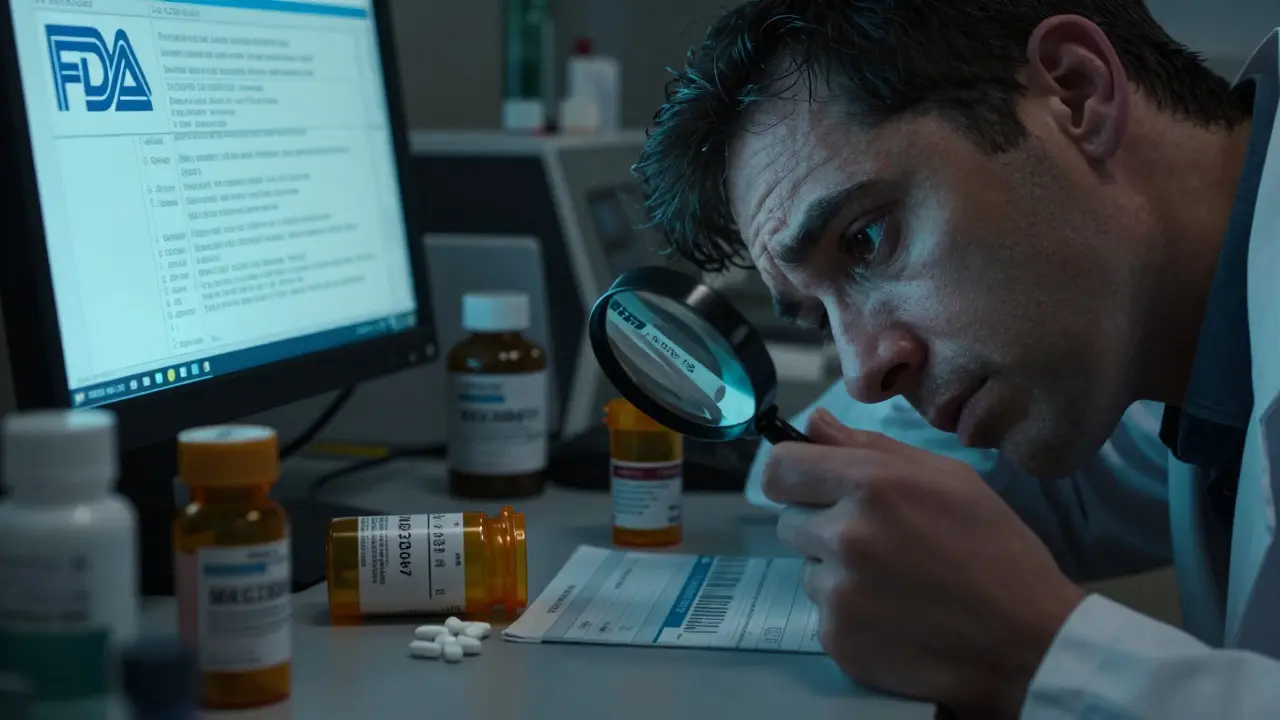
- Look for the word EXP, Expiry, or Expires. It’s usually right next to the date.
- Check the font size. Legally, it must be large enough to read without a magnifier. If it’s tiny, the label might be counterfeit.
- Use good lighting. At least 500 lux - a bright desk lamp works. Poor lighting causes 31% of misreads, according to University of Florida studies.
- If you’re unsure, don’t guess. Call the pharmacy that sold it. They can look up the lot number in their system and confirm the expiry.
One common trap: European meds sometimes say MFG: 01/2023 + 36 months. That’s not the expiry date. That’s a manufacturing date plus shelf life. The actual expiry is 01/2026. Many U.S. pharmacies have thrown out perfectly good meds because staff misread this.
Check Recalls Before You Throw Anything Away
Just because a drug is expired doesn’t mean it’s unsafe to use. But if it’s part of a recall? That’s a different story.
Recalls happen for real reasons: contaminated batches, wrong strength, pills stuck together, or even foreign objects found in packaging. The FDA tracks every one.
Before you dispose of expired meds, especially if they’re in bulk or you’re clearing a pharmacy shelf:
- Find the lot number on the bottle or box.
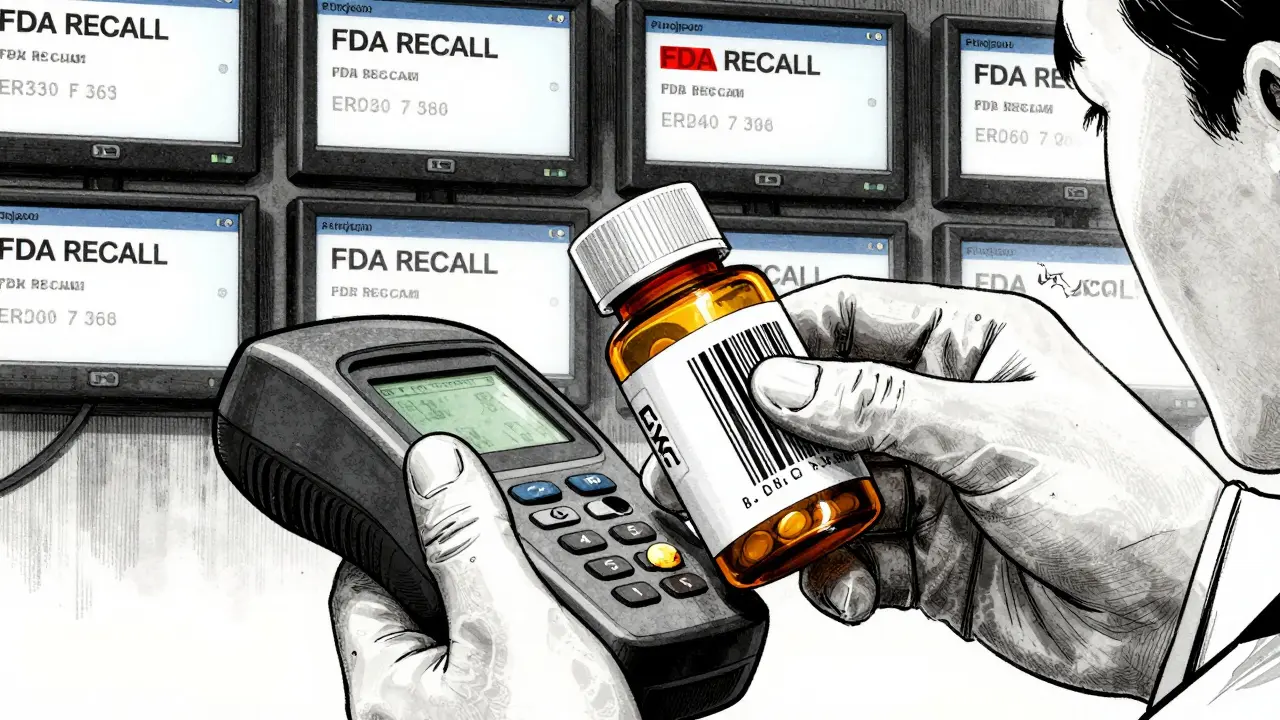
- Go to the FDA’s official database: Recalls, Market Withdrawals & Safety Alerts.
- Search by lot number. If it shows up, don’t throw it out - follow the recall instructions. Sometimes you get a refund. Sometimes you need to return it.
- If it’s not listed, proceed with disposal.
Don’t skip this step. In 2021, 217 recall incidents were delayed because lot numbers weren’t cross-checked. That meant expired or dangerous meds stayed on shelves longer - and patients got sick.
Use Technology - But Don’t Rely on It Alone
Many pharmacies now use barcode scanners that read both the lot number and the EXP date at the same time. Systems like Medplore’s AI scanner can read faded labels with 99.2% accuracy. That’s a game-changer.
But here’s the catch: these tools still need human oversight. If the scanner picks up a lot number but misses the EXP date because the label is torn, you’re still at risk.
Best practice: Use tech to speed things up, but always do a visual check. Scan it. Then look at it. Then confirm it.
At UC San Diego Medical Center, switching to barcode scanning cut inventory clearance time from 3 hours to 22 minutes. But they still require staff to verify every item by sight. No shortcuts.
The 7-Step Clearing Process (For Pharmacies and Clinics)
If you’re responsible for clearing expired meds - whether you run a clinic, pharmacy, or long-term care facility - here’s what you must do:
- Isolate all medications within 60 days of their EXP date. Don’t wait until the day they expire.
- Scan every lot number into your inventory system at least 30 days before expiry.
- Check the FDA’s recall database using each lot number.
- Call the manufacturer if you’re unsure. Keep a list of their contact info - update it every quarter.
- Take timestamped photos of the meds before disposal. Include the lot number and EXP date in the frame.
- If it’s a controlled substance (like opioids or benzodiazepines), fill out FDA Form 3639. Keep copies for at least 2 years.
- Dispose properly. Don’t flush. Don’t throw in the trash without mixing with coffee grounds or cat litter. Use a DEA-authorized take-back program if you can.
Training staff takes about 4.2 hours. But after three practice rounds, accuracy jumps to 90%. That’s worth the time.
What Happens If You Get It Wrong?
Getting expiration dates wrong has real consequences.
Take vaccines. A CVS technician in 2024 said they waste 15-20% more doses because staff can’t decode lot numbers fast enough. That’s money gone - and people left unprotected.
On the flip side, keeping expired meds can be deadly. The FDA estimates 1.3 million emergency room visits each year are tied to expired or misused medications. Some antibiotics lose potency. Insulin can degrade. Heart meds might not work when needed most.
Independent pharmacies are especially at risk. Only 42% have automated lot tracking. That means 1 in 8 expired meds cleared improperly come from small clinics and local pharmacies - places with fewer checks and less training.
What’s Changing in 2025 and Beyond
The FDA is pushing for full electronic tracking of every drug batch by November 2025. That means every pill bottle will be traceable from factory to patient.
Companies like Pfizer are testing blockchain systems to make this foolproof. GS1 standards are becoming the norm - meaning lot numbers will be more consistent across manufacturers.
But here’s the key: expiration dates will still be printed separately. Even with better tech, the law won’t change. The EXP date on the package is the law. Not the lot number. Not the system. Not the scanner.
By 2027, experts predict lot-number-related errors will drop by 90%. But until then, you need to rely on what’s right in front of you: the printed date.
Final Rule: Always Trust the Label
Dr. Emily Chen from the FDA says it plainly: "Pharmacies must never calculate expiration dates from lot numbers - the printed EXP date is legally binding and supersedes any derived calculation."
So when you’re holding a bottle of pills, ask yourself: Do I see the EXP date? Is it clear? Is it after today? If yes, you’re safe. If no - don’t use it. Don’t guess. Don’t hope.
Clearing expired meds isn’t about being fast. It’s about being sure. One wrong call can hurt someone. Two wrong calls can cost a life.
Can I still use expired medication if it looks fine?
No. Even if the pills look normal, the chemical breakdown over time can reduce effectiveness or create harmful byproducts. Antibiotics, insulin, epinephrine, and heart medications are especially risky after expiry. The FDA doesn’t guarantee safety or potency past the EXP date - and neither should you.
How do I know if my medication is part of a recall?
Find the lot number on the bottle or box. Go to the FDA’s official Recalls, Market Withdrawals & Safety Alerts page and search by lot number. If it shows up, follow the instructions - don’t just throw it out. Some recalls offer free replacements or refunds.
Is it safe to flush expired pills down the toilet?
Only if the label says so. Most medications should not be flushed. Instead, mix them with coffee grounds or cat litter, seal them in a container, and throw them in the trash. For controlled substances, use a DEA-authorized take-back program. Flushing can contaminate water supplies.
Why do some lot numbers look like dates and others don’t?
There’s no universal standard. Each manufacturer uses their own system. Pfizer might use YYMMDD + batch code. Merck might use letters and numbers with no date at all. Don’t assume a lot number tells you the expiry. Always read the EXP date - it’s the only reliable source.
Can I trust expiration dates on international medications?
Yes - but read carefully. Some countries use day/month/year format. If you see "15/06/2025", that’s June 15, 2025 - not May 6. If it says "MFG: 01/2023 + 36 months", the expiry is 01/2026. Always confirm the format before assuming.
What if the EXP date is missing from the packaging?
Don’t use it. The FDA requires expiration dates on all prescription and OTC drugs sold in the U.S. If it’s missing, the product may be counterfeit, stolen, or improperly stored. Return it to the pharmacy or contact the FDA’s MedWatch program.
How often should pharmacies check for recalls?
At least once a week - and always before clearing any expired inventory. Recalls can happen at any time. Some last only hours. Automated alerts help, but manual checks are still required by law. Don’t wait for a notification - be proactive.
Do I need special training to clear expired meds?
Yes. The American Society of Health-System Pharmacists recommends at least 4 hours of training on lot number decoding, recall procedures, and proper disposal. Staff should practice with real bottles and scanned data. Accuracy improves after three rounds of hands-on practice.
pradnya paramita
February 3, 2026 AT 15:02The FDA's requirement for explicit EXP dates is non-negotiable-lot numbers are purely traceability artifacts, not temporal indicators. Misinterpreting YYMMDD as expiry is a systemic error in community pharmacies, especially with imported generics. Always validate against the printed expiration, not the batch code. Even if the lot looks like a date, it's a manufacturing marker, not a shelf-life predictor. The pharmacokinetic degradation curves are compound-specific, and manufacturers don't encode those into lot numbering schemes. Trust the label. Period.
Jamillah Rodriguez
February 3, 2026 AT 16:37Susheel Sharma
February 4, 2026 AT 06:18Let’s be candid: the FDA’s enforcement of expiration labeling is a regulatory farce. You’ve got multinational conglomerates gaming the system with opaque lot numbering while small pharmacies get audited for a smudged ‘EXP’ stamp. The real issue? Profit-driven obsolescence disguised as safety. And don’t get me started on the ‘coffee grounds’ disposal ritual-pathetic performative compliance. If the pill looks fine, tastes fine, and hasn’t turned to chalk, it’s probably fine. The real danger is the over-regulation killing access.
Janice Williams
February 5, 2026 AT 21:08It is imperative to underscore that the reliance upon printed expiration dates is not merely a best practice-it is a statutory obligation under 21 CFR 211.137. Any deviation, including the speculative interpretation of lot numbers, constitutes a violation of the Federal Food, Drug, and Cosmetic Act. Furthermore, the notion that ‘if it looks fine’ implies safety is not only scientifically indefensible-it is ethically reprehensible. The degradation of active pharmaceutical ingredients is often imperceptible to the human senses. To suggest otherwise is to endanger public health with dangerous pseudoscience.
Roshan Gudhe
February 6, 2026 AT 17:28There’s something deeper here than just dates and lot numbers. We treat medicine like a product to be managed, not a lifeline to be respected. That drawer full of old pills? It’s not clutter-it’s anxiety. People hoard meds because they’re scared of cost, access, or being told ‘no.’ We focus on scanning and disposing, but we never ask why the bottle was never used in the first place. Maybe the real problem isn’t expired pills-it’s a system that leaves people feeling like they can’t get new ones when they need them.
Rachel Kipps
February 7, 2026 AT 15:28I just wanted to say thank you for this post. I work in a small clinic and we’ve had two near-misses with expired insulin because staff misread the lot number as the expiry. Now we’ve got a printed checklist by the disposal bin. It’s simple, but it works. Also, the 500 lux tip? Game changer. We bought a $15 LED lamp and now we’re way less error-prone. 🙏
Joy Johnston
February 9, 2026 AT 14:42Yes!! This is exactly what we’ve been teaching at our pharmacy chain. We used to have people arguing with us about ‘but the lot says 2025!’ and now we just say: ‘The EXP date is the law. The lot number is just the receipt.’ We even put up a poster with examples: Pfizer = manu date, Merck = nonsense, Teva = who knows? EXP = only answer. Staff training dropped from 6 hours to 2.5 after this. And no one’s missed a recall since.
Amit Jain
February 9, 2026 AT 16:07Simple rule: If you can’t read the EXP date clearly, don’t use it. No guessing. No decoding. No ‘it looks okay.’ I’ve seen too many grandmas take old antibiotics because they ‘remember when it was bought.’ Bad idea. Expired meds don’t just weaken-they can turn toxic. Stick to the label. It’s there for a reason.
Geri Rogers
February 9, 2026 AT 19:46Okay but why are we still using paper labels in 2025? 🤦♀️ I scanned my blood pressure med with my phone and it told me the lot was recalled last Tuesday. The EXP date was right there too. Why isn’t every bottle QR-coded? Why do we still need to squint at faded ink? This whole system is a relic. I get the law-but the tech exists. We’re doing it wrong.
Caleb Sutton
February 11, 2026 AT 06:31They’re lying. The FDA knows most meds are fine past expiry. They want you to buy new ones. Look at the 2012 DoD study-90% of stockpiled meds were still potent after 15 years. They just don’t want you to know. Lot numbers? Controlled. EXP dates? Manufactured. You’re being played.
Katherine Urbahn
February 13, 2026 AT 00:52It is, unequivocally, a regulatory imperative-and, indeed, a moral obligation-that expiration dates be treated as absolute, immutable, and legally binding; any attempt to derive, infer, or extrapolate expiration from lot numbers is not merely an error-it is a gross, negligent, and potentially lethal misinterpretation of federal law, and constitutes a breach of professional duty in all clinical and pharmaceutical settings.