

Sodium Intake Calculator for Moon Face Reduction
Your Sodium Intake Calculator
Helps you manage fluid retention from corticosteroids by tracking your daily sodium intake
Why This Matters
Corticosteroids increase sodium retention
This causes fluid buildup that contributes to moon face and swelling
Recommended target: 1,500 mg or less per day
Studies show reducing sodium intake to under 1,500 mg daily can help reduce fluid retention and visible swelling within 10-14 days. The NHS and Cleveland Clinic recommend this limit for patients taking corticosteroids.
When you're taking corticosteroids like prednisone to control inflammation from conditions like rheumatoid arthritis, Crohn’s disease, or lupus, the last thing you expect is to look in the mirror and not recognize yourself. That round, puffy face-often called moon face-is one of the most visible and emotionally painful side effects of long-term steroid use. It’s not just about appearance. It’s about feeling like your body has betrayed you, even as the medication is saving your health.
Why Does Moon Face Happen?
Moon face isn’t caused by eating too much sugar or skipping the gym. It’s a direct result of how corticosteroids interact with your body’s fat and fluid systems. These drugs mimic cortisol, your natural stress hormone, and when you take them for weeks or months, your body starts behaving as if it’s under constant stress.Glucocorticoids like prednisone trigger fat to move from your limbs and abdomen toward your face, neck, and upper back. At the same time, they cause your kidneys to hold onto sodium and water. That double hit-fat redistribution plus fluid retention-creates that swollen, rounded look. It’s not puffiness you can sweat out. It’s hormonal.
Studies show that about 25-30% of people on long-term corticosteroid therapy develop this side effect. The risk goes up with higher doses: if you’re taking more than 7.5 mg of prednisone daily for three months or longer, your chances jump significantly. Women and younger adults are more likely to notice it, possibly because of how fat is naturally distributed in those groups.
It’s Not Just Your Face
Moon face rarely comes alone. It’s often part of a larger pattern called Cushingoid appearance. You might also notice:- Buffalo hump-a fatty lump between your shoulders
- Weight gain around your midsection, even if your arms and legs stay thin
- Thinning skin that bruises easily
- Acne or slow-healing cuts
- Increased thirst and frequent urination
These aren’t just cosmetic issues. They’re signs your body is struggling with metabolic changes. Long-term steroid use raises your risk of developing steroid-induced diabetes. Blood sugar levels can climb without you realizing it-until you start feeling tired, thirsty, or losing weight unexpectedly. That’s why regular glucose checks every 3-6 months are critical if you’re on steroids long-term.
Can You Prevent Moon Face?
There’s no magic trick to stop it before it starts. You can’t prevent moon face by eating clean or exercising harder-though those things help manage the effects. The truth is, if your body needs corticosteroids to control a serious condition, the side effects are often unavoidable.That doesn’t mean you’re powerless. What you can control is how your body responds once the changes begin. The goal isn’t to eliminate moon face overnight-it won’t happen-but to reduce its severity and speed up recovery after treatment ends.
Diet: Your Most Powerful Tool
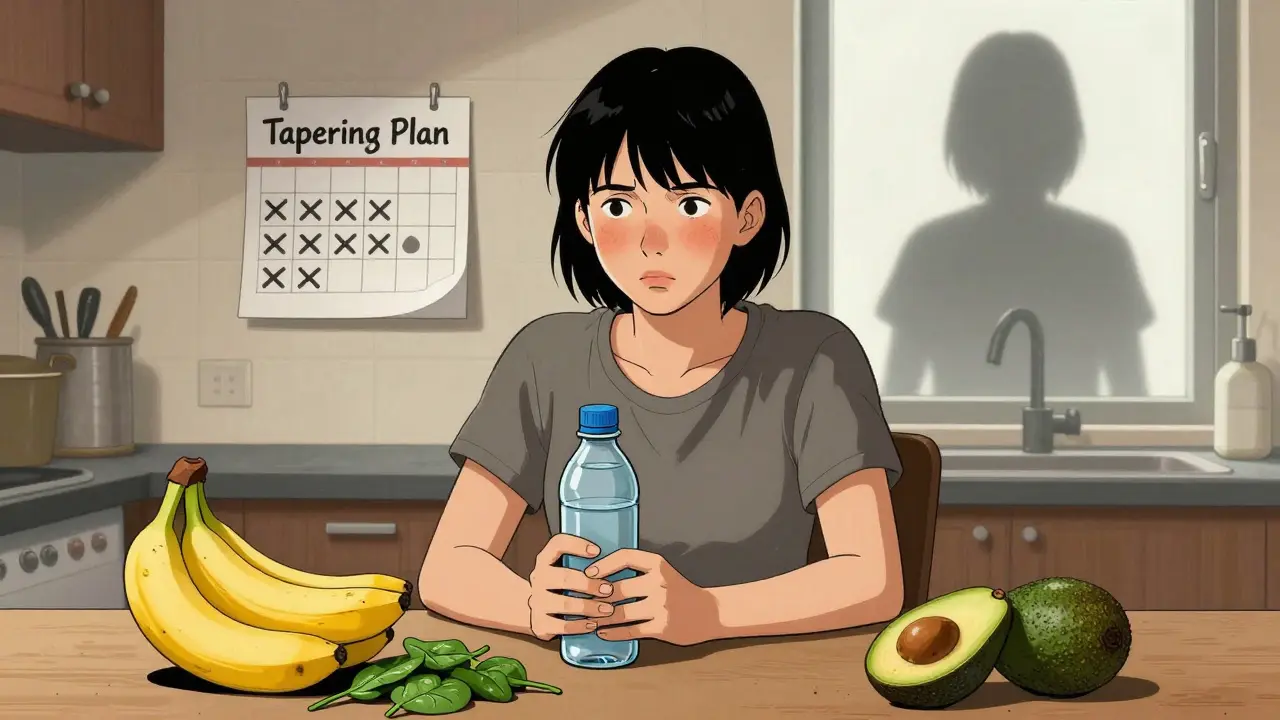
Diet isn’t optional here. It’s medical management.Sodium is the enemy. Corticosteroids make your body hold onto salt. More salt means more water retention. That’s what makes your face look swollen. The NHS and Cleveland Clinic both recommend limiting sodium to under 1,500 mg per day. That’s less than one teaspoon of salt. Read labels. Avoid processed foods, canned soups, deli meats, and restaurant meals-they’re all loaded with hidden sodium.
Drink more water. It sounds backwards, but drinking 2-3 liters of water a day helps your kidneys flush out excess sodium. When you’re dehydrated, your body clings to every drop of fluid. When you’re well-hydrated, it lets go. Many patients report visible reduction in facial puffiness within 10-14 days of increasing water intake and cutting salt.
Focus on potassium. Potassium helps balance sodium. Bananas, spinach, sweet potatoes, avocados, and beans are great sources. You don’t need supplements-just eat more whole foods. One study found that patients who increased potassium intake saw a 20% greater reduction in fluid retention than those who didn’t.
Watch your calories. Steroids increase appetite and slow metabolism. You don’t need to go on a diet, but portion control matters. Swap sugary snacks for protein and fiber-rich foods to stay full longer and avoid blood sugar spikes.
Exercise: Move Smart, Not Hard
You might feel too tired to work out. That’s normal. Steroids cause muscle weakness. But gentle movement helps.High-intensity workouts can make fluid retention worse. Stick to low-impact activities: walking, swimming, yoga, or light resistance training with bands or bodyweight. These help maintain muscle mass, improve circulation, and reduce fat buildup. Even 20 minutes a day makes a difference.
Don’t expect to “sweat out” the puffiness. That’s not how it works. But staying active helps your body recover faster once you stop the steroids.
Medication Adjustments: Talk to Your Doctor
The only way to truly reverse moon face is to reduce or stop the steroid. But you can’t do this on your own.Stopping prednisone suddenly can cause adrenal insufficiency-a life-threatening drop in cortisol levels. Symptoms include severe fatigue, dizziness, nausea, and low blood pressure. Always taper under medical supervision.
Your doctor might:
- Lower your dose to the minimum needed to control your condition
- Switch you to an alternate-day dosing schedule
- Try a different type of anti-inflammatory drug
Some newer drugs called SEGRMs (selective glucocorticoid receptor modulators) are in clinical trials and show promise for reducing side effects like moon face. But they’re not available yet. For now, working with your doctor to find the lowest effective dose is your best bet.
The Emotional Toll
This is the part no one talks about enough.People with moon face report avoiding mirrors, skipping social events, and feeling ashamed. One patient on a Crohn’s disease forum said, “I avoided my own family for months because I didn’t recognize myself.” Another said, “I felt like I was lying when I told people I was fine.”
Studies show that up to 23% of patients stop taking life-saving steroids just because of how they look. That’s not weakness-it’s human.
Psychological support isn’t optional. If you’re feeling depressed, anxious, or isolated because of your appearance, talk to your doctor. Ask for a referral to a counselor who understands chronic illness. Support groups like the Cushing’s Support & Research Foundation offer peer connections that can make you feel less alone.

How Long Does It Take to Go Away?
The good news? Moon face usually reverses after you stop the steroids.For most people, facial swelling starts to improve within 6-12 months. The timeline depends on:
- How long you were on steroids
- Your dose
- Your metabolism
- Your age and sex
Some people see changes in as little as 3 months. Others take over a year. Patience is key. Your body is healing-it just needs time.
When to Worry
Moon face from steroids is usually harmless. But if you develop any of these symptoms, call your doctor right away:- Severe headaches
- Blurred vision
- Slow-healing wounds
- Extreme fatigue or dizziness
- Unexplained weight gain in just a few weeks
These could signal Cushing’s syndrome caused by a tumor-not just steroid side effects. That requires different treatment, often surgery.
What You Can Do Today
You don’t need to wait for your next appointment to start feeling better. Here’s your simple action plan:- Check your salt intake. Swap one processed meal for a whole-food meal today.
- Drink at least 2 liters of water daily. Carry a bottle with you.
- Walk for 20 minutes. Even if it’s just around the house.
- Write down how you’re feeling emotionally. You’re not alone.
- Ask your doctor: “Is there a way to reduce my dose without risking a flare?”
Moon face doesn’t define you. It’s a side effect-not your identity. With the right approach, it will fade. And while you wait, your body is still healing. You’re doing the hard work. That matters more than how you look in the mirror today.
Can moon face go away on its own?
Yes, moon face usually reverses after stopping corticosteroids, but it takes time-typically 6 to 12 months. The speed of recovery depends on how long you were on the medication, your dose, and your metabolism. Dietary changes like reducing salt and drinking more water can speed up the process, but it won’t disappear overnight.
Does drinking water really help with steroid-induced swelling?
Yes. Corticosteroids cause your body to hold onto sodium and water. Drinking more water helps your kidneys flush out excess sodium, reducing fluid retention. Many patients notice less facial puffiness within 10-14 days of increasing water intake to 2-3 liters per day while cutting salt.
Is moon face dangerous?
Moon face itself isn’t dangerous-it’s a cosmetic side effect. But it’s a sign your body is under hormonal stress. It often comes with other risks like high blood sugar, high blood pressure, muscle weakness, and bone loss. If you have moon face, you should be monitored for steroid-induced diabetes and osteoporosis.
Can I reduce my steroid dose to avoid moon face?
You can, but only under medical supervision. Stopping or lowering steroids too quickly can cause adrenal insufficiency, which is life-threatening. Your doctor can help you taper slowly to the lowest effective dose, which often reduces side effects without triggering a disease flare.
Will losing weight help with moon face?
Losing weight won’t directly fix moon face because it’s caused by fat redistribution and fluid retention-not overall body fat. However, eating a healthy, low-sodium diet and staying active can reduce swelling and improve your overall health while you’re on steroids.
Are there creams or treatments that can remove moon face?
No proven topical treatments exist yet. Some experimental creams and injections are being studied, but they’re not available for public use. The only reliable way to reduce moon face is through medication adjustment, diet, hydration, and time after stopping steroids.
Why does moon face affect women more than men?
Women tend to store fat differently than men, with a higher tendency to accumulate fat in the face and upper body under hormonal changes. Corticosteroids amplify this pattern. Younger adults, especially women, are more likely to notice facial changes because their bodies are more sensitive to hormonal shifts.
Can moon face come back after it’s gone?
If you restart corticosteroids at a high dose or for a long duration, yes-it can return. That’s why doctors aim for the lowest effective dose and shortest treatment time. Once you’ve recovered, maintaining a healthy lifestyle reduces the risk of it coming back if you need steroids again in the future.
Liam Tanner
January 2, 2026 AT 14:12Been on prednisone for 4 years now. Moon face is real. So is the shame. I stopped looking in mirrors for months. Then I started taking walks every morning just to get out of the house. Didn’t fix the puffiness, but it fixed my head a little.
It’s not vanity. It’s grief. You’re mourning the person you used to be. And that’s okay.
Wren Hamley
January 4, 2026 AT 05:02Let’s be clear: moon face isn’t ‘side effect’-it’s a systemic glucocorticoid-induced adipokine dysregulation with concurrent mineralocorticoid-mediated sodium retention. The facial fat redistribution is mediated by PPARγ upregulation in subcutaneous adipose depots, while fluid retention stems from ENaC channel activation in renal collecting ducts. Bottom line? It’s biology, not laziness. And yes, potassium helps-NKCC2 inhibition reduces net sodium reabsorption. Drink water. Cut salt. Your kidneys will thank you.
erica yabut
January 5, 2026 AT 06:56Ugh. People act like this is some tragic hardship. You’re taking a powerful drug that saves your life, and now you’re upset about your face? Grow up. If you can’t handle the trade-offs of modern medicine, maybe don’t ask for it.
Also, ‘drink more water’? Really? That’s your solution? I’ve seen people on steroids who eat kale and yoga every day and still look like they swallowed a balloon. It’s not about your diet. It’s about chemistry. Stop pretending you have control.
Tru Vista
January 7, 2026 AT 03:30water dont work. i tried. also salt? lol. i eat like a bird and still got moon face. doctor says its just how it is. no magic. just wait. and dont be mad at yourself. its not your fault. also why is everyone so obsessed with their face???
Vincent Sunio
January 8, 2026 AT 04:57While I appreciate the attempt at patient education, the casual tone and oversimplification of a complex endocrine phenomenon are deeply irresponsible. To suggest that hydration and potassium intake constitute ‘medical management’ is not merely misleading-it is dangerously reductive. Corticosteroid-induced Cushingoid morphology is a pharmacodynamic cascade involving hypothalamic-pituitary-adrenal axis suppression, adipocyte hypertrophy, and altered aldosterone kinetics. To reduce this to ‘drink water and walk’ is to infantilize patients who are already grappling with profound physiological betrayal.
JUNE OHM
January 8, 2026 AT 22:33THEY KNOW. THEY KNOW THIS IS HAPPENING ON PURPOSE. 🤔💧
Big Pharma doesn’t want you to look like yourself. They want you to feel ashamed so you’ll take MORE drugs to ‘fix’ the side effects. They’re selling ‘moon face recovery kits’ next. I bet you. 😡
Also, why is the NHS telling you to drink water? That’s a British thing. They’re trying to replace your immune system with tea. 🇺🇸🔥
Philip Leth
January 10, 2026 AT 00:35Yo, I’m from Nigeria and we have a saying: ‘The body remembers what the mind tries to forget.’
My cousin took steroids for lupus. She looked like a balloon for a year. But she laughed every day. Said, ‘This face? It’s just my body’s way of saying I’m still here.’
She didn’t fix it. She accepted it. And that’s the real win.
Angela Goree
January 11, 2026 AT 17:27STOP TELLING PEOPLE TO ‘DRINK WATER.’
That’s what they told my sister when she had kidney failure. ‘Just drink more water!’
And now she’s on dialysis. And you’re telling people on steroids to drink 3 liters? Are you insane? This isn’t a wellness blog-it’s a life-threatening hormonal imbalance! You’re not helping. You’re endangering people.
And who even wrote this? A nutrition influencer?!
Shanahan Crowell
January 11, 2026 AT 18:39I see so many people saying ‘just wait’ or ‘it’ll go away’-and I get it. But I also see people who feel like they’re failing because their face hasn’t changed yet.
You’re not failing. You’re surviving.
Every step you take-even just walking around the block-is a win. Every time you drink water instead of soda? Win.
And every time you look in the mirror and say, ‘I’m still me’? That’s the biggest win of all. 💪❤️
Kerry Howarth
January 12, 2026 AT 23:10Low sodium + water + walking = best combo I’ve seen. Not a cure, but it helps. My sister cut processed food and her face looked less swollen in 3 weeks. Not gone, but better. And she slept better too.
Don’t overthink it. Just do one thing today.
Joy F
January 13, 2026 AT 23:01Let’s not romanticize this. Moon face isn’t ‘a journey.’ It’s a grotesque manifestation of pharmaceutical tyranny. You’re not ‘healing’-you’re being slowly reshaped by synthetic cortisol into a walking advertisement for Big Pharma’s indifference.
And the ‘support groups’? They’re just echo chambers for people who’ve internalized their own dehumanization.
They want you to accept it. But you shouldn’t. You should rage. You should demand better. You should burn the system down.
And if your face swells? Let it swell. Let it scream for you.
Haley Parizo
January 15, 2026 AT 09:56There’s a deeper truth here: we live in a world that equates worth with appearance. Moon face isn’t the problem. The problem is that we’ve been taught to believe that if you don’t look like a magazine, you’re broken.
But you’re not broken.
You’re a human being who’s enduring a medical intervention to stay alive. That’s not weakness. That’s courage wrapped in fluid retention.
And if your face looks different? Good. Now you know what real strength looks like.
Michael Burgess
January 16, 2026 AT 00:27Real talk: I had moon face for 14 months. Didn’t go away until I dropped from 20mg to 5mg.
But here’s the thing-I started cooking. No more takeout. I made huge pots of lentil soup with no salt, loaded with spinach and sweet potato. Drank 3L water. Walked 20 min every day.
It didn’t vanish overnight. But after 6 months? My jawline came back.
And honestly? I feel stronger now than before I got sick. Not because I lost weight. Because I learned how to care for myself without punishing myself.
Also, I cried a lot. That’s okay too. 🥲
Lori Jackson
January 17, 2026 AT 17:45How is this even a topic? People on steroids are lucky to be alive. You think you’re special because your face puffs up? I know people who lost limbs to this disease. You’re complaining about a round face? Get over yourself.
And ‘drink water’? That’s the best advice you got? Pathetic. This isn’t a TikTok hack. It’s a life-or-death medical condition. Stop trivializing it with ‘wellness tips.’
Ian Ring
January 19, 2026 AT 05:19Thank you for writing this. I’ve been on 10mg prednisone for 18 months. My face looks like a balloon, and my knees ache, and I’m tired all the time.
But I read this, and I didn’t feel alone.
Just wanted to say: you’re not just giving advice. You’re giving dignity.
Thank you.
- Ian, UK