
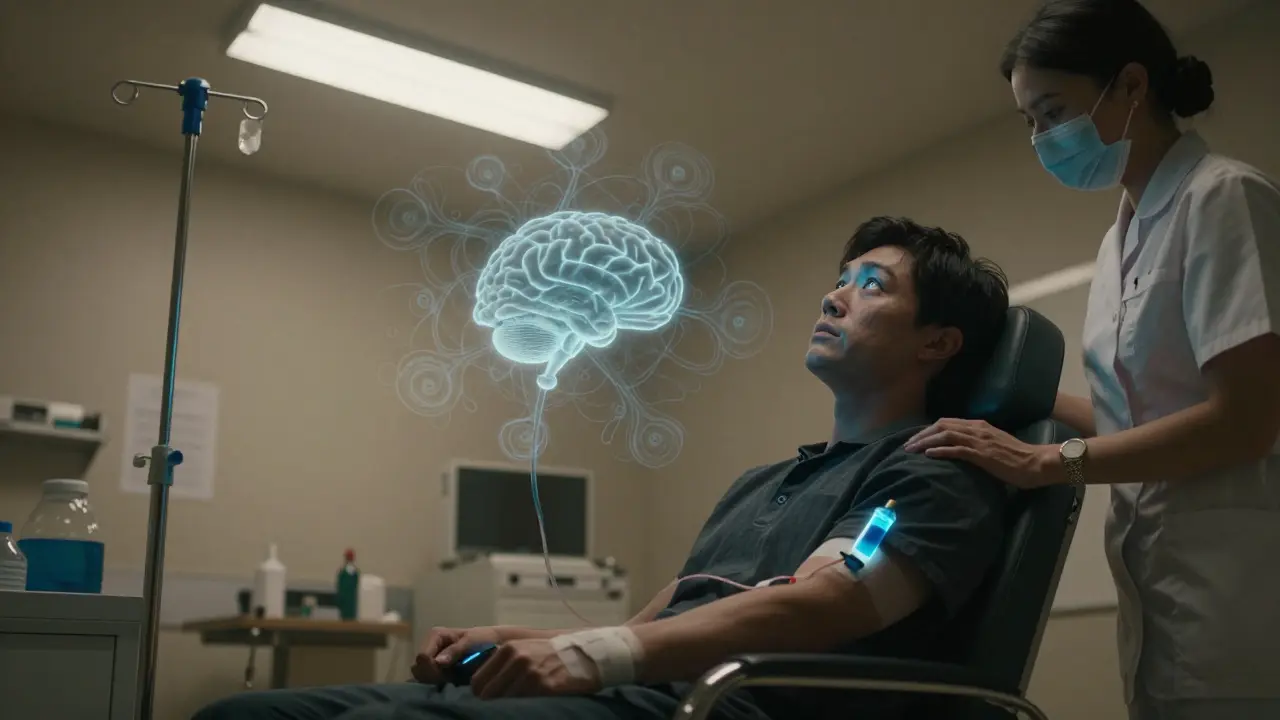
When standard antidepressants fail, people with severe depression often face months - sometimes years - of trial and error. For many, the wait is too long. That’s where ketamine and esketamine come in. These aren’t just new drugs. They’re fast-acting tools that can shift the trajectory of depression in hours, not weeks. And for those stuck in treatment-resistant depression (TRD), that speed can mean the difference between life and death.
What Makes Ketamine and Esketamine Different?
Ketamine and esketamine are chemically related, but not the same. Ketamine is a racemic mixture - meaning it contains both (R)- and (S)-enantiomers. It was first approved by the FDA in 1970 as an anesthetic. For decades, doctors used it off-label for depression, especially in emergency settings. Esketamine, on the other hand, is just the (S)-enantiomer. It’s the purified version, developed specifically for depression and approved as Spravato® in 2019.
The difference isn’t just chemical. It affects how the drugs work. Ketamine’s dual structure produces stronger dissociative effects - the feeling of being detached from your body or surroundings. Esketamine, being more targeted, tends to cause milder dissociation. This matters because side effects influence who can tolerate treatment and where it can be given.
How Are They Administered?
Ketamine is given intravenously (IV). A patient sits in a chair, a needle goes into their arm, and the drug flows slowly over 40 minutes. A trained nurse or anesthesiologist monitors them closely. The whole process takes about 90 minutes, including prep and recovery.
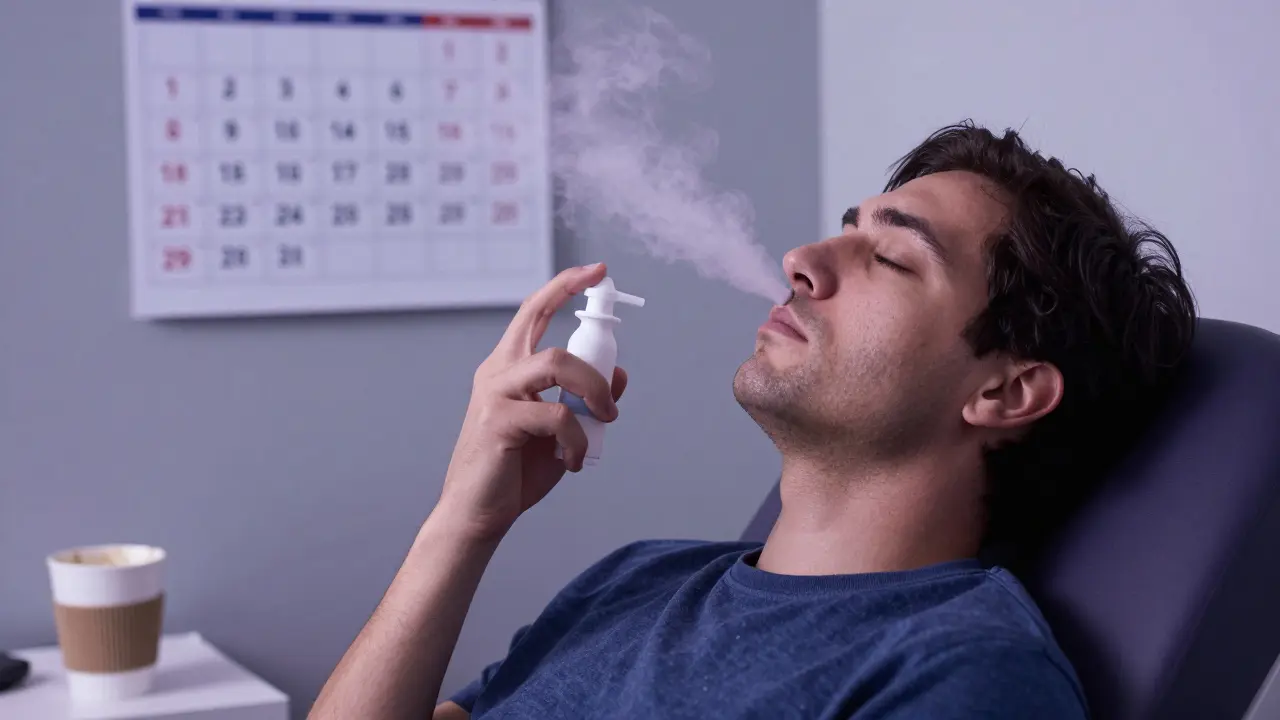
Esketamine is a nasal spray. Patients sit in a clinic, spray one or two doses into each nostril, and wait under supervision. The spray delivers a precise dose - 56 mg or 84 mg - twice a week during the initial phase. No IV line. No needle. Just a simple nasal puff.
But here’s the catch: both require mandatory 2-hour post-treatment monitoring. You can’t drive yourself home. Both can cause dizziness, nausea, or temporary confusion. The difference? IV ketamine’s dissociation is often more intense. One patient described it as “being in a dream while awake.” Esketamine? More like “a heavy haze you can still talk through.”
Efficacy: Which One Works Faster and Better?
A major 2025 study from Mass General Brigham tracked 153 adults with treatment-resistant depression. 111 got IV ketamine. 42 got intranasal esketamine. The results were clear.
- IV ketamine reduced depression scores by 49.22% after the full course.
- Esketamine reduced scores by 39.55%.
And timing? Ketamine worked faster. Many patients felt relief after just one session. Esketamine needed at least two doses before noticeable improvement. This matches earlier meta-analyses - ketamine consistently shows stronger effects across multiple time points, from 24 hours to eight weeks out.
Real-world feedback backs this up. On PatientsLikeMe, 63.2% of IV ketamine users reported major relief within 24 hours. For esketamine, it was 51.7%. But here’s the twist: 78.4% of esketamine users rated their overall experience as “good” or “excellent.” Why? Less scary side effects. No IV. No hospital setting. More control.
Safety and Side Effects
Both drugs carry risks. Dissociation, elevated blood pressure, nausea, and potential for misuse are real concerns. But the numbers tell a story.
- IV ketamine: 42.3% of patients experienced dissociation.
- Esketamine: 28.7% experienced dissociation.
That’s a 37.2% drop in severe dissociative symptoms with esketamine. The FDA’s clinical data confirms this safety advantage. Ketamine also has a higher potential for abuse because of its stronger psychoactive effects. That’s why clinics using IV ketamine often require psychological screening and ongoing therapy.
Both are classified as Schedule III controlled substances. That means they’re regulated but not banned. Still, clinics must follow strict protocols. IV ketamine requires providers trained in advanced airway management. Esketamine? Only basic life support certification is needed. That’s why esketamine can be offered in more psychiatric offices - not just anesthesiology clinics.
Cost and Insurance Coverage
Money matters. A full course of eight IV ketamine treatments costs $4,200 to $5,600. A comparable esketamine course? $5,800 to $6,900. On paper, ketamine is cheaper. But insurance coverage flips the script.
- 67.4% of commercial insurers cover Spravato®.
- Only 38.2% cover IV ketamine.
That means many patients pay out-of-pocket for ketamine. Esketamine, despite being more expensive per dose, is often covered - because it’s FDA-approved for depression. Ketamine remains off-label. Even though doctors have used it safely for 20+ years, insurers see it as experimental. That’s changing slowly, but not fast enough.
A 2025 JAMA Psychiatry cost-effectiveness study found IV ketamine delivers $14,327 per quality-adjusted life year (QALY). Esketamine? $18,764. In plain terms: ketamine gives you more health value for your dollar. But if you can’t get it covered, that advantage vanishes.
Who Gets Which Treatment?
There’s no one-size-fits-all. Experts have opinions.
Dr. John Krystal at Yale says: “For life-threatening depression, IV ketamine is the better tool. It’s faster. It’s stronger. When someone is actively suicidal, you need maximum impact immediately.”
Dr. Christine Denny at Columbia adds: “Esketamine’s convenience and milder side effects make it ideal for long-term maintenance. You can keep coming back week after week without the trauma of a full IV session.”
So who’s a good fit?
- IV ketamine: Severe, acute depression. Rapid response needed. Patients who can tolerate dissociation. Those with insurance that covers it or can afford cash pay.
- Esketamine: Chronic TRD. Outpatient-friendly. Patients who want less intense side effects. Those with insurance that covers Spravato®.
Long-Term Use and Maintenance
Neither drug is a cure. Both require ongoing sessions. The 2024 multicenter trial showed:
- 56.3% of IV ketamine responders stayed in remission at 6 months with maintenance doses every 1-3 weeks.
- 48.7% of esketamine users did the same.
That’s promising. But we still don’t know what happens after a year. Or five. Long-term data is thin. Some clinics offer monthly ketamine infusions for years. Others taper off after three months. There’s no standard.
And here’s something new: EEG brain scans are starting to show patterns. A November 2025 study in Nature Mental Health found that patients who responded to ketamine had a measurable increase in gamma brainwave power in the frontoparietal region. It’s not a diagnostic tool yet - but it could become one. Imagine a blood test for depression response? Not far off.
Access Is Still a Big Problem
Even if you’re a perfect candidate, you might not be able to get treatment. Only 12.4% of U.S. counties have certified Spravato® centers. Fewer still offer IV ketamine. In rural areas, patients travel hundreds of miles. Some wait months.
Meanwhile, ketamine clinics have exploded. From 142 in 2020 to over 1,000 in 2025. But many aren’t connected to hospitals. Some are run by non-psychiatrists. Quality varies. That’s why experts warn against “ketamine tourism.”
And then there’s the cost barrier. Even with insurance, copays can hit $300 per session. For some, that’s more than their rent.
What’s Coming Next?
The FDA recently accepted Janssen’s application for a higher-dose Spravato® (112 mg). That could mean fewer sessions. Also in the pipeline: intramuscular ketamine - a shot in the hip or shoulder. It’s between IV and nasal in terms of speed and intensity. Phase 3 trials are underway.
More clinics are training staff. More insurers are adjusting policies. And more patients are speaking up. The demand is there. The science is solid. The question isn’t whether these drugs work - it’s how we make them accessible.
Final Thoughts
Ketamine and esketamine aren’t magic. But they’re the most powerful tools we’ve had for depression in decades. For people who’ve tried everything else, they offer real hope. The choice between them isn’t about which is “better.” It’s about which fits your life - your symptoms, your body, your budget, your access.
One thing is clear: if you’re stuck in treatment-resistant depression, waiting for antidepressants to kick in is no longer your only option. You have a path. And it moves faster than you think.
Is ketamine FDA-approved for depression?
Ketamine itself is not FDA-approved for depression - it’s approved only as an anesthetic. But doctors prescribe it off-label for depression, and it’s widely used in clinics. Esketamine, sold as Spravato®, is the only FDA-approved ketamine-derived drug specifically for depression.
Can I take ketamine or esketamine at home?
No. Both require medical supervision. IV ketamine must be given in a clinic with monitoring equipment and trained staff. Esketamine is administered as a nasal spray under supervision, and you must stay for two hours after each dose. Home use is not permitted due to safety risks like dissociation and elevated blood pressure.
How long do the effects of ketamine or esketamine last?
The immediate antidepressant effects usually last a few days to a week after a single dose. For lasting results, patients typically undergo a series of treatments - often 6 to 12 sessions over 3-6 weeks - followed by maintenance doses every few weeks. Some people stay on monthly infusions or sprays for months or years.
Do ketamine and esketamine cause addiction?
There’s potential for misuse, especially with ketamine, because of its dissociative effects. But when used in clinical settings under supervision, the risk of addiction is low. Most patients don’t develop cravings. The controlled dosing, medical oversight, and combination with therapy reduce abuse potential significantly.
Can I use ketamine or esketamine if I’m on other antidepressants?
Yes. In fact, esketamine is FDA-approved only when used alongside an oral antidepressant. IV ketamine is often combined with antidepressants too. You should not stop your current medication unless your doctor advises it. These treatments work best as part of a broader plan, not as replacements.
Natali Shevchenko
March 20, 2026 AT 05:09It’s wild how much this whole field has shifted in just a decade. I remember when people were calling ketamine a party drug, and now we’re talking about it as a lifeline for people who’ve lost all hope. The fact that it works in hours instead of months? That’s not just science-that’s a revolution in how we think about mental health care.
And honestly, the difference between IV and nasal isn’t just medical-it’s emotional. One feels like a hospital procedure, the other like a quiet moment in a doctor’s office. For someone already drowning in stigma, that difference matters more than we admit.
I’ve talked to people who’ve tried both, and the ones who got IV ketamine often say it felt like a reset button. Like their brain finally stopped screaming. The ones on esketamine? They say it felt gentler, like someone turned down the volume instead of silencing it entirely. Both work. But one leaves you feeling like you survived a storm, and the other like you found shelter.
The cost issue is brutal though. Insurance covering Spravato but not ketamine isn’t about efficacy-it’s about bureaucracy. It’s like saying a lifeboat is only worth funding if it has a brand name. People are dying while paperwork gets shuffled.
And we can’t ignore the access gap. In rural areas, getting to a clinic might mean driving three hours each way, taking two days off work, and paying for gas. That’s not treatment. That’s a test of endurance. We need mobile units. Telehealth monitoring. Something. This shouldn’t be a privilege for people who live near a city with a fancy clinic.
Also, the brainwave data? Gamma waves in the frontoparietal region? That’s not just a biomarker. That’s proof that this isn’t placebo. The brain is literally rewiring itself. We’re not just treating symptoms-we’re healing the architecture of depression. That’s monumental.
I hope we stop arguing about which is better and start asking how we make both accessible. Because right now, the system is failing people who need it most.
Solomon Kindie
March 20, 2026 AT 14:08ketamine is not magic its just a dissociative that tricks the brain into thinking its not depressed for a few days then it comes back harder like a glitch in the matrix the real issue is we dont have real antidepressants anymore just temp fixes and big pharma loves it because you gotta keep coming back like a subscription service
esketamine is just ketamine with a marketing team and a nasal spray the iv version is way more potent but no one wants to admit it because the fda says no so they made a new drug with the same active ingredient and called it spravato and now its 2k per dose lol
also why is no one talking about the fact that ketamine clinics are run by dudes with no medical training who just took a weekend course and now theyre giving out ivs like its a smoothie bar
its not treatment its a vibe
Johny Prayogi
March 20, 2026 AT 14:28Yesss this is the kind of info we need more of! 🙌 I had a friend go through IV ketamine last year and it literally saved her life. She went from barely getting out of bed to holding a job again in 3 weeks. The dissociation was wild but she said it felt like her brain was rebooting. No more crying in the shower every morning.
And yeah esketamine is way more chill to do-no needles, no hospital vibes. I’d totally pick that if I had insurance coverage. But the fact that ketamine is cheaper and more effective but insurers won’t touch it? That’s messed up. We need to fix this. 💪
Also the brainwave study? Mind blown. We’re actually seeing the change happen. This isn’t voodoo. It’s neuroscience in real time. 🤯
Nicole James
March 22, 2026 AT 04:22Wait… so… are we sure this isn’t just a controlled experiment by the government to normalize dissociative states? I mean, ketamine has been used in military and CIA programs since the 60s… and now suddenly it’s a depression cure? Coincidence? I think not.
And why is esketamine the only one covered? Because it’s patented. Because it’s branded. Because it’s easier to track. Because they want to know who’s taking it. Who’s monitoring the clinics? Who’s logging the data? Who’s selling it to insurers? It’s not about healing-it’s about control.
Also, the FDA approved it in 2019… right after the opioid crisis peaked. Is this just a replacement drug? Are they replacing one addiction with another? And why are we not asking these questions? Why is everyone so eager to embrace this?
My gut says… this is bigger than depression. Much bigger.
Nishan Basnet
March 24, 2026 AT 03:31I’m from India, and here, ketamine clinics don’t even exist in most places. But I’ve read about people traveling to the US for treatment because they’ve run out of options. It breaks my heart.
What I find fascinating is how this isn’t just about biology-it’s about culture. In the West, we treat depression like a machine that needs a part replaced. In many other places, it’s seen as a spiritual or social wound. We don’t have the infrastructure here, but we also don’t have the stigma. People talk about it openly, with family, with priests, with neighbors.
Maybe the real breakthrough isn’t the drug-it’s the fact that we’re finally saying: ‘This isn’t your fault. You’re not weak. We can help.’
That’s why I’m hopeful. Even if access is unequal, the conversation has changed. And that’s where healing begins.
Allison Priole
March 24, 2026 AT 11:06I’ve been on antidepressants for 12 years. Tried 7 different ones. Nothing worked. Then I got esketamine last year. It didn’t feel like a miracle… it felt like a sigh. Like my brain finally stopped fighting itself.
Yeah, I got a little dizzy. Yeah, I sat there for two hours staring at the ceiling. But I didn’t cry. I didn’t feel numb. I just… felt like me again. Not the version of me that’s been holding on by a thread.
And honestly? The fact that I can do this without an IV? That matters. I hate needles. I hate hospitals. I hate feeling like a patient. This felt like… self-care with a doctor.
My mom still thinks I’m on drugs. I told her it’s like a spray for your brain. She didn’t get it. But I did. And that’s enough.
Paul Cuccurullo
March 26, 2026 AT 05:16While the science is compelling, we must not overlook the ethical implications of commercializing such a potent intervention. The fact that access is dictated by insurance policies and geographic privilege undermines the very principle of equitable healthcare.
It is profoundly troubling that a treatment capable of preventing suicide is subject to the same market forces that determine the cost of a new smartphone.
Furthermore, the narrative that esketamine is ‘safer’ because it is less dissociative may inadvertently pathologize the experience of dissociation itself-something that, for many, is a necessary psychological release from chronic emotional pain.
We must advocate not just for access, but for a reimagining of mental health care-one that values depth over convenience, and humanity over efficiency.
Casey Tenney
March 26, 2026 AT 19:26Stop treating depression like it’s a video game level you can unlock with a magic spray. These drugs are powerful, dangerous, and should be last-resort options-not first-line treatments. People are getting hooked on the high, not the healing. And now clinics are advertising this like it’s a spa day. Wake up.