
Medical Term Translator
Bridging the Language Gap
This tool converts clinical terms from medical records into everyday language. Understanding your care plan reduces confusion, medication errors, and improves health outcomes.
Translation Result
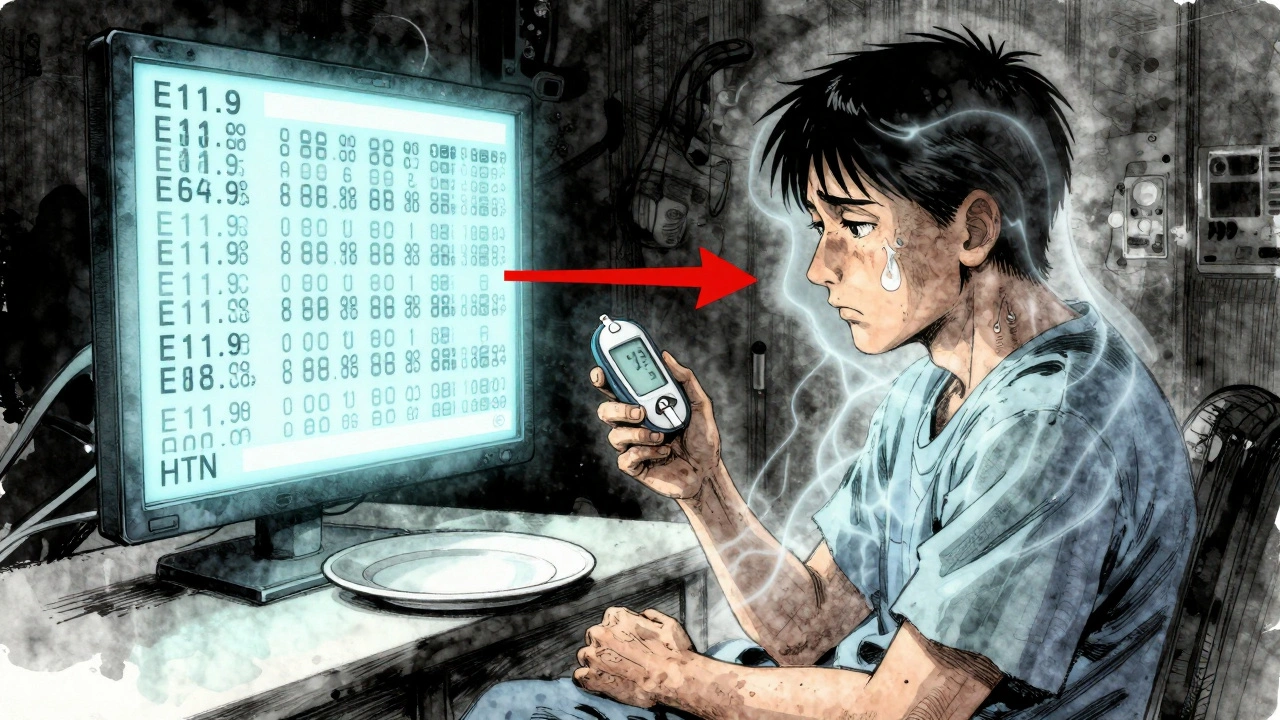
Ever read your medical record and felt like it was written in another language? You’re not alone. A doctor might write "Type 2 Diabetes Mellitus, E11.9" in your chart, but you know it as "my blood sugar won’t stay down." That gap isn’t just confusing-it’s dangerous. Between what patients say and what providers record, critical details get lost. And it’s not about poor communication. It’s about label differences-how two sides of the same health story use completely different words to describe the same reality.
Why Your Doctor’s Notes Don’t Sound Like You
Healthcare providers rely on standardized codes to keep things efficient and billable. ICD-10 has over 70,000 diagnosis codes. CPT codes track every procedure. These aren’t just numbers-they’re the language of insurance, research, and legal records. Systems like Epic and Cerner are built around them. But these codes don’t capture how you feel. They don’t tell the story of waking up exhausted, drinking water all day, or skipping meals because you’re afraid your sugar will spike. Patients don’t think in codes. They think in symptoms. "I’m always tired." "My feet hurt when I walk." "I don’t know why I’m so thirsty." These aren’t vague complaints-they’re vital clues. But when providers translate those into "fatigue" and "polydipsia," the human meaning gets stripped away. A 2019 study in the Journal of General Internal Medicine found that 68% of patients misunderstood common medical terms. Forty-two percent didn’t know "hypertension" meant high blood pressure. Sixty-one percent couldn’t identify "colitis."The Real Cost of Misunderstanding
This isn’t just about confusion. It’s about safety. Dr. Thomas Bodenheimer from UCSF estimates that 30-40% of medication errors come from language gaps. If you think "poorly controlled DM" means you’re a bad patient-not that your blood sugar is high-you’re more likely to feel ashamed than empowered. That’s what one patient on PatientsLikeMe wrote: "I thought it meant I was a bad person. I didn’t realize it was just a medical term." The American Medical Association’s 2022 survey showed 57% of patients felt confused by terms in their records. Over a third avoided follow-up care because of it. Meanwhile, doctors are spending 15 to 30 minutes per visit just explaining what they wrote. That’s time taken from diagnosis, treatment, or rest.Who’s Trying to Fix This?
Health Information Management (HIM) professionals are the bridge. They’re trained in both medical coding and patient communication. They make sure records are accurate, complete, and protected under HIPAA. But they can’t fix the problem alone. Some hospitals are making changes. Kaiser Permanente started Open Notes in 2010-letting patients read their doctors’ notes. By 2021, they saw a 27% drop in patient confusion and a 19% rise in medication adherence. Mayo Clinic built EHR templates that auto-translate "myocardial infarction" to "heart attack" in patient-facing documents. Their pilot cut confusion by 38%. The government is pushing too. The 21st Century Cures Act of 2016 forced providers to share clinical notes with patients by April 2021. No more hiding behind jargon. Now, 89% of U.S. hospitals give patients access to their records-up from just 15% in 2010.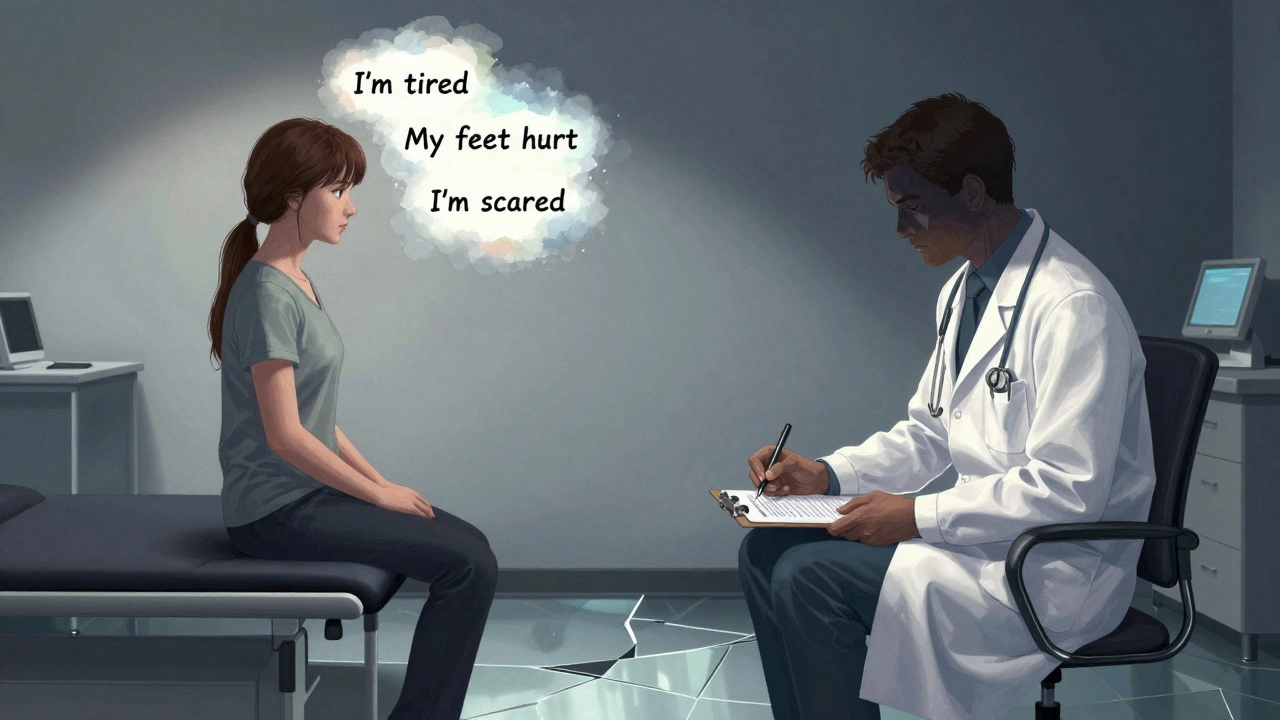
What’s Changing on the Tech Side
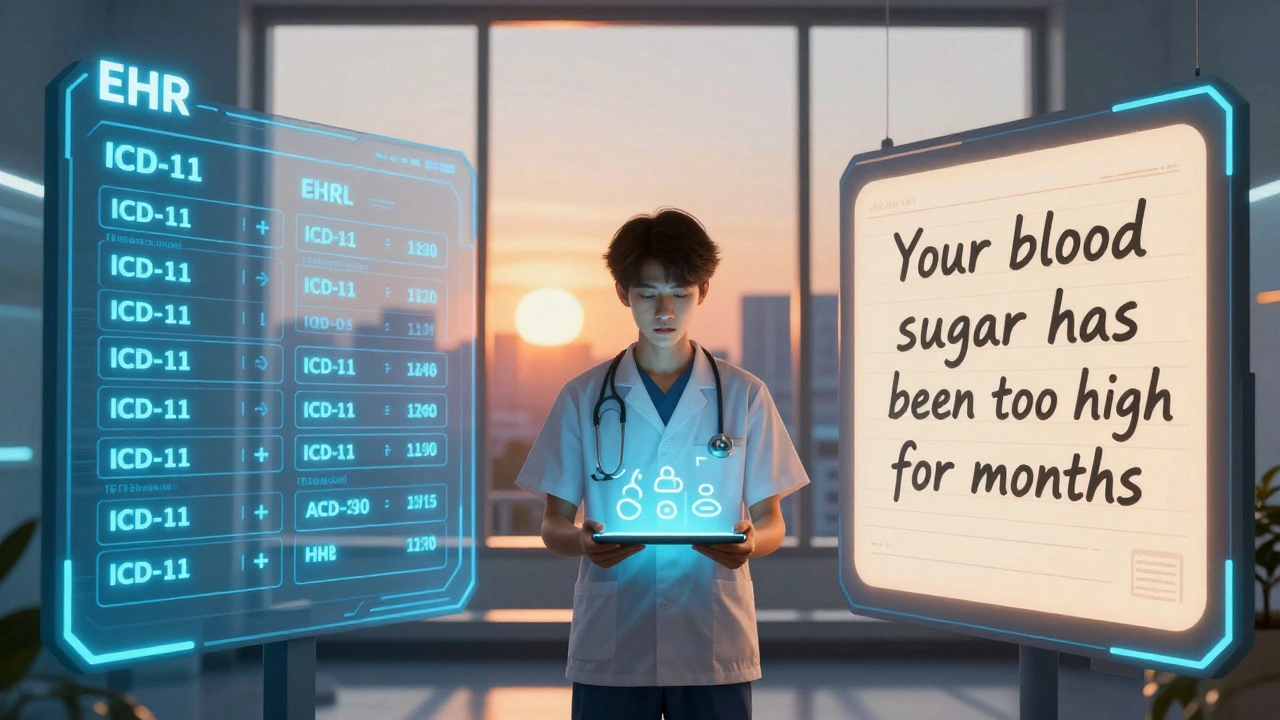
The world of health data is shifting. ICD-11, launched globally in 2022, now includes plain-language descriptions alongside clinical codes. For the first time, the official disease classification system speaks to patients too. Then there’s FHIR-the Fast Healthcare Interoperability Resources standard. Used by 78% of major U.S. health systems in 2023, it lets EHRs show two versions of the same note: one for providers, one for patients. Think of it like a dual-language display. The doctor sees "HbA1c 8.7%"; you see "your average blood sugar has been high for months." Even AI is stepping in. Google Health’s Med-PaLM 2, released in 2023, can convert clinical notes into plain language with 72.3% accuracy. It’s not perfect yet-95% is the bar for clinical use-but it’s getting closer.What You Can Do Right Now
You don’t have to wait for tech to fix this. Here’s how to take control:- Ask: "Can you say that in simpler terms?" No shame in it. Providers expect it.
- Use the teach-back method: After they explain something, say, "So if I understand right, you’re saying..." Then repeat it back. Studies show this cuts miscommunication by 45%.
- Read your notes. If something feels off, write it down and bring it to your next visit. You’re not being difficult-you’re being smart.
- Ask for a plain-language version of your summary. Many clinics now offer it. If they don’t, ask why.
What Providers Need to Do
Providers aren’t the enemy. They’re trapped in a system built for efficiency, not understanding. But change is possible:- Start using patient-friendly terms in notes-even if the official record uses codes. Add a "For You" section.
- Use templates that auto-translate jargon. Mayo Clinic’s system proves it works.
- Train staff in health literacy. The AHRQ’s Toolkit is free and easy to implement.
- Stop assuming patients know what "DM" or "HTN" means. Assume they don’t-and explain anyway.
The Bigger Picture
This isn’t just about words. It’s about power. For over a century, medical records were written for doctors, by doctors. Patients were observers. Now, they’re partners. And the law, the tech, and even public opinion are catching up. CMS now ties 2% of hospital payments to how well patients rate communication clarity. That’s not a bonus-it’s a requirement. Health systems that ignore patient language are losing money. And worse-they’re losing trust. The future? AI-assisted translation built into every EHR. Real-time plain-language summaries. Patient input directly shaping how diagnoses are labeled. By 2027, the American Medical Informatics Association predicts 60% of systems will do this automatically. But right now? You can start today. Ask for clarity. Read your notes. Speak up. The system is changing-but you don’t have to wait for it to catch up. You can help it move faster.Why do doctors use medical terms patients don’t understand?
Doctors use medical terms because they’re required for billing, legal records, and research. Systems like ICD-10 and CPT use standardized codes so hospitals can get paid and data can be compared across patients. But these terms aren’t designed for patients-they’re designed for efficiency. The problem isn’t intent-it’s system design. Many providers want to explain clearly, but they’re rushed, overworked, and trained to prioritize codes over conversation.
Can I ask my doctor to rewrite my medical record in plain language?
Yes. Under the 21st Century Cures Act, you have the right to see your full clinical notes. You can also ask your provider to add a plain-language summary. Many clinics now include a "For You" section in notes. If yours doesn’t, ask. You’re not asking for special treatment-you’re asking for basic clarity, and you’re within your rights.
What’s the difference between ICD-10 and patient-friendly labels?
ICD-10 uses precise, coded terms like "E11.9" for Type 2 Diabetes. These are for billing and data tracking. Patient-friendly labels say "high blood sugar" or "diabetes." They describe symptoms and impact, not codes. ICD-10 tells the system what happened. Patient labels tell you what it felt like. The new ICD-11 system now includes both, but most U.S. systems still use the older version.
How do I know if my provider is using plain language?
Look for simple, everyday words in your notes. Instead of "hyperlipidemia," you should see "high cholesterol." Instead of "dyspnea," you should see "shortness of breath." If you see terms like "DM," "HTN," or "COPD," they’re not using plain language. You can ask: "Can you write this in words I’d understand?" If they refuse or seem annoyed, it’s a red flag.
Does reading my medical record help me get better care?
Yes. Studies show patients who read their notes are more likely to take medications correctly, spot errors, and ask better questions. Kaiser Permanente found a 19% increase in medication adherence after Open Notes launched. When you understand your own record, you become an active partner-not just a patient. That leads to fewer mistakes, faster recovery, and more trust in your care team.
Haley P Law
December 10, 2025 AT 04:00This is why I read my notes like a detective. Last week I saw "HTN" and thought, "Wait, that’s not my blood pressure-it’s my anxiety." Turned out the doc meant hypertension, but I was already spiraling. 😅 Now I ask for plain language. No shame. My life, my health.
Andrea DeWinter
December 10, 2025 AT 23:01I work in a clinic and we started adding "For You" sections to every note. Patients cry. Not from sadness-from relief. One woman said, "I thought "E11.9" meant I was dying. I didn’t know it was just diabetes." We’re not fixing the system. We’re just translating humanity back into it.
ian septian
December 12, 2025 AT 17:03Ask. Say it back. Read your notes. That’s it. No tech needed. Just show up like you own your health. You do.
Arun Kumar Raut
December 13, 2025 AT 04:26My uncle in India got his records in English. He thought "polyuria" meant he was cursed. We laughed, then we called the doctor. Now he knows it just means peeing too much. Simple words save lives. No fancy tech needed.
Suzanne Johnston
December 14, 2025 AT 10:36Let’s not pretend this is just about language. It’s about power. For over a century, medicine has been a temple guarded by priests who speak in Latin. Patients were worshippers, not participants. Now the altar is cracking. The Cures Act didn’t just open notes-it opened a door to dignity. The real revolution isn’t AI or FHIR. It’s the moment a patient says, "I don’t understand," and the system doesn’t punish them for it. That’s the moment medicine stops being a ritual and becomes care.
Doctors aren’t villains. They’re cogs in a machine that values billing over being heard. But the machine is breaking. Because patients are no longer silent. And silence was never the price of healing.
When a woman reads "HbA1c 8.7%" and sees "your blood sugar has been dangerously high for months," she doesn’t just understand her condition-she understands her worth. That’s not translation. That’s liberation.
ICD-11 includes plain language now. But it’s not the codes that matter. It’s whether we’re willing to listen when someone says, "I don’t know what that means." The real diagnostic tool isn’t in the EHR. It’s in the pause after a patient speaks.
Some say tech will fix this. But tech doesn’t care if you feel ashamed. Only humans do. And if we want real change, we need to stop building better systems and start building better relationships.
Every time you ask for clarity, you’re not being difficult. You’re rewriting the contract between patient and provider. And that contract? It was never supposed to be written in Latin.
Graham Abbas
December 16, 2025 AT 07:07OMG I JUST REALIZED-my doctor’s note said "uncontrolled DM" and I thought I was a BAD PERSON. Like, I deserved to feel tired, dizzy, thirsty… like I failed at being human. I didn’t know it was a CODE. I thought it was a verdict. I cried for an hour. Then I printed my record and wrote "I’m not failing-I’m learning" on the front. Now I show it to every new provider. It’s my manifesto.
Why does medicine speak in hieroglyphics? Why can’t a note say "your sugar’s too high, let’s fix this together" instead of "E11.9"? I don’t need a PhD to survive my own body. I need compassion. And clarity. And maybe a little less Latin.
precious amzy
December 17, 2025 AT 02:28One must question the epistemological foundations of this discourse. The conflation of linguistic accessibility with therapeutic efficacy is a neoliberal fallacy. The clinical record is not a love letter to the patient-it is an epistemic artifact, forged in the crucible of scientific objectivity. To reduce ICD-10 to "plain language" is to surrender the rigor of medical taxonomy to the tyranny of emotional comfort. The patient who cannot parse "hypertension" is not the victim of systemic failure-they are the casualty of intellectual laziness. Perhaps they should read a dictionary before scheduling their next appointment.
Carina M
December 18, 2025 AT 14:07It is utterly irresponsible to suggest that medical terminology should be diluted for the sake of convenience. The precision of diagnostic codes is what separates medicine from quackery. To replace "myocardial infarction" with "heart attack" is to regress to the era of bloodletting and humors. If patients cannot comprehend the language of science, they should not be entrusted with their own health records. This is not exclusion-it is preservation of standards.
William Umstattd
December 19, 2025 AT 16:25Correction: The 21st Century Cures Act mandates access to clinical notes-not translation. There is a difference. You are conflating transparency with simplification. And let’s be clear: if a patient can’t understand "DM," they’re not owed a translation-they’re owed better education. The solution isn’t to dumb down medicine. It’s to demand that patients invest in their own health literacy. Blaming the system for their ignorance is not empowerment-it’s abdication.
Also, "FHIR" is not a dual-language display. It’s a data standard. The plain-language summaries are implemented by clinicians, not the protocol. Please stop misrepresenting technology.
And for the record: I’ve read my records for 12 years. I know what "E11.9" means. I don’t need a children’s version. I need accuracy. And if you can’t handle it, maybe you shouldn’t be managing your own chronic condition.