

Waiting for a kidney transplant isn’t just about hoping for a call. It’s a long, detailed process that starts long before you’re added to the waitlist. If you’re considering a transplant, understanding what comes next - the evaluation, the wait, and the possibility of a living donor - can make all the difference in your outcome.
What Happens During the Transplant Evaluation?
The transplant evaluation is your first real step toward getting a new kidney. It’s not a single appointment. It’s a full medical and personal review that can take weeks to complete. Most centers start this process when your kidney function drops below an eGFR of 20 mL/min/1.73m². That’s when your nephrologist refers you to a transplant center.
Once you’re referred, you’ll meet with a transplant coordinator who walks you through everything. You’ll fill out forms, sign consent papers, and attend education sessions to learn what life is like after a transplant - especially the lifelong need for anti-rejection meds. You can’t be listed until you fully understand this.
Then comes the testing. Blood tests check your blood type, liver and kidney function, and screen for infections like HIV, hepatitis B and C. You’ll also get an immune system check with HLA typing and PRA testing to see how likely your body is to reject a donor kidney. If you’ve had previous transplants or blood transfusions, your antibody levels might be higher, making it harder to find a match.
Heart health is non-negotiable. You’ll need an echocardiogram to check your heart’s pumping strength (ejection fraction must be at least 40%), an EKG, a chest X-ray, and often a stress test. You’ll need to prove you can handle physical activity - like walking on a treadmill for 5 metabolic equivalents. If your heart isn’t up to it, the transplant team can’t risk the surgery.
Women over 40 need a mammogram and Pap smear. Men over 50 need a PSA test. Cancer screenings are mandatory. If you’ve had cancer in the last five years, you might be delayed or disqualified, depending on the type and treatment.
And then there’s the psychosocial evaluation. This isn’t just a chat. A social worker will ask about your support system - who will drive you to appointments? Who will help you take your meds? Do you have stable housing? Are you financially able to afford the $3,500+ in co-pays for the first year? They’ll also assess your mental health. Anxiety and depression are common, but untreated, they can lead to missed doses or missed appointments - which can get you removed from the list.
At the end, a committee of doctors, nurses, social workers, and psychiatrists meets weekly to review your file. They decide if you’re a good candidate. The decision comes within 72 hours. If you’re approved, you’re placed on the waitlist.
How Long Is the Wait for a Kidney?
As of early 2024, over 102,000 people in the U.S. are waiting for a kidney. The average wait time? About 3.6 years. But that number hides big differences.
If you’re lucky enough to have a living donor, your wait drops to zero. Living donor transplants make up nearly 40% of all kidney transplants - the highest rate of any organ. That’s because kidneys can be donated by someone who’s still alive. A healthy person can live perfectly fine with one kidney.
For those relying on deceased donors, wait times vary by region, blood type, and how sensitized your immune system is. People with rare blood types or high antibody levels (cPRA over 98%) get priority under the new OPTN rules. But even with priority, it can take years.
Black patients still wait longer on average - 28.4% longer than white patients - though centers using standardized pathways have cut that gap to just 12.1%. If you’re facing delays, ask your coordinator if your center has a fast-track evaluation option.
And here’s something most people don’t know: you can be listed for both deceased and living donor kidneys at the same time. That’s called dual listing. It doesn’t hurt your chances - it doubles them.
Living Donors: How It Works
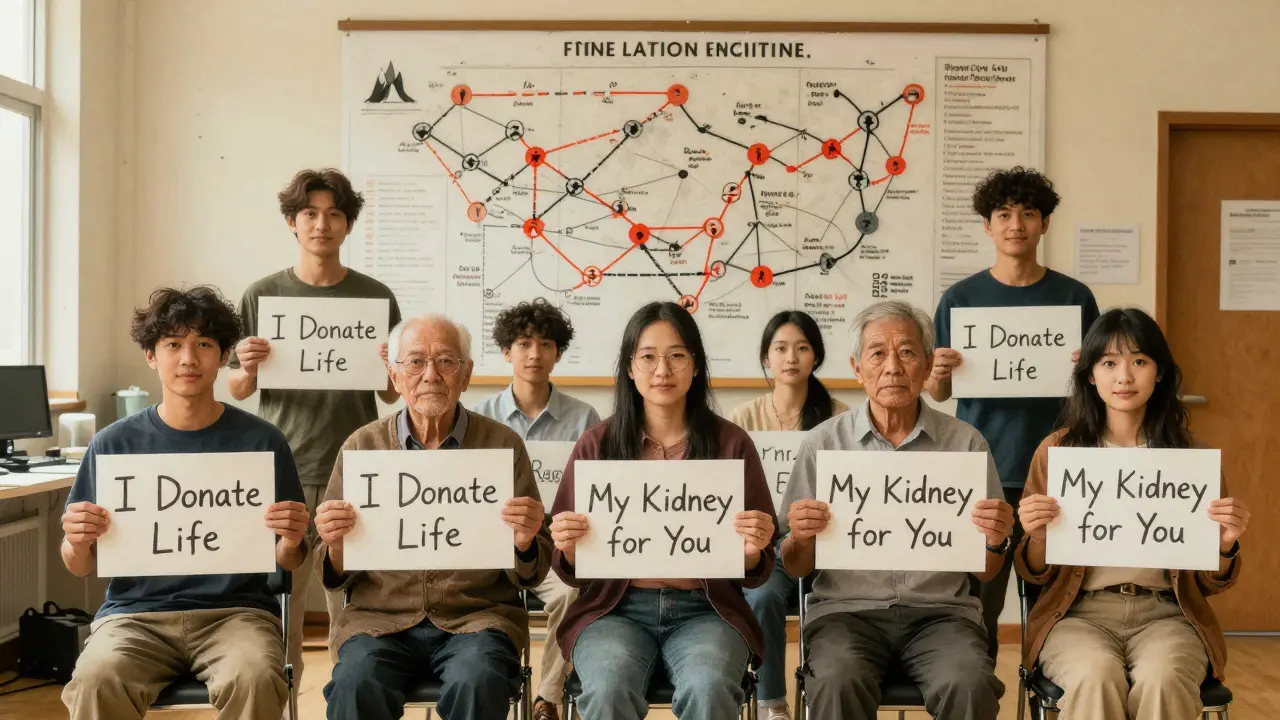
A living donor doesn’t have to be a family member. It can be a friend, coworker, or even a stranger who wants to give the gift of life. The donor evaluation is almost as thorough as the recipient’s - because their health matters just as much.
Donors must be at least 18, in good physical and mental health, and free of uncontrolled diabetes, high blood pressure, cancer, or kidney disease. They’ll go through the same blood tests, imaging, and psychological screening. The goal isn’t just to find a match - it’s to make sure the donor won’t regret it or suffer health problems later.
One big change in recent years is the rise of kidney paired donation. If your loved one wants to donate but isn’t a match for you, they can donate to someone else - and you get a kidney from someone else’s donor. In 2023, this program helped 1,872 people get transplants.
At top centers, donor evaluations now take just 2 to 3 weeks thanks to rapid crossmatch protocols. That’s a huge jump from the 6 to 8 weeks it used to take. The process is faster, safer, and more efficient.
Costs? The donor’s medical care is covered by your insurance. But they might lose wages during recovery, face travel costs, or deal with childcare. Some states and nonprofits offer financial help. Ask your transplant center about donor assistance programs.

Why Do Evaluations Fail?
Not everyone who starts the process gets listed. About 1 in 5 evaluations don’t lead to listing. The top reasons? Not what you’d think.
Active cancer is the #1 medical reason - 14.2% of candidates are turned away. Severe heart disease comes next (11.8%), followed by uncontrolled infections (9.3%) and severe obesity (BMI over 40, 8.7%). But here’s the surprise: non-adherence - missing dialysis, not taking meds, skipping appointments - is the 5th leading reason (7.9%).
And then there’s the psychosocial side. Studies show psychosocial issues cause 32% of evaluation failures - more than medical problems. If you don’t have someone to help you take your meds, or if you’re homeless, or if you’re struggling with addiction, the team may delay or deny listing. That’s not punishment. It’s protection. Transplant success depends on lifelong discipline.
Insurance problems are another major roadblock. One in four Medicaid patients face delays because insurers deny coverage for certain tests. The average deductible is $4,550 a year. If you can’t pay out-of-pocket for tests, your evaluation stalls. Don’t wait for your insurance to approve things - call them. Get everything in writing. If you’re denied, appeal.
How to Succeed in the Process
The most successful transplant candidates do three things: stay organized, stay in contact, and stay proactive.
Keep a folder - physical or digital - with all your medical records. Include dialysis logs, lab results, and doctor notes. Bring the same support person to every appointment. That way, someone’s there to remember what was said.
Use your patient portal. Check your test results. If something’s missing, email your coordinator. Don’t wait. Transplant coordinators manage 45 to 60 patients at once. If you don’t follow up, your file gets buried.
Complete your evaluation within 90 days of your first appointment. People who do this are 22.7% more likely to get a transplant within two years. High-volume centers finish evaluations 23% faster than low-volume ones. If your center is slow, ask if you can transfer.
And finally - be honest. If you’ve missed dialysis. If you’ve had a drinking problem. If you’re scared. Say it. The team isn’t judging you. They’re trying to help you succeed. Hiding things leads to failure. Talking openly leads to support.
What Comes After the Waitlist?
When a kidney becomes available, you’ll get a call - day or night. You’ll need to get to the hospital fast. If it’s a living donor, you’ll schedule the surgery together.
After surgery, you’ll stay in the hospital for 3 to 7 days. Then comes the real work: taking your meds every single day. Anti-rejection drugs cost about $32,000 a year. You’ll need insurance that covers them. Many patients use Medicare Part D or private plans. If you can’t afford them, ask about patient assistance programs. Skipping doses can kill your new kidney in months.
Follow-up visits are weekly at first, then monthly, then every few months. You’ll have blood tests to check your kidney function and drug levels. You’ll learn to spot signs of rejection - fever, swelling, pain, or reduced urine output.
And you’ll live differently. You’ll eat healthier. You’ll exercise. You’ll avoid crowds during flu season. You’ll never skip a doctor’s visit again. But you’ll also feel better than you have in years. Many patients say they feel like they’ve been given a second life.
Can I get a kidney transplant if I have diabetes?
Yes, but it depends. If your diabetes is well-controlled with diet, pills, or insulin, and you don’t have severe heart or nerve damage, you can be listed. But uncontrolled diabetes increases the risk of transplant failure. Most centers require HbA1c levels below 8% and no active foot ulcers or retinopathy. Some patients get a kidney-pancreas transplant together if they’re eligible.
Can I be on the waitlist if I’m on dialysis?
Yes - most patients are. In fact, being on dialysis is often the reason you’re referred for transplant evaluation. You don’t need to wait until you’re on dialysis to start the process. Many people begin evaluation while still having some kidney function. Starting early gives you more time to find a living donor and increases your chances of getting a transplant before dialysis takes a heavy toll on your body.
How do I find a living donor?
Start by talking to family and close friends. Many donors are discovered this way. If no one steps forward, you can share your story on social media, community boards, or through nonprofit groups like the National Kidney Foundation. Some centers offer donor matching events or media outreach programs. Be clear about what’s involved: surgery, recovery time, and lifelong health monitoring. Most donors say the reward outweighs the risk.
What if I’m turned down for a transplant?
Being turned down isn’t always permanent. If you’re denied for obesity, you might be asked to lose weight. If you’re denied for smoking or alcohol use, you may need to complete a rehab program. If it’s financial, you can apply for assistance. Ask the committee for a written explanation. Then work with your social worker to fix the issue. Many people get re-evaluated and listed after making changes.
Do I need to be a U.S. citizen to get a kidney transplant?
No. Citizenship is not required. Transplant centers can list legal residents, visa holders, and even undocumented immigrants - though access to insurance and post-transplant care can be barriers. Medicare doesn’t cover transplants for undocumented patients, but some states and nonprofit programs offer help. The key is having a plan for lifelong medication and follow-up care, regardless of immigration status.
What to Do Next
If you’re thinking about a transplant, don’t wait. Call your nephrologist today and ask for a referral. If you’re already in the evaluation process, keep moving forward. Track every test. Ask questions. Bring someone with you. Don’t let insurance delays or anxiety stop you.
Living donors save lives - and they’re more common than you think. If you know someone willing to help, encourage them to get evaluated. Even if they’re not a match, they might be part of a paired donation chain.
And remember: this isn’t just about getting a new kidney. It’s about building a plan for a healthier, longer life. The process is hard. But for thousands of people, it’s worth every step.
Uzoamaka Nwankpa
January 4, 2026 AT 18:24The evaluation process is brutal, but honestly? It’s the only thing standing between me and a normal life. I’ve been waiting two years and still haven’t cleared psych eval because I cried in front of the social worker. They said I was ‘too emotional.’ I just wanted to say I’m scared. That’s not a character flaw.
Chris Cantey
January 5, 2026 AT 10:18There’s a deeper philosophical layer here: the transplant system forces us to prove our worthiness to live. We’re not patients-we’re applicants. And the committee decides who deserves a second chance based on insurance forms, BMI charts, and whether we have someone to remind us to take pills. Who gave them that authority?
Abhishek Mondal
January 6, 2026 AT 14:00Let’s be precise: the OPTN’s ‘priority system’ is a performative gesture-unless you’re white, wealthy, and compliant, you’re statistically doomed. And don’t get me started on the ‘living donor’ myth-it’s just a neoliberal cop-out to shift burden from systemic healthcare failure to individual altruism.
Oluwapelumi Yakubu
January 6, 2026 AT 22:01Man, I’ve seen this play out in Lagos-people with end-stage kidney disease begging on the streets because dialysis costs more than rent. Here, at least you got a shot. But you right-this system ain’t fair. Still, if you got a cousin who willing, go hard. My uncle gave a kidney to his niece last year. She’s back teaching school now. That’s the real miracle, not the surgery.
Terri Gladden
January 7, 2026 AT 13:55Okay so I just found out my mom is on the waitlist and I’m like OMG I HAVE TO DO SOMETHING BUT I’M SCARED OF NEEDLES AND WHAT IF I’M NOT A MATCH AND WHAT IF SHE DIES AND WHAT IF I REGRET IT AND WHAT IF I GET A BLOOD TRANSFUSION AND THEN I GET HIV AND THEN I GET CANCELED BY MY FRIENDS???
Jennifer Glass
January 7, 2026 AT 23:33I appreciate how thorough this breakdown is. One thing I’d add: many centers now use AI tools to predict rejection risk based on HLA and PRA data. It’s not perfect, but it’s helping reduce wait times for high-sensitized patients. Also, if you’re on Medicaid, ask about transplant-specific case managers-they can cut through insurance red tape faster than you think.
Joseph Snow
January 8, 2026 AT 00:01Let’s examine the data objectively. The claim that 40% of transplants come from living donors is misleading. It ignores the fact that 78% of those donors are spouses or immediate family members-meaning the system still relies on coercive familial obligation. And the ‘paired donation’ program? A PR stunt to make the system look innovative while the waitlist grows by 8,000 annually.
melissa cucic
January 9, 2026 AT 01:00Thank you for this comprehensive overview. I’m a transplant nurse, and I’ve seen too many patients fall through the cracks because they didn’t know to ask for financial assistance or psych support. The system is broken-but the people in it? They’re trying. Please, if you’re reading this: don’t be afraid to ask for help. The coordinator isn’t your enemy.
Akshaya Gandra _ Student - EastCaryMS
January 10, 2026 AT 07:29i read this and i think wow i am so lucky to be healthy but also why is it so hard to get a kidney?? i mean like i know people who got free phone and free food but if you need a kidney you need to prove you deserve it??
en Max
January 11, 2026 AT 23:07Based on the clinical guidelines referenced, the 3.6-year median wait time remains statistically valid, though regional disparities persist due to organ procurement organization (OPO) efficiency metrics. Furthermore, the 1:5 evaluation failure rate aligns with 2023 UNOS audit data. I would recommend cross-referencing your center’s outcomes with the SRTR database for individualized projections.
Angie Rehe
January 12, 2026 AT 20:06They’re lying about the costs. My sister got approved, then insurance denied her pre-transplant MRI-$2,800 out of pocket. They said it was ‘not medically necessary.’ Then they told her she had to ‘prove compliance’ by attending 12 counseling sessions. Meanwhile, the hospital made $120K off her case. This isn’t healthcare. It’s a pyramid scheme.
Jacob Milano
January 14, 2026 AT 01:16I’ve been on the list for 4 years. I didn’t think I’d make it. But then my coworker-who I barely knew-got tested and turned out to be a match. We didn’t even talk about it for weeks. He just said, ‘I’m doing this.’ Surgery was last month. I’m eating pizza for the first time in 6 years. Don’t give up. Someone out there is waiting to be your hero.
John Wilmerding
January 15, 2026 AT 15:52As a transplant coordinator at a high-volume center, I can confirm: patients who complete evaluation within 90 days have a 2.3x higher transplant rate. The key is consistency-don’t wait for the next appointment. Email your coordinator every time a test result is pending. We’re not ignoring you-we’re juggling 50+ files. But if you speak up, you move to the top.