

The U.S. Food and Drug Administration (FDA) doesn’t treat every generic drug application the same. If you’re a manufacturer trying to get a generic version of a brand-name drug to market, the difference between a priority review and a standard review can mean millions in revenue-and months, sometimes years, in time to market. Understanding how the FDA decides which applications get priority is critical for anyone in pharma, from small startups to big generics players.
What’s the Difference Between Priority and Standard Review?
The FDA uses two timelines for reviewing Abbreviated New Drug Applications (ANDAs). Standard review gives you 10 months from the date your application is accepted. Priority review cuts that down to 8 months. That two-month window isn’t just bureaucratic noise-it’s a financial lifeline. For a first generic drug, getting to market even 60 days earlier can mean capturing the lion’s share of sales before competitors even file. These timelines come from the Generic Drug User Fee Amendments (GDUFA) III, which took effect in October 2022 and runs through 2027. They replaced older standards and now serve as the official clock that regulators follow. The FDA’s Office of Generic Drugs (OGD) runs the whole process, making sure every generic is safe, effective, and made to the same quality standards as the brand-name version.Who Gets Priority Review?
Not every generic gets priority. The FDA only gives it to applications that meet specific, narrow criteria. There are three main reasons an ANDA qualifies:- First generic: You’re the first to submit a complete ANDA after the brand-name drug’s patents and exclusivity expire. These get 180 days of market exclusivity, and priority review helps you get there faster.
- Drug shortage: If the brand-name drug-or any existing generic-is in short supply, the FDA fast-tracks any application that can help fill the gap. This is especially common for antibiotics, insulin, or critical heart medications.
- Medically important advance: Rare, but possible. If your generic offers a meaningful improvement-like better stability, easier dosing, or fewer side effects-it might qualify.
The New U.S. Manufacturing Pilot Program
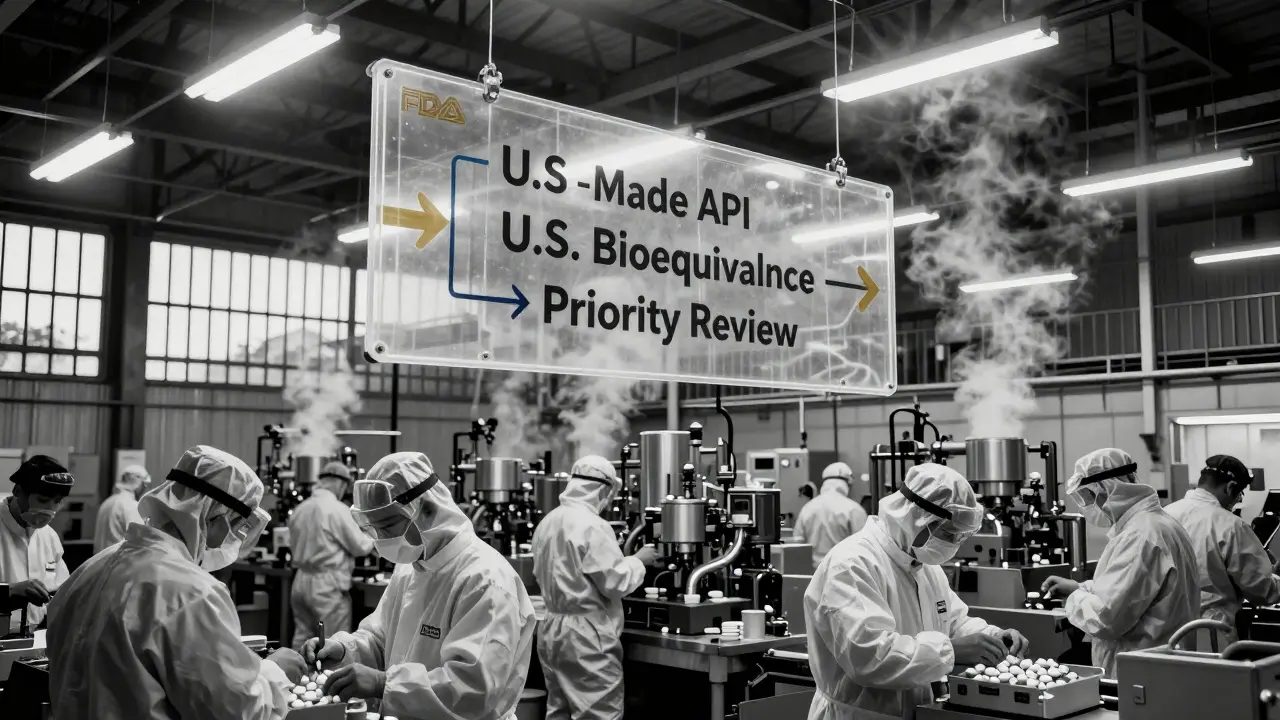
In October 2023, the FDA dropped a major new rule: the ANDA Prioritization Pilot Program. This isn’t just a tweak-it’s a strategic shift aimed at reshaping the entire U.S. drug supply chain. To qualify for priority review under this pilot, your ANDA must meet three hard requirements:- Final dosage form is manufactured in the U.S.
- Active pharmaceutical ingredient (API) is sourced entirely from U.S. suppliers.
- Bioequivalence testing was done in U.S. facilities.
Why Most Applications Get Rejected-And How to Avoid It
Getting priority doesn’t mean your application gets approved. In fact, 31.7% of ANDAs get a Complete Response Letter (CRL) in their first round. The biggest reason? Chemistry, Manufacturing, and Controls (CMC) issues. These account for nearly half of all review delays. CMC problems include:- Inconsistent particle size in the active ingredient
- Improper dissolution profiles
- Unstable packaging that affects shelf life
- Missing or flawed bioequivalence data
Complex Generics Are the New Frontier
Not all generics are created equal. Simple tablets? Easy. Inhalers, topical creams, or extended-release capsules? Much harder. These are called complex generics, and they make up 18.3% of pending ANDAs but only 9.7% of approvals. To help, the FDA launched the Complex Generic Drug Product Pilot Program in January 2023. It offers early scientific advice-think of it as a free consultation before you spend $164,880 on a filing fee. Companies that use it report fewer surprises during review and faster approvals.
What’s Next? AI and Faster Approvals
The FDA isn’t just changing rules-it’s changing tools. By Q3 2024, the agency plans to roll out AI-assisted review systems for straightforward ANDAs. In internal tests, these tools reduced review times by 18.7% for low-complexity applications. Industry analysts predict that by 2026, these combined efforts-priority review, domestic manufacturing incentives, AI tools, and pre-submission meetings-could cut average approval time by 4.3 months. That’s an estimated $18.7 billion in annual savings for the U.S. healthcare system.Real-World Impact: Who Benefits?
Patients win when generics reach the market faster. In 2022, generics made up 88.6% of all prescriptions in the U.S.-but only 15.3% of total drug spending. That’s how savings happen. Manufacturers win too. First generics often command premium prices before competitors enter. One analyst estimated that a two-month head start could add $200-500 million in revenue for a high-volume drug. The FDA wins by reducing drug shortages and improving supply chain resilience. The goal? Increase U.S.-manufactured generic drugs from 28% to 40% within five years.Bottom Line: It’s Not Just About Speed
Priority review isn’t a free pass. It’s a reward for preparation, compliance, and strategic alignment with national health goals. If you’re aiming for priority status, don’t just file an ANDA-build a plan. Focus on U.S. manufacturing. Invest in bioequivalence testing at home. Use pre-submission meetings. Fix your CMC issues before you submit. The system is designed to reward those who play by the rules-and who help fix the system’s biggest weaknesses. The clock is ticking. And the FDA isn’t waiting.What’s the main difference between priority and standard review for generic drugs?
Priority review gives generic drug applicants an 8-month timeline from submission to decision, while standard review allows 10 months. Priority review is reserved for first generics, drugs in shortage, or products with significant medical advantages. The faster timeline can mean millions in extra revenue for the first company to market.
Can any company get priority review for their generic drug?
No. Priority review is only given to ANDAs that meet strict criteria: being the first generic after patent expiry, addressing a drug shortage, or offering a medically important improvement. The FDA does not grant priority review based on company size, funding, or request alone.
What is the ANDA Prioritization Pilot Program?
Launched in October 2023, this FDA pilot gives priority review to ANDAs that manufacture their finished dosage form in the U.S., use U.S.-sourced active ingredients, and conduct bioequivalence testing domestically. It’s designed to strengthen U.S. pharmaceutical supply chains and reduce reliance on foreign manufacturing.
Why do so many generic applications get rejected?
About 32% of ANDAs receive a Complete Response Letter (CRL), mostly due to Chemistry, Manufacturing, and Controls (CMC) issues like inconsistent drug particle size, poor dissolution profiles, or unstable packaging. Many companies fail because they skip pre-submission meetings with the FDA, leading to avoidable errors.
How long does it take to get a generic drug approved on average?
The FDA’s official review clock is 10 months for standard and 8 months for priority. But in practice, most applications need 1.7 review cycles, adding about 4.2 months per cycle. So the real-world average is closer to 15-18 months, especially for complex drugs. Companies using pre-submission meetings and U.S.-based manufacturing see faster results.
Are there any new tools helping speed up FDA reviews?
Yes. The FDA is testing AI-powered tools to review straightforward ANDAs. In pilot tests, these tools reduced review times by nearly 19% for low-complexity applications. The full rollout is expected by Q3 2024, with the goal of cutting approval times by up to 4.3 months on average by 2026.
Becky Baker
December 25, 2025 AT 07:02Finally someone’s doing something right. If we’re gonna rely on generics, they better be made here. No more outsourcing our health to China or India. I don’t care how cheap it is-if it’s not made in America, it shouldn’t be on our shelves.
Amy Lesleighter (Wales)
December 26, 2025 AT 19:28priority review isnt magic its just recognizing that some drugs matter more. if you make insulin or antibiotics and you’re first or you fix a shortage-yeah you deserve to go faster. simple. no fluff. just life or death stuff.
Peter sullen
December 26, 2025 AT 22:06It is imperative to underscore that the implementation of the ANDA Prioritization Pilot Program represents a paradigmatic shift in pharmaceutical regulatory strategy, predicated upon the imperative of supply chain sovereignty and domestic manufacturing resilience. The confluence of U.S.-sourced API, domestic bioequivalence testing, and localized final dosage form production constitutes a trifecta of strategic imperatives that mitigate systemic vulnerabilities exposed during the global health crisis.
Steven Destiny
December 27, 2025 AT 07:06Stop talking and start building. If you’re waiting for the FDA to hand you priority, you’re already behind. I’ve seen startups waste years on bad CMC data. Get your house in order. Move your lab to Ohio. Test in Michigan. Stop crying about costs-your patients can’t afford delays.
Fabio Raphael
December 28, 2025 AT 19:52It’s interesting how the FDA is using review speed as a policy tool. I wonder if this will lead to more small companies being priced out-because only big players can afford to relocate entire production lines. Is this really about health, or is it about economic nationalism?
sakshi nagpal
December 30, 2025 AT 12:55This is a well-structured overview. However, I believe we must also consider the global implications. While domestic manufacturing is important, we should not isolate ourselves. Collaboration with reliable international partners can still ensure quality while maintaining affordability for developing nations.
Brittany Fuhs
December 31, 2025 AT 11:06Of course, the FDA is pushing this ‘Made in America’ agenda. But let’s be honest-most of these companies only moved because they got a free pass on review time. It’s not patriotism. It’s profit. And don’t pretend this is about patients. It’s about politicians wanting to look tough.
Sophia Daniels
December 31, 2025 AT 19:36Let’s cut the BS. The FDA’s AI tools are gonna be the real game-changer. Imagine a system that doesn’t need 1.7 cycles-just one clean submission and boom, approved. But here’s the kicker: 80% of submissions are still trash. CMC issues? Please. It’s lazy science. If you can’t nail particle size, maybe you shouldn’t be in pharma. 🤦♀️
Nikki Brown
January 2, 2026 AT 01:51Ugh. Another ‘let’s fix the system’ post. Where were you when the insulin shortages hit? Where were you when grandma couldn’t get her heart med? You don’t get to sit on the sidelines and pretend you care. The system was broken. Now it’s being fixed. Stop complaining and support it.
Natasha Sandra
January 3, 2026 AT 10:18AI is gonna make this so much easier 😍 I just hope they don’t mess up the testing. Also, U.S. manufacturing = more jobs for us! 🇺🇸💪
Erwin Asilom
January 4, 2026 AT 23:55For anyone thinking about applying: use the pre-submission meeting. It’s free. It’s structured. It’s your best shot at avoiding a CRL. I’ve seen companies save 8 months and $2M just by talking to the FDA before they file. Don’t guess. Ask.