
Potassium Risk Assessment Tool
Use this tool to understand how your health profile interacts with potassium-based salt substitutes. Disclaimer: This is an educational tool, not a medical diagnosis. Always consult your doctor.
Risk Level
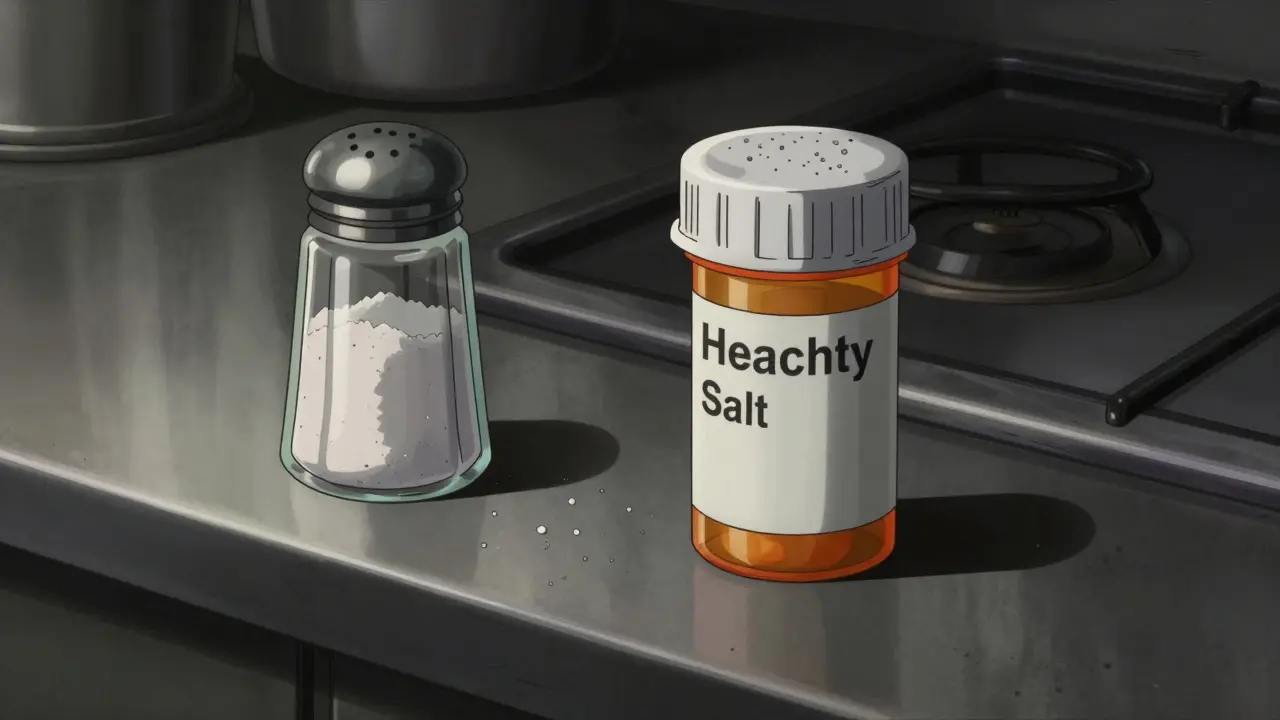
You decide to swap your table salt for a healthier alternative to lower your blood pressure. It seems like a win-win: less sodium and more potassium. But if you are taking certain blood pressure medications, this simple kitchen switch could actually be dangerous. For some people, the combination of a "heart-healthy" salt substitute and a prescription pill can lead to a medical emergency called hyperkalemia, where potassium levels in the blood spike to toxic levels.
The Hidden Chemistry of Salt Substitutes
Standard table salt is made of sodium chloride. Most salt substitutes is a product where sodium chloride is partially or fully replaced with potassium chloride to reduce sodium intake. While this helps many people lower their blood pressure, it fundamentally changes what you are putting into your body. For example, "lite" salts usually split the difference 50/50, while some pure substitutes like LoSalt contain about 66% potassium chloride.
To put this in perspective, a 1/4 teaspoon of regular salt gives you about 1,500 mg of sodium. An equivalent amount of a potassium-based substitute can provide 400-600 mg of potassium. While potassium is an essential mineral, too much of it-especially when your body can't get rid of it-is a serious problem.
Why ACE Inhibitors and ARBs Change the Game
If you are treating hypertension, you might be taking ACE inhibitors (like Lisinopril) or ARBs (like Losartan). These medications are great for protecting the heart and kidneys, but they have a specific side effect: they tell your body to hold onto potassium instead of flushing it out through your urine.
When you combine these drugs with a potassium-rich salt substitute, you create a "perfect storm." The medication blocks the exit, and the salt substitute floods the entrance. This can lead to hyperkalemia, which is a condition where serum potassium levels exceed 5.0 mmol/L. If levels climb above 6.5 mmol/L, you are in the danger zone for cardiac arrhythmias or sudden cardiac arrest. There are documented cases, including a 72-year-old patient, who suffered cardiac arrest after their potassium levels hit 7.8 mmol/L simply by using a salt substitute while on medication and having slight kidney issues.

The Role of Kidney Health
Your kidneys are the primary filter for potassium. If they aren't working at 100%, the risk of a potassium spike skyrockets. About 37 million Americans live with chronic kidney disease (CKD), and many don't even know it. If your estimated glomerular filtration rate (eGFR) is below 60 mL/min/1.73m², your kidneys struggle to excrete excess potassium.
For someone with perfect kidney function, a potassium substitute might actually reduce the risk of stroke. But for someone with Stage 3 CKD or higher, the risk of a dangerous event increases nearly ten-fold when combined with ACE inhibitors. This is why a "one size fits all" approach to heart-healthy diets can be so misleading.
| Patient Profile | Kidney Function (eGFR) | Risk Level | Recommendation |
|---|---|---|---|
| General Population | > 90 | Low | Generally safe; may lower stroke risk |
| Mild Kidney Impairment | 45 - 60 | Moderate | Consult physician; monitor blood levels |
| Advanced CKD / High K+ | < 45 | High | Avoid all potassium-based substitutes |
Warning Signs and Red Flags
The scary thing about hyperkalemia is that it doesn't always have obvious symptoms until it's too late. However, some people do notice early warning signs. If you've switched to a salt substitute and start feeling severe muscle weakness, a "fluttering" sensation in your chest (irregular heartbeat), or sudden numbness and tingling in your hands or feet, you need to get your blood work checked immediately.
Real-world reports from patients describe waking up in the emergency room after just a few weeks of using "heart salts" while taking medications like lisinopril. Because the labels on many of these products don't explicitly warn about medication interactions, many people assume these products are safe for everyone.

Safer Ways to Cut Sodium
You don't have to go back to heavy salting just to stay safe. There are ways to reduce your sodium intake without risking your heart rhythm. The key is to move away from "substitutes" and toward "flavor enhancers."
- Fresh Herbs: Use cilantro, parsley, or basil to add brightness to a dish.
- Acidic Brighteners: A squeeze of lemon or lime juice often tricks the tongue into thinking there is more salt than there actually is.
- Spice Blends: Use salt-free blends (like Mrs. Dash) that rely on garlic, onion, and paprika. These have negligible potassium levels.
- Aromatics: Sautéing onions, ginger, and garlic creates a deep flavor base that reduces the need for added salt.
Using these natural alternatives can still help you hit that optimal target of 1,500 mg of sodium daily without the hidden dangers of potassium chloride.
Questions to Ask Your Doctor
If you are on blood pressure medication, don't guess about your diet. Be specific when talking to your healthcare provider. Instead of asking "Is this salt substitute okay?", provide the actual brand name and the ingredients list.
Ask about your latest eGFR and your serum potassium levels. If your potassium is already on the higher end of the normal range (above 4.5 mmol/L), even a small amount of a potassium substitute could push you over the edge. For those at higher risk, your doctor might suggest checking your potassium levels every three months to ensure your medication and diet are staying in balance.
Are all salt substitutes dangerous with ACE inhibitors?
Not all, but most common ones are. The danger comes specifically from those containing potassium chloride. If a substitute uses herbs or other non-mineral flavorings, it is generally safe. Always check the label for "potassium chloride."
Can't I just eat less of the substitute?
For people with healthy kidneys, moderation is fine. However, if you have CKD or are on an ARB/ACE inhibitor, even small amounts can accumulate in your system over time because your excretion mechanism is impaired. It's safer to avoid them entirely.
Why aren't these risks on every label?
Labeling laws vary. While some countries like Canada require explicit warnings, the FDA in the U.S. has had slower implementation. Many brands follow voluntary standards, but not all of them warn specifically about ACE inhibitors or ARBs.
What is the difference between a salt substitute and "lite salt"?
A "substitute" often aims to replace as much sodium as possible, sometimes nearly 100%. "Lite salt" is typically a 50/50 blend of sodium chloride and potassium chloride. Both can be dangerous if you are on potassium-sparing medications.
Is it safe to use these if I have diabetes?
Diabetic patients are at a higher risk. Some people with diabetes develop a condition called hyporeninemic hypoaldosteronism, which makes it even harder for the body to clear potassium. This makes the combination of ACE inhibitors and salt substitutes even more hazardous.