
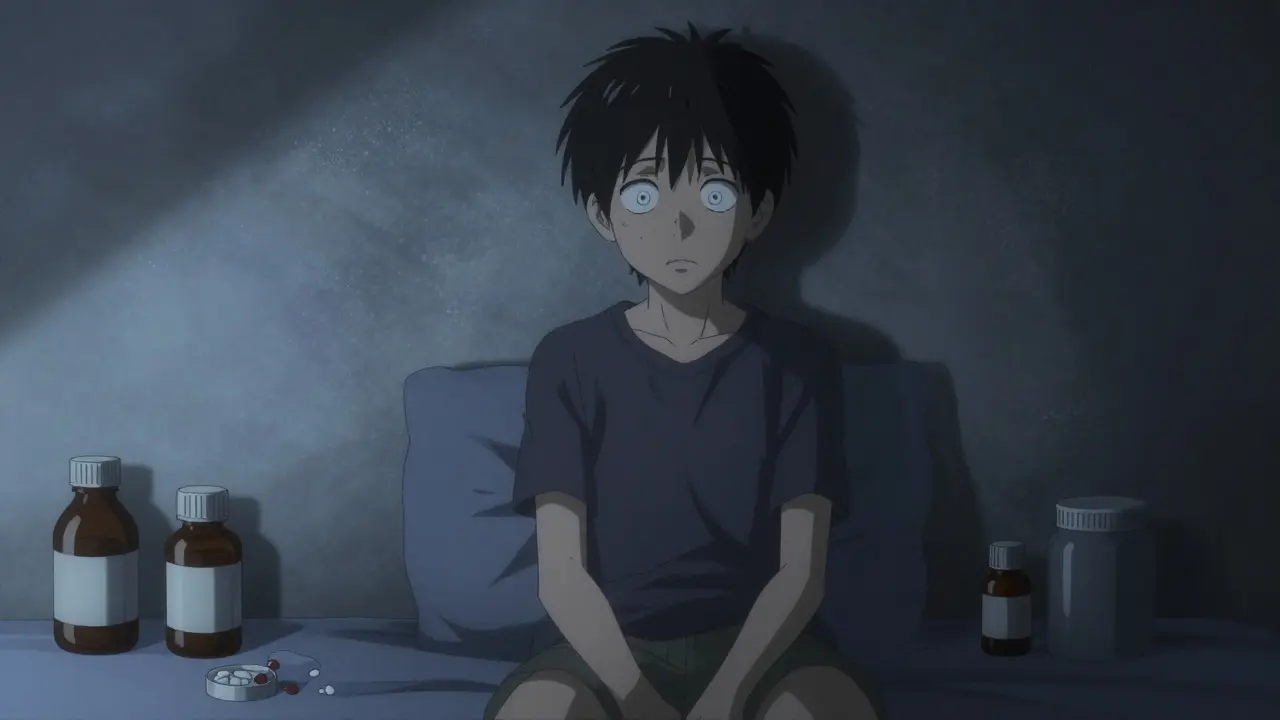
Most people think over-the-counter (OTC) drugs are safe because you can buy them without a prescription. But taking more than the label says, using them for fun, or mixing them with other substances can turn a simple cough syrup into a life-threatening habit. You don’t need to be a drug addict to be at risk. It starts with one extra pill, one extra spoonful, or one night of experimenting. And before you know it, your body and mind are changing in ways you didn’t expect.
Physical Signs You’re Taking Too Much
If you’re regularly taking more than the recommended dose of cough medicine, cold tablets, or pain relievers, your body is sending you signals. Look for these clear physical red flags:
- Dilated or constricted pupils - This isn’t just about lighting. If your pupils stay unusually large or small for hours after taking an OTC drug, it’s a sign your nervous system is reacting abnormally. Studies show this happens in 78% of dextromethorphan (DXM) abuse cases.
- Slurred speech - You might think you’re just tired, but if your words sound fuzzy or you stumble over simple sentences, your brain is being affected. At abusive doses, speech errors jump from 2% to 68% compared to normal use.
- Unexplained weight loss - Losing 10 pounds or more in a few months without trying? Chronic misuse can suppress appetite and mess with digestion. Average loss in long-term users: 12.7 pounds over three months.
- High body temperature - If you’re running a fever of 103°F or higher without being sick, it could be drug-induced hyperthermia. This can lead to organ damage if not treated.
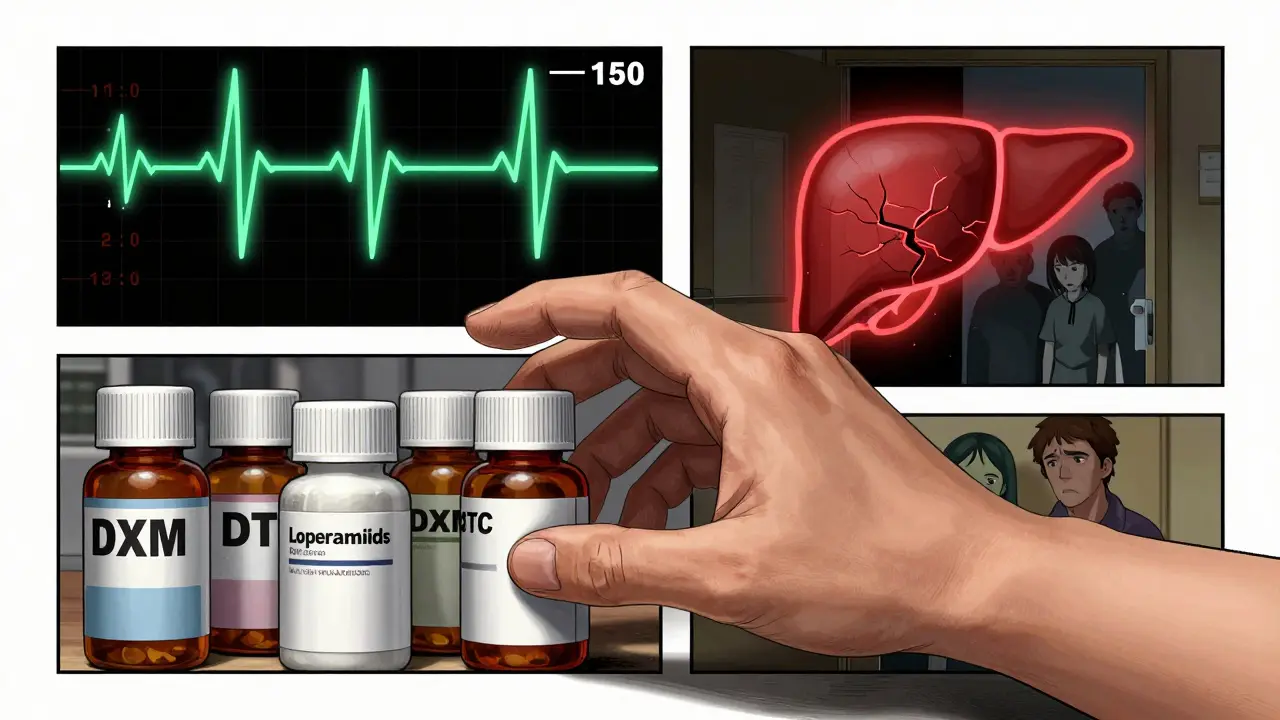
- Fast or irregular heartbeat - Your heart rate might spike from 70 bpm to over 150 bpm. Some users report chest tightness or palpitations. In extreme cases, this can trigger dangerous arrhythmias.
- Liver pain or jaundice - Many OTC cold medicines contain acetaminophen. Taking more than 4,000 mg a day can quietly damage your liver. One in three chronic abusers of these products shows signs of liver stress.
These aren’t side effects - they’re warning signs your body can’t handle what you’re putting into it.
Behavioral Changes You Can’t Ignore
It’s not just your body that changes. Your behavior starts to shift, often in ways you don’t even notice until someone else points it out.
- Secretive behavior - Locking your room, changing phone passwords, hiding pills in vitamin bottles - these aren’t quirks. They’re survival tactics. Eighty-nine percent of teens who misuse OTC drugs show increased secrecy, according to state health data.
- Financial oddities - Unexplained spending of $100+ a month on cough syrup or painkillers? That’s not normal. Many users visit three or more pharmacies in a week to avoid detection.
- Academic or work decline - A GPA drop from 3.4 to 2.1 in one semester? A pattern of missed shifts or deadlines? OTC misuse directly impacts focus, memory, and motivation. In 89% of cases, school performance crashes within months.
- Social withdrawal - You used to hang out with friends every day. Now you’re alone. Average daily social interactions drop from 5.2 to 1.7. Isolation isn’t a choice - it’s a symptom.
- Risk-taking - Driving after taking DXM? Trying to get more pills from strangers? These aren’t bad decisions - they’re signs your judgment is impaired. Users are 3.2 times more likely to get traffic violations.
These behaviors aren’t about rebellion. They’re about dependency. Your brain is rewiring itself to need the drug to feel normal.
Psychological Red Flags
Some of the most dangerous signs aren’t visible. They’re happening inside your head.
- Mood swings - One minute you’re laughing, the next you’re crying or angry for no reason. Studies show mood swings occur 5.7 times more often in users than in non-users.
- Paranoia - Feeling like people are watching you, talking about you, or out to get you? That’s not stress. It’s a direct effect of high-dose DXM. In 44% of abuse cases, users report these episodes lasting 2 to 4 hours after the drug wears off.
- Emotional numbness - You can’t feel joy, sadness, or connection anymore. It lingers for 12 to 24 hours after the high. This isn’t depression - it’s chemical shutdown.
- Visual disturbances - Seeing static on walls, trails behind lights, or colors that don’t exist? This is called “visual snow,” and it’s been reported to last for weeks after a single heavy dose.
- Out-of-body experiences - Feeling like you’re floating, watching yourself from above, or disconnected from reality? At doses above 500 mg of DXM, this is common. But it’s not a trip - it’s brain disruption.
Dr. Nora Volkow, director of the National Institute on Drug Abuse, says high-dose DXM abuse causes brain changes similar to ketamine. After six months, users show an 8.3% reduction in hippocampal volume - the part of the brain responsible for memory and learning.
What You’re Really Doing to Your Body
Let’s talk about the two most common OTC drugs being misused: dextromethorphan (DXM) and loperamide.
DXM - Found in cough syrups like Robitussin and Coricidin. At normal doses, it’s a safe cough suppressant. At 100-200 mg, it gives a mild buzz. At 300-600 mg, you lose coordination. At 500-1,500 mg, you enter a dissociative state - where you feel like you’re not in your body. But here’s the catch: every time you do this, you’re damaging your brain. The FDA says 14.3% fewer teens are misusing DXM since warning labels were added in 2021. That’s progress - but not enough.
Loperamide - Sold as Imodium, it’s meant to stop diarrhea. But some people take 50 to 100 tablets a day (that’s 5,000 mg - 300 times the recommended dose) to get a heroin-like high. This isn’t myth. In 2023, the FDA approved a new treatment protocol using low-dose naltrexone to help users withdraw. Why? Because loperamide abuse can stretch your heart’s QT interval beyond 500 ms. Normal is 350-440 ms. When it goes too high, your heart can stop.
And here’s the scary part: 63% of users develop tolerance within 4-6 weeks. That means you need more and more to feel the same effect. And 67% of people who start with OTC drugs end up using prescription pills or illegal drugs within 18 months.
What to Do If You Recognize These Signs
If you see even two or three of these signs in yourself or someone you care about, don’t wait. Don’t think it’s just a phase. Don’t assume you can stop anytime. The truth is, you might not be able to.
Step 1: Stop using immediately - Don’t try to cut back. Quit cold turkey. Withdrawal from DXM or loperamide can cause anxiety, insomnia, nausea, and cravings. But it’s manageable with support.
Step 2: Talk to someone - Call a doctor, a school counselor, or the SAMHSA National Helpline (1-800-662-4357). They’ve handled over 14,000 calls about OTC misuse in 2022 alone. You’re not alone.
Step 3: Remove access - Lock up all OTC meds. Throw out expired or unused bottles. If you live with others, ask them to help. Homes without lockboxes have 3.2 times higher misuse rates.
Step 4: Get professional help - Cognitive behavioral therapy (CBT) combined with family therapy has a 68% success rate at keeping teens drug-free after six months. That’s higher than any single approach. Treatment works.
Step 5: Monitor for relapse - Recovery isn’t linear. One slip doesn’t mean failure. But if you find yourself going back to the same behavior, go back to step one - and ask for help again.
How to Prevent It From Happening Again
Prevention starts with awareness. Here’s what works:
- Keep all OTC meds locked up - even aspirin and antacids.
- Check expiration dates. Old meds lose potency but still carry risk.
- Talk to teens openly - not with fear, but with facts. Schools in 32 states now run “Know the Dose” programs. Since 2021, first-time DXM misuse among 8th graders has dropped 29%.
- Don’t assume it’s harmless because it’s legal. Alcohol and tobacco are legal too. That doesn’t mean they’re safe in excess.
- Learn the labels. If a product contains DXM, acetaminophen, or loperamide, read the warning. It’s there for a reason.
OTC drugs aren’t toys. They’re powerful chemicals with real consequences. You don’t have to hit rock bottom to get help. You don’t have to wait for a hospital visit or a police call. The moment you realize something’s off - that’s the moment to act.
Can you really get addicted to cough syrup?
Yes. While many think OTC cough medicine is harmless, drugs like dextromethorphan (DXM) can cause physical dependence. Users develop tolerance within 4-6 weeks, needing 3-5 times the normal dose to feel the same effect. Withdrawal symptoms include anxiety, insomnia, and cravings - signs of addiction. The American Society of Addiction Medicine confirms this pattern in clinical guidelines.
Is it dangerous to mix OTC drugs with alcohol?
Extremely dangerous. Mixing alcohol with DXM or acetaminophen (common in cold medicines) increases the risk of liver failure, seizures, and respiratory depression. Alcohol also lowers your body’s ability to process toxins, making overdose more likely. Emergency room visits involving both substances have risen sharply since 2015.
Can you overdose on OTC painkillers?
Yes - and it’s more common than you think. Acetaminophen, found in Tylenol and many cold medicines, can cause severe liver damage if you take more than 4,000 mg in 24 hours. Many people don’t realize they’re exceeding this limit because they take multiple products at once. In 2023, the FDA reported over 1,000 cases of liver failure linked to OTC acetaminophen misuse.
Why do teens misuse OTC drugs more than adults?
Accessibility is the biggest factor. Nearly 72% of households keep OTC meds in unlocked cabinets. Teens are also more influenced by online trends - like “robotripping” - and less aware of long-term risks. NIDA’s Monitoring the Future survey shows teens aged 12-17 make up 58% of OTC misuse cases. Peer pressure, curiosity, and lack of supervision all contribute.
How long does it take to recover from OTC drug misuse?
Recovery varies. Physical withdrawal from DXM or loperamide usually lasts 5-7 days. But psychological effects - like memory issues, mood swings, and emotional numbness - can linger for weeks or months. Studies show that with proper therapy, 68% of teens remain drug-free after six months. Recovery isn’t about time - it’s about support.
Michaela Jorstad
February 19, 2026 AT 15:51I know this sounds crazy, but I used to take Robitussin to sleep-just one spoonful, I thought. Then it became two. Then three. I didn’t realize I was addicted until I started shaking at 3 a.m. and couldn’t remember my own phone number. I called my mom. She cried. We went to a counselor. It’s been eight months. I’m still scared-but I’m here. And I’m proud.
Chris Beeley
February 19, 2026 AT 16:57Let me tell you something, my dear naive Reddit denizens-this isn’t about ‘misuse’; it’s about the collapse of Western pharmacological literacy. You see, in ancient India, Ayurvedic practitioners used plant alkaloids with surgical precision, while here, we hand out dextromethorphan like Halloween candy. The FDA’s warning labels? A Band-Aid on a hemorrhage. And don’t even get me started on how loperamide is being used as a poor man’s opioid substitute-this is not addiction, this is capitalism’s last gasp before the next pandemic. The hippocampal volume loss? Of course it’s 8.3%. Your brain is a temple, and you’re turning it into a rave.
Arshdeep Singh
February 20, 2026 AT 19:10Bro, you think you're the first person to do this? Everyone's been doing it since 2010. I know a guy in Delhi who used to buy 10 bottles of cough syrup every week. He said it made him feel like he was floating on a cloud made of angels and Wi-Fi. Then he started seeing his dead grandma in the ceiling tiles. Now he's in rehab. You think you're special? Nah. You're just late to the party. And yeah, you're probably gonna end up on a forum like this crying about how 'it wasn't supposed to be like this.' Classic.
Danielle Gerrish
February 21, 2026 AT 21:28I read this and I just started crying. Not because I’m scared-I’m angry. Angry that we treat kids like they’re stupid. Angry that pharmacies don’t lock these things up. Angry that no one talks about this until someone ends up in the ICU. I work in a pediatric ER. Last week, a 15-year-old came in with a heart rate of 168. She had taken 12 pills of Coricidin because ‘everyone on TikTok says it’s chill.’ I held her hand while they pumped her stomach. She didn’t say a word. Just stared at the ceiling. I haven’t slept since. If you’re reading this and you’ve done this-please, please, please-call someone. Now. I’m not asking. I’m begging.
Maddi Barnes
February 23, 2026 AT 01:32OMG I’m so glad this post exists 😭 I used to do this with my bestie in high school-we called it ‘space walking.’ We thought it was funny. Now she’s in recovery. I’m not. But I’m trying. I deleted all my old pics of syrup bottles. I even threw out my favorite hoodie because it smelled like Robitussin. It’s been 2 years. I still have nightmares. But I’m alive. And that’s something. 💙
Benjamin Fox
February 24, 2026 AT 01:07Y’all are overreacting. I took DXM for fun in college. No big deal. My liver’s fine. My heart’s fine. I’m alive. Why are you making this into a national crisis? We had alcohol. We had weed. We had cigarettes. This is just the new thing. Stop the panic. Chill. America is falling apart because you’re scared of cough syrup 🤡
Jonathan Rutter
February 25, 2026 AT 23:03Oh wow, another ‘I’m just a kid who got hooked’ story. I’ve heard this 47 times this week. You think you’re the first? You think you’re unique? You think your trauma is special? Let me tell you-your mom didn’t notice because she was too busy scrolling through TikTok. Your school didn’t care because they’re underfunded. Your doctor didn’t ask because they’re overworked. You didn’t ‘misuse’-you were failed. And now you’re here, crying on Reddit, hoping someone will say ‘it’s okay.’ It’s not okay. But it’s not your fault. It’s everyone else’s. And you’re still not fixed.
Jana Eiffel
February 27, 2026 AT 14:47It is with profound gravity that I acknowledge the systemic erosion of pharmacological autonomy in contemporary Western society. The normalization of self-administered neurochemical modulation-particularly via over-the-counter agents-represents not merely a public health crisis, but a metaphysical one: the commodification of consciousness. The hippocampal atrophy cited herein is not merely physiological; it is symbolic of a civilization’s retreat from embodied presence into the digital and dissociative. We must, therefore, reconstitute epistemic humility in the face of biochemical power. This is not about dosage. It is about ontological vulnerability.
aine power
March 1, 2026 AT 01:27Stop. Just stop.