

Your eyes should work together as a team, but sometimes they don't listen to the same boss. When your eyes point in different directions, it creates a condition called strabismus, commonly known as a squint. It affects roughly 5 out of every 100 children, according to data from Valley Eye Australia. While many adults develop it later due to strokes or trauma, seeing a specialist early makes a massive difference. You might have heard of patching or glasses, but what happens when those don't cut it? That is when we look at the surgical option.
Understanding Eye Misalignment
It isn't just about looks. Strabismusis a visual disorder where eyes fail to align when focusing on an object. Imagine trying to watch a movie while two projectors show slightly offset images. Your brain gets confused. For some people, the brain just shuts off the image from one eye to avoid confusion, which leads to amblyopia (lazy eye). In other cases, especially adults who developed the condition suddenly, they experience double vision (diplopia).
There are four main ways the eye can turn:
- Esotropia: The eye turns inward toward the nose. This is actually the most common type, accounting for 50% of cases.
- Exotropia: The eye turns outward toward the temple.
- Hypertropia: One eye sits higher than the other.
- Hypotropia: One eye points downward.
Kids with these issues might tilt their heads to see better. You might notice them closing one eye in sunlight or having trouble reading because the lines jump around. If you are an adult and suddenly see double after a head bump or feel dizzy, doctors call this paralytic strabismus, which often signals a nerve issue rather than just muscle control problems.
When Surgery Becomes Necessary
You don't jump straight to the operating room for every case. Usually, doctors try simpler things first. Corrective glasses can fix alignment if it stems from refractive errors. Vision therapyinvolves prescribed eye exercises to strengthen coordination. Patching helps train the weaker eye. But if you have a constant misalignment greater than 15 prism diopters (a measurement unit doctors use), non-surgical methods often hit a wall.
Surgery steps in when conservative treatments fail or when the risk of permanent vision loss looms. According to the American Academy of Ophthalmology's 2023 guidelines, surgery is recommended when the eyes won't come together despite other efforts. The goal isn't always perfect symmetry; it's about restoring binocular visionthe ability to use both eyes simultaneously. If your brain stops fusing the two images, you lose depth perception, which makes everything from driving to catching a ball harder.
The Surgical Procedure
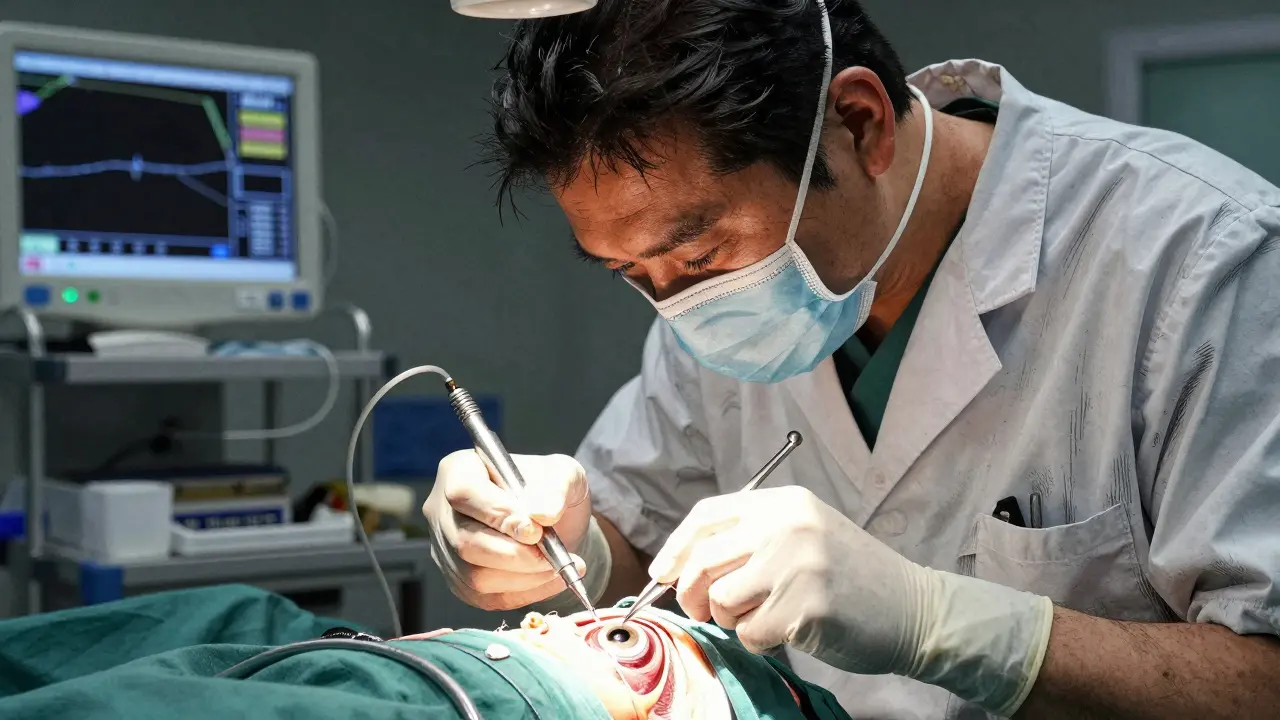
The actual operation sounds scary, but for modern ophthalmologists, it is routine. Strabismus surgeryadjusts the tension on the extraocular muscles controlling eye movement. Think of it like tuning a guitar string. Surgeons either weaken a muscle (recession) or tighten it (resection) to bring the eye back into line.
Most surgeries happen under general anesthesia for kids, but adults can often have local anesthesia with sedation. The procedure takes about 45 to 90 minutes depending on how many muscles need adjustment. A significant trend in 2023 was the rise of adjustable suturestemporary stitches that allow surgeons to tweak alignment after waking up. This technique is now used in about 68% of adult cases. It means if the eye is slightly off-center the next day, the surgeon can make a tiny tweak before you even leave the hospital. It significantly improves the precision of the outcome.
| Children (Under 2) | 75-85% |
| Adults | 55-65% |
| Recurrent Cases | Lower variance requiring re-operation |
Data shows that younger patients generally have higher success rates. Children under two years old have a 75-85% success rate for achieving good alignment, whereas adults see rates closer to 55-65%. Why the drop? Adults have had years of their brains adapting to the crossed eye, so rewiring that takes longer.
Recovery and What to Expect
The week after surgery involves red, swollen eyes. This is normal. You will likely need to use antibiotic eye drops daily for two weeks. Most patients return to normal activities fairly quickly, but heavy lifting or swimming is restricted for a short period. A surprising number of people report temporary double vision immediately after surgery-up to 80% experience this initially-but it usually fades as the brain recalibrates.
Patients often ask how long until results are final. While the physical healing happens in weeks, the visual benefit continues growing as your brain learns to process the new input. Many eye specialists recommend starting vision therapy 4 to 6 weeks after the surgery. Studies suggest 85% of post-surgical cases benefit from this combination approach. Without follow-up exercises, you might still struggle with the "software" side of vision even if the "hardware" (muscles) is fixed.

Risks and Complications
No surgery is zero-risk. Undercorrection happens in 20-30% of cases, meaning you might need a second operation. Overcorrection happens less often (10-15%). Rare complications like retinal detachment or infection (endophthalmitis) occur in fewer than 1 in 1,000 cases. Doctors consider these risks manageable compared to the quality-of-life improvements gained. Patient surveys indicate that 82% of people reviewing strabismus surgery online say it was "worth it," mostly citing improved social interactions and elimination of embarrassment.
Frequently Asked Questions
Is strabismus surgery painful?
You shouldn't feel pain during the procedure itself because of anesthesia. Afterward, you might feel a dull ache, soreness like a bad hangover, or irritation from the stitches. Most doctors prescribe mild painkillers, and the discomfort usually subsides within a few days.
Does insurance cover strabismus surgery?
Coverage varies. Medicare and most private insurers cover it if it impacts function or prevents lazy eye. However, they increasingly require proof that non-surgical methods failed first. Cosmetic alignment alone might not qualify in some cases, though policies have relaxed recently.
Can adults get strabismus surgery?
Absolutely. Adult surgery has seen a boom. Many adults seek surgery to resolve double vision caused by stroke or thyroid disease. Success rates are lower than in children, but eliminating double vision drastically improves daily functioning.
Will I need glasses after surgery?
Not necessarily because of the surgery itself, but yes if you needed them before. Surgery fixes muscle position, not your prescription for nearsightedness or astigmatism. You will likely keep wearing the same glasses you wore pre-surgery.
What if the surgery fails?
Surgeons plan for adjustments. About 1 in 5 patients needs a touch-up. Modern adjustable suture techniques allow immediate correction. If undercorrection persists months later, a secondary procedure is performed to refine the result.
Goodwin Colangelo
April 2, 2026 AT 02:56I have worked with several families navigating this exact path so I understand the hesitation completely. The data regarding success rates for adults is honestly quite discouraging when you look at the raw numbers alone. However the functional improvement is what really matters for daily life activities. You need to weigh the quality of life gains against the recovery time required fully. Most doctors recommend a full workup before scheduling anything though. Adjustable sutures are a game changer for adult patients specifically. They allow for fine tuning while you are awake which reduces anxiety later on.
Will Baker
April 3, 2026 AT 04:39People always fear surgery unnecessarily until it is too late.
Dipankar Das
April 3, 2026 AT 20:41It is absolutely crucial that individuals understand the gravity of strabismus before seeking intervention. Many people underestimate the complexity involved in eye muscle realignment procedures. You cannot simply walk into a clinic and expect immediate perfection without thorough preparation. The statistics presented regarding children versus adults are particularly alarming when scrutinized closely. Adults face significant neural adaptation challenges that younger patients simply do not encounter. This is why delaying treatment often results in permanently diminished binocular vision capabilities. Parents must act decisively rather than hoping the condition resolves itself through time alone. Medical literature supports early surgical intervention for cases exceeding fifteen prism diopters significantly. Ignoring professional guidelines leads to preventable complications such as amblyopia development. The concept of adjustable sutures is innovative yet requires expert handling to avoid errors. Surgeons who fail to utilize modern techniques are neglecting patient welfare fundamentally. Recovery expectations must remain realistic throughout the entire rehabilitation process period. Temporary double vision is standard but prolonged issues indicate underlying neurological problems. Insurance coverage varies widely depending on the specific medical policies in your region. Never hesitate to request second opinions if the initial recommendation seems questionable to you. One must remain vigilant about follow up care as well.
simran kaur
April 4, 2026 AT 22:47The mainstream medical consensus is usually hiding something bigger about long term effects. Big pharma benefits too much from recurring surgeries to tell us everything honestly. We should question why the success rate drops so sharply after childhood. It feels like the brain rewiring story is a convenient excuse for failed outcomes. Only independent practitioners seem to share the full picture regarding alternative treatments.
Sam Hayes
April 6, 2026 AT 05:30yeah i think that makes sense just dont forget about insurance claims
i had to fight my provider pretty hard before they approved the procedure cost wise so read the policy carefully
also the red eyes part is super normal everyone tells you that during consult
Dee McDonald
April 8, 2026 AT 04:49Stop being negative and scaremongering about everything! People need hope not your cynicism right now. Surgery saves lives and fixes vision for thousands annually. Your lack of enthusiasm is frankly unhelpful to anyone reading this thread. Take your skepticism elsewhere where it might actually matter to someone.
Mark Zhang
April 9, 2026 AT 15:26I appreciate the detailed breakdown here but please remember everyone reacts differently. Some folks heal faster than others regardless of age group stats. Its great that we have these guidelines but personal experience varies wildly. Stay supportive of those going through it and offer patience instead of rigid timelines.
Joseph Rutakangwa
April 11, 2026 AT 11:10insurance is tricky sometimes
read your plan docs
sophia alex
April 12, 2026 AT 08:33OMG insurance is such a nightmare 🙄😤
I hate how complicated health systems are made to be intentionally confusing 😫
You really have to advocate for yourself constantly 💪
Hope you get covered soon!
Rob Newton
April 12, 2026 AT 18:53Your conspiracy theories are wild and clearly uninformed.