
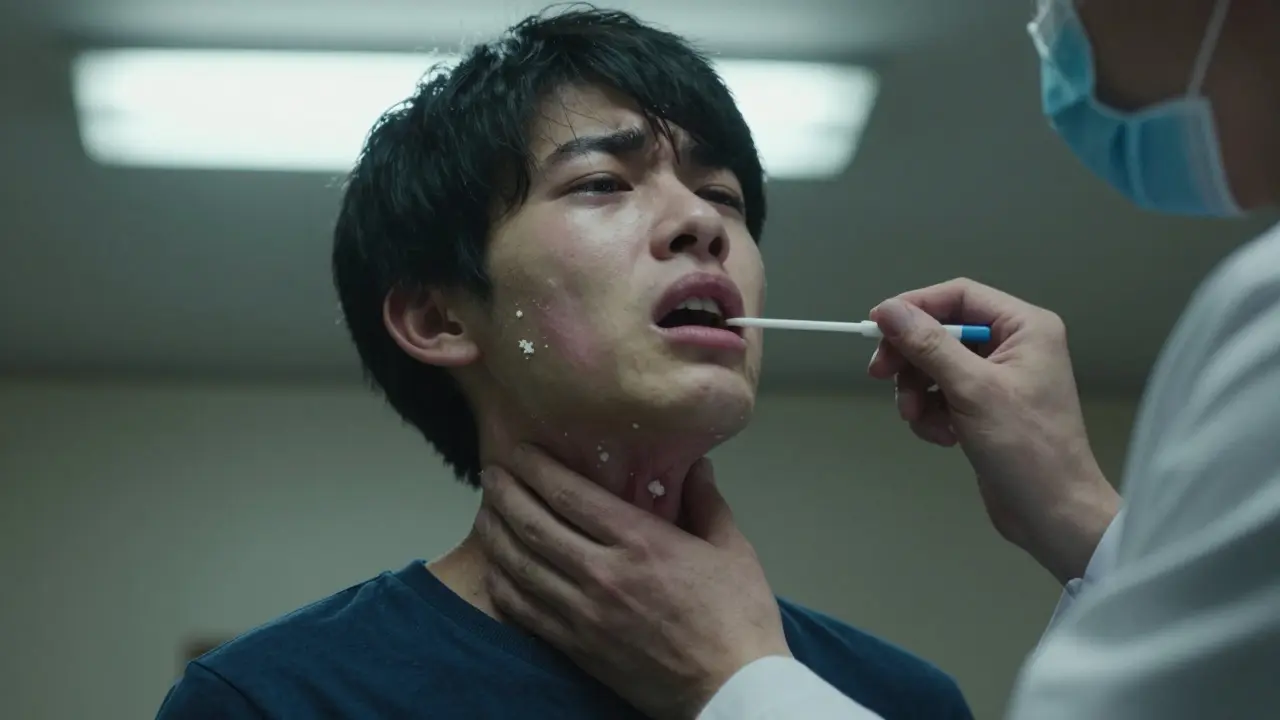
When your throat suddenly feels like sandpaper and swallowing hurts so much you avoid even sipping water, it’s easy to assume it’s just a cold. But if you also have a fever over 100.4°F, swollen glands in your neck, and no cough or runny nose, you might be dealing with strep throat. Unlike the common cold, strep is a bacterial infection caused by Group A Streptococcus - and it doesn’t just go away on its own. Left untreated, it can lead to serious complications like rheumatic fever, which can damage your heart valves. The good news? With the right diagnosis and antibiotics, most people bounce back in under a week.
How to Tell If It’s Strep - Not Just a Cold
- Your sore throat came on fast - usually within hours, not days.
- You have a fever above 100.4°F (38°C).
- Your tonsils are swollen and coated with white patches or pus.
- Your neck lymph nodes are tender to the touch.
- You have tiny red spots on the roof of your mouth (palatal petechiae).
- You have no cough, no runny nose, and no red eyes.
That last point is critical. If you’re coughing or congested, it’s almost certainly viral - not strep. Doctors use this pattern to rule out strep in about 90% of cases without even testing. This is called the Centor criteria. If you have three or four of these signs, your chance of having strep jumps to 40-60%. But don’t guess. Testing is the only way to be sure.
Testing for Strep Throat: What Works and What Doesn’t
The fastest test is the rapid antigen detection test (RADT). A swab from your throat gives results in 10 to 30 minutes. It’s over 95% specific, meaning if it’s positive, you’ve got strep. But it can miss up to 15% of cases - especially in kids under 5, where bacterial load is lower. That’s why guidelines from the CDC say: if the test is negative in a child or teen, you still need a throat culture.
The throat culture is the gold standard. It takes 18 to 48 hours, but it catches almost all cases - 90-95% sensitivity. Most clinics still use it as a backup to the rapid test. In urgent care centers and hospitals, molecular PCR tests are becoming more common. They’re even more sensitive (95-98%) and give results in 24 to 48 hours. A new FDA-approved test called Strep Ultra (launched March 2024) delivers results in 15 minutes with 98% accuracy - and it’s starting to replace older rapid tests.
Adults with low risk (one or two Centor criteria) and a negative rapid test usually don’t need further testing. But children? Always confirm. Their risk of rheumatic fever is real.
Antibiotics: Which Ones Work and Why Timing Matters
Antibiotics aren’t just for feeling better faster - they prevent life-threatening complications. The first-line treatment is penicillin V (500 mg twice daily for adults) or amoxicillin (once daily for kids, up to 1000 mg for adults). Both are taken for 10 days and clear the infection in 95% of cases. They’re cheap - a 10-day course of generic penicillin costs as little as $4.
If you’re allergic to penicillin, alternatives include:
- Cephalexin - a first-generation cephalosporin, taken twice daily.
- Clindamycin - used when resistance is suspected, taken three times daily.
- Azithromycin - a 5-day course, but it’s less effective (85-90% success) and resistance is rising in some areas.
Why 10 days? Because strep bacteria can hide in the tonsils. Stopping early - even if you feel fine - leaves behind survivors. These survivors can cause a relapse (5-15% of cases) or spread resistance. Studies show 99% of infections are fully cleared when patients finish the full course. When they don’t? Relapse rates jump to 30%.
Antibiotics don’t just help you - they stop you from spreading it. Within 24 hours of starting antibiotics, you’re no longer contagious. Without treatment, you can spread strep for up to 10 days.
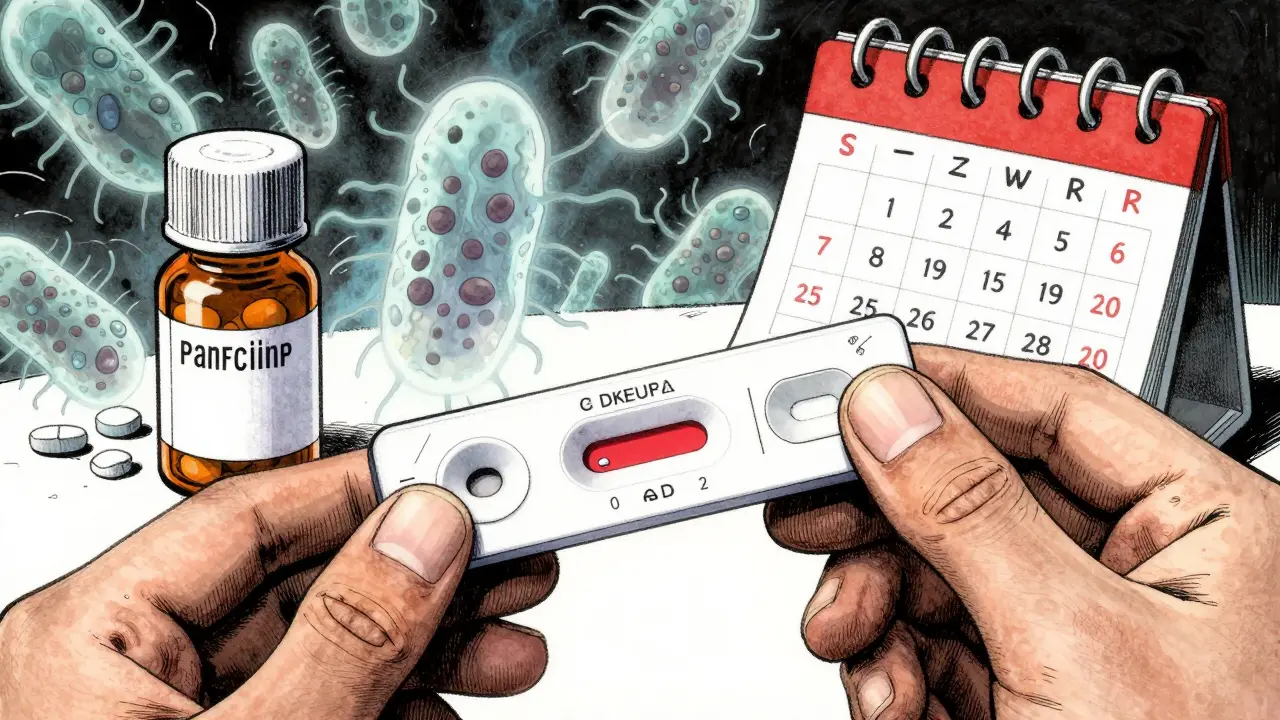
Recovery Timeline: What to Expect Day by Day
With antibiotics, here’s what happens:
- Day 1: You start the antibiotic. Symptoms won’t change yet.
- Day 2: Fever drops. Swallowing gets easier. This is when you can return to school or work - if you’ve been fever-free for 24 hours.
- Day 3-4: Throat pain fades. Swollen glands begin to shrink.
- Day 5-7: Most symptoms are gone. You feel back to normal.
- Day 10: Finish your antibiotics. Even if you feel great, don’t stop early.
Without antibiotics? Symptoms last 7-10 days, and you’re contagious the whole time. The risk of complications - like a peritonsillar abscess (a pus-filled pocket behind the tonsil) - increases. That happens in 1-2% of untreated cases and often requires surgery.
Don’t be fooled by feeling better. A 2023 study in JAMA Pediatrics found 40% of parents stop antibiotics as soon as their child stops crying during swallowing. That’s dangerous. It’s not just about comfort - it’s about preventing long-term damage.
When to Call the Doctor Again
If you’ve been on antibiotics for 48 hours and you’re still feverish, in severe pain, or having trouble breathing or swallowing, go back. You might have a complication like:
- Peritonsillar abscess - swelling that pushes the tonsil sideways.
- Scarlet fever - a rash that follows strep, often on the chest and groin.
- Rheumatic fever - rare, but can cause joint pain, heart inflammation, or involuntary movements.
Also, if you develop nausea, vomiting, or a rash after starting antibiotics, you may be having an allergic reaction. Don’t ignore it.
Common Mistakes That Make Things Worse
People make the same mistakes over and over:
- Sharing antibiotics - 8% of adults admit to giving leftover meds to family members. That’s how resistance spreads.
- Using old prescriptions - 12% of people in a 2023 CDC survey used leftover antibiotics for a new sore throat. But if it’s not strep? You’re just poisoning your body with useless drugs.
- Skipping the test - many doctors skip testing for adults, assuming it’s viral. But if it’s strep and you’re untreated? You could be the silent spreader.
- Staying home too long - if you’ve been on antibiotics for 24 hours and your fever is gone, you’re no longer contagious. There’s no need to miss 5 days of work or school.
And here’s something surprising: kids under 3 almost never get strep throat. Their immune systems don’t react the same way. So if your toddler has a sore throat, it’s almost always viral. No need to test unless symptoms are severe.
What’s Changing in 2026?
Research is moving fast. The CDC is tracking rising resistance to macrolides like azithromycin - now at 15% in some U.S. regions. Clindamycin resistance is creeping up too. That’s why penicillin remains the go-to: resistance is still below 0.5%.
Point-of-care PCR tests are getting cheaper and faster. By 2026, 40% of urgent care centers expect to use them routinely. That means same-day confirmation without waiting 24 hours.
And yes - there’s talk of a vaccine. A vaccine targeting the M-protein of Group A strep is in Phase II trials. But with over 200 different strains, it’s like chasing a moving target. Don’t hold your breath - prevention still comes down to good hygiene and proper treatment.
Final Takeaway
Strep throat isn’t just a sore throat. It’s a bacterial infection that needs antibiotics - not home remedies, not honey and lemon, not even garlic. If you have the classic signs (fever, no cough, swollen glands), get tested. If it’s positive, take every pill. Don’t stop early. Don’t share. Don’t guess. You’re not just helping yourself - you’re protecting others. And you’re preventing damage that could last a lifetime.
marjorie arsenault
February 28, 2026 AT 15:42Just wanted to say this post saved me last month. I thought my kid had a cold, but the no-cough + fever combo made me double-check. Got the rapid test done and it was strep. Took the full 10 days of amoxicillin even though she felt fine by day 3. No relapse, no drama. Seriously, don’t skip the pills.
Also, your note about kids under 3 rarely getting strep? Spot on. My niece had a sore throat at 2 and the doctor didn’t even test. Perfect call.
Thanks for writing this clearly.
Deborah Dennis
March 2, 2026 AT 00:43Wow. Just… wow. You’re telling me people are still giving their kids leftover antibiotics from last year’s ear infection? And they wonder why we have superbugs? This is why we can’t have nice things. And don’t even get me started on the ‘I’ll just wait and see’ crowd. You’re not a doctor. You’re not a crystal ball. Get. Tested.
Shivam Pawa
March 2, 2026 AT 19:58From India, I’ve seen this play out in rural clinics. Rapid tests are rare. Many rely on clinical signs alone. The Centor criteria work here too. But access to penicillin is still a win-costs less than a chai. The real issue isn’t diagnosis-it’s compliance. Families stop meds when fever breaks. No one explains the 10-day rule. We need community health workers to reinforce this, not just posters.
Also, kids under 3-yes. Viral all the way. No need to overtest. Save the swabs for those who need them.
Diane Croft
March 3, 2026 AT 18:10So many people don’t realize strep is contagious before symptoms even peak. I work in a daycare and we had an outbreak last winter. One parent thought their kid was fine after 2 days because they stopped crying. Nope. Still shedding bacteria. We had to send home 7 kids. This post should be mandatory reading for every parent and teacher.
Donna Zurick
March 5, 2026 AT 13:49Just finished my 10-day course yesterday. Felt fine after day 3. Felt like a hero for pushing through. Then I read this and realized I was just lucky. No relapse. No drama. But next time? I’ll remember. Thanks for the clarity. No more guessing.
Tobias Mösl
March 7, 2026 AT 00:56Let’s be real-the CDC and Big Pharma are happy you’re taking antibiotics. But what if you don’t need them? What if your immune system could handle it? What if the whole ‘strep is deadly’ narrative is exaggerated to sell drugs? I’ve had strep three times. Took nothing. Got better. Doctors push penicillin like it’s holy water. Maybe we’re being manipulated.
And that ‘Strep Ultra’ test? Launched March 2024? That’s not innovation. That’s profit. They’re monetizing fear.
tatiana verdesoto
March 7, 2026 AT 11:48This is the kind of post that makes me believe in the internet again. Clear. Calm. Fact-based. I shared it with my mom-she’s 68 and still thinks antibiotics are for ‘any fever.’ She’s going to get tested now. Thank you for taking the time to write this. It matters.
Ethan Zeeb
March 7, 2026 AT 22:50Stop. Right now. If you’re considering skipping a test because ‘it’s probably just a cold,’ you’re gambling with your heart. Rheumatic fever doesn’t announce itself. It sneaks in. One missed strep. One untreated kid. One damaged valve. It’s not a ‘maybe.’ It’s a guarantee if you ignore the signs. This isn’t opinion. It’s epidemiology. And you’re not immune because you’re ‘healthy.’
Darren Torpey
March 9, 2026 AT 16:25Strep throat is the silent ninja of infections. One minute you’re sipping tea, next you’re gagging on air. Penicillin’s the OG hero here-cheap, clean, and brutal on the bugs. Azithromycin? That’s the flashy cousin who shows up late and leaves half the job undone. And don’t even get me started on people sharing meds like it’s a potluck. You’re not a chef. You’re a germ courier.
Also-kids under 3? Nah. Their immune systems are basically tiny tanks. Let ‘em fight. No need to turn a sniffle into a medical drama.
Lebogang kekana
March 10, 2026 AT 22:33I’m from South Africa. We don’t have rapid tests in most clinics. We rely on symptoms and penicillin. It works. Simple. Cheap. Effective. I’ve seen kids recover in 3 days with no complications because the mom knew the signs. No fancy gear. Just knowledge. This post? It’s universal. Keep it real. Keep it simple.
marjorie arsenault
March 11, 2026 AT 09:11Love this. Especially the part about kids under 3. My sister kept insisting her 2-year-old had strep because he wouldn’t eat. We took him in. Negative. Viral. She cried because she ‘felt guilty’ for not pushing harder. But you’re right-over-testing does more harm than good. Thanks for the clarity.